Medieval by Orhan Aksel
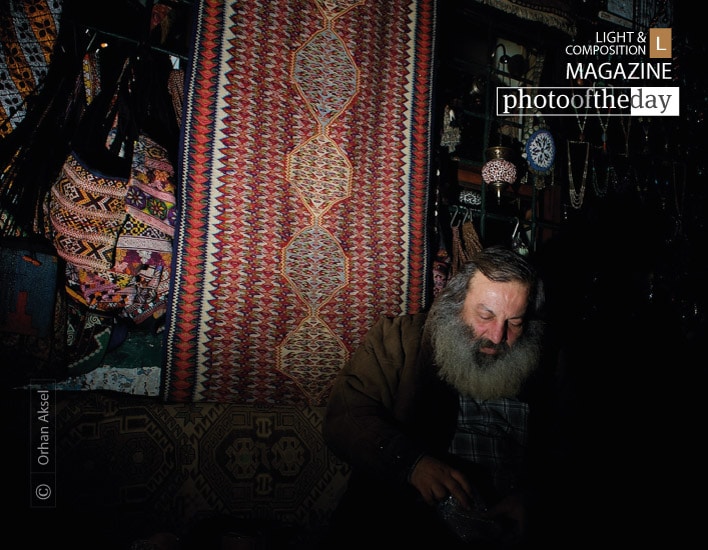
While enjoying tea in an authentic Istanbul cafe, the photographer discovered a local shopkeeper whose presence captured his imagination. After establishing a rapport through conversation and a small purchase, he received permission to document the man at work. The resulting image captures a quiet, candid moment as the shopkeeper wraps a parcel, his expression reflecting the timeless atmosphere of the city. This photograph is award-worthy for its genuine human connection and the masterful use of natural light, which highlights the textures of the shop and the character of its proprietor, transforming a fleeting interaction into a poignant, historical portrait.
Orhan Aksel
Born in 1961, Orhan Aksel is an Istanbul-based industrial and systems engineer who graduated from the University of Florida in 1986. A lifelong photography enthusiast who honed his craft in darkrooms since age twelve, he now balances his professional career with a dedicated pursuit of fine art photography. Driven by a philanthropic vision, Aksel aspires to transition his creative practice into a platform that supports the education of children in need, blending his technical background with a deep, humanistic approach to candid storytelling.
Resonance Score Breakdown
Transparency Note: The resonance score (13.8/20) is calculated based on social engagement metrics collected before the award announcement.
Expert Photography Reviews · 7
The Weight of Paper and Time
The smell of old paper is a specific kind of silence. It is the scent of dust settling on things that have been handled for decades, a dry, woody fragrance that clings to the back of the throat like the memory of a library basement.
Read the reflection →The Weight of Hands
We often speak of time as a river, something that flows past us, indifferent and swift. But perhaps it is more like the dust that settles on a shelf—a slow, quiet accumulation of presence.
Read the reflection →Reviews & Comments
Share your thoughts about this award-winning photograph. Your reviews contribute to the community engagement score.
The shopkeeper’s hands move. Paper folds. The rest of the frame recedes into shadow. It’s a quiet geometry. I’ve spent minutes watching the way the light catches the dust. Nothing here is accidental. The empty corner is not empty. It holds the weight of the city outside. I feel a sudden, sharp ache for the stillness he’s found. It’s rare to see a man so entirely present in his own silence.
Most candid portraits from Istanbul rely on tired tropes of exoticism, but this one avoids the trap. The 20mm lens forces an intimacy that feels earned rather than stolen. I’ve seen thousands of shopkeeper shots, yet the way his hands navigate that paper—with such weary, rhythmic precision—actually makes me miss a city I’ve never lived in. It’s the quiet dignity of the mundane that ensures this will still matter in thirty years. It’s a rare, honest triumph.
Within this Istanbul interior, the ochre of the shopkeeper’s apron bleeds into the shadows like a Morandi still life, grounding the scene in a dusty, sepia-toned melancholy that I find utterly intoxicating. It’s the way the light catches the parchment, turning it the colour of aged bone against the deep, bruised umber of the walls, that makes one’s heart ache; it’s a quiet, chromatic symphony that feels as if it’s breathing through the lens.
The light here doesn’t just illuminate; it settles, thick with the dust of centuries. He stood in that shop, waiting for the shopkeeper’s hands to find their rhythm. I’ve felt that same stillness, where the shutter is merely a heartbeat. It’s not about the parcel being wrapped, but the quiet dignity of a life lived in the shadows. Looking at his weathered face, I find myself wanting to sit there and simply breathe.
At f/10, the 20mm lens renders the shopkeeper’s hands with a crispness that defies the diffraction limit. The light’s interaction with the parcel’s rough paper texture is exquisite; it’s a masterclass in micro-contrast. I’m genuinely moved by how the focal plane clings to the twine, resolving details my own eyes would surely miss. It’s rare to see such optical discipline in a candid moment. Aksel hasn’t just captured a man; he’s mapped the very physics of Istanbul’s soul.
Darkness here isn’t merely the absence of Istanbul’s sun; it’s the heavy, velvet shroud of history itself. Aksel doesn’t just capture a shopkeeper; he traps a soul within the architecture of gloom. I’ve stared at these deep, cavernous corners until my own pulse slowed to match the man’s rhythmic wrapping. It’s a haunting, claustrophobic intimacy. When light finally grazes those calloused hands, it doesn’t reveal a person—it reveals the crushing, beautiful weight of time.
It’s rare to see a lens used with such restraint in a crowded city. Most would have sprinted past, but Aksel clearly sat long enough for the tea to go cold and the shopkeeper to forget the camera existed. That texture on the parcel paper—it’s earned. I’ve spent enough afternoons in similar dust to know that light didn’t just happen; it was waited for. A quiet, honest bit of work. I quite like it.