Returning Home by Park Se Jin
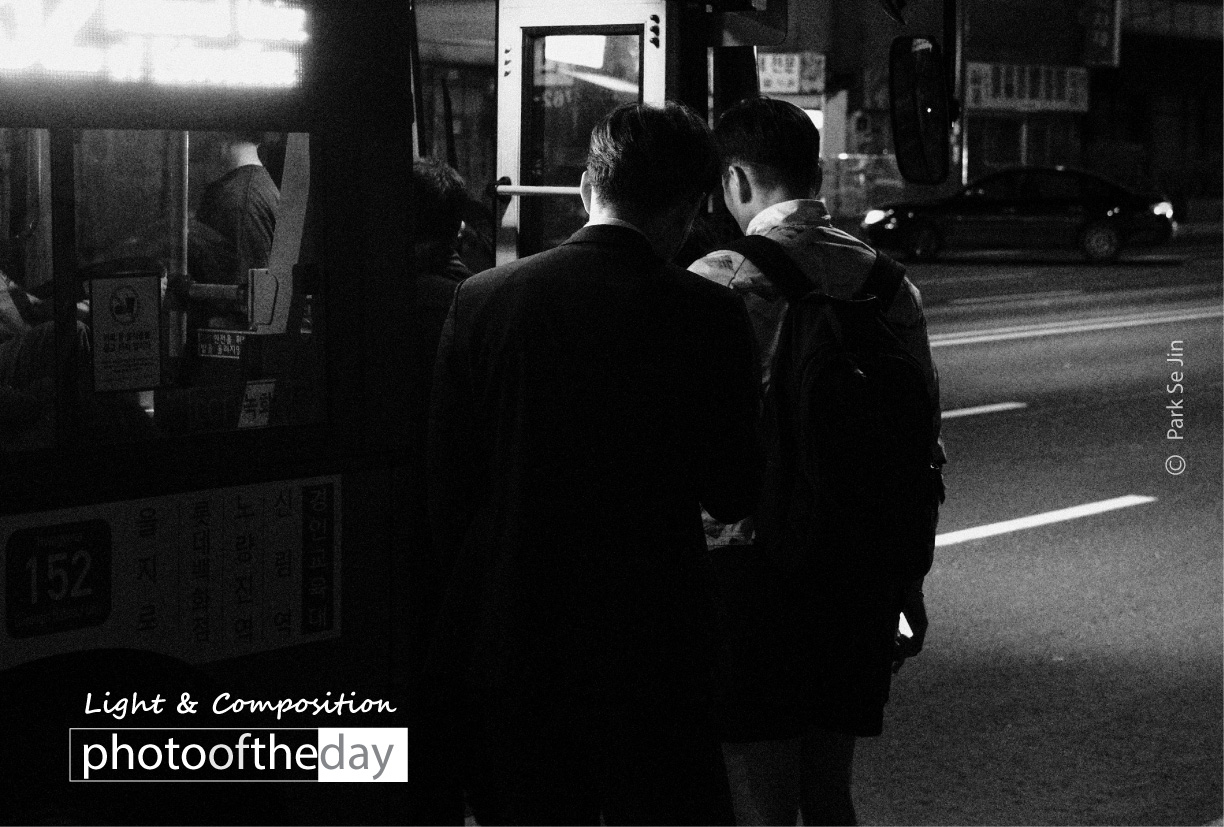
In this poignant street photograph, Park Se Jin captures a weary man waiting for the bus at the end of a long day. Clutching his briefcase, the subject embodies the quiet exhaustion and dedication of a father working tirelessly for his family. The photographer’s decision to frame the subject from behind emphasizes the universal weight of responsibility, turning a fleeting moment into a profound narrative of human endurance. The image is award-worthy for its raw emotional resonance and the photographer's ability to transform an ordinary commute into a deeply evocative story of love and sacrifice.
Park Se Jin
Born and based in Seoul, South Korea, Park Se Jin is a dedicated street photographer who finds beauty in the spontaneous rhythms of daily life. Rather than staging his images, he prefers to wander with his camera, capturing the authentic, unscripted moments that define the human experience. Park is currently expanding his artistic horizons, with a new goal to traverse the country by motorcycle to document the diverse landscapes and stories found beyond the bustling streets of his home city.
Resonance Score Breakdown
Transparency Note: The resonance score (11.0/20) is calculated based on social engagement metrics collected before the award announcement.
Expert Photography Reviews · 8
The Weight of the Day
I remember sitting in a train station in Osaka, watching a man in a charcoal suit lean his forehead against the cold glass of the window. He held his briefcase on his lap like a shield, his knuckles white against the worn leather.
Read the reflection →The Weight of the Horizon
We carry the day like a heavy coat, the fabric soaked through with the damp of small failures and the quiet friction of being alive.
Read the reflection →Reviews & Comments
Share your thoughts about this award-winning photograph. Your reviews contribute to the community engagement score.
The frame holds. A man, a briefcase, the heavy silence of a bus stop at midnight. It’s the final shot of the second act, the moment the protagonist finally drops the mask. I’ve felt that exhaustion in my own bones, the weight of a day that refuses to end. Park didn’t need a wide angle or a complex setup. The cut would’ve been a mistake. This is the frame the editor keeps. It’s perfect.
The silhouette against the harsh, artificial glow recalls the urban isolation of Bill Brandt’s night studies, yet Park’s choice to shoot from behind avoids the cliché of the weary face. It’s a quiet, heavy geometry of exhaustion. I’ve spent decades cataloging these lonely commuters, but the way the briefcase anchors the frame here actually made me catch my breath. It’s a rare, honest look at the burden of the modern provider, stripped of all sentimentality.
The bus stop light spills across the pavement. A man, a briefcase, a shadow. That’s all. I’ve spent minutes staring at the concrete behind him. It’s not just ground. It’s the weight of the day settling into the grain. Nothing here is accidental. The empty corner is not empty. It’s the silence he carries. It’s heavy. I feel a sudden, sharp ache in my own shoulders just watching him wait. He’s finally home.
The palette here evokes a Morandi still life, where the muted, bruised indigo of the evening air bleeds into the charcoal grey of the man’s coat, creating a melancholy harmony that feels almost tactile. It’s a quiet, heavy atmosphere; I’ve found myself shivering at the sheer weight of that desaturated light. One senses the exhaustion in the way the shadows cling to his silhouette, a chromatic ache that lingers long after the bus departs.
You caught the slump in his shoulders, and it hits me right in the gut. I’ve spent enough nights on cold benches to recognize that specific kind of exhaustion. You didn’t try to make him look heroic or tragic; you just let him be tired. And that’s the truth of it. You waited for the right moment to frame his solitude against the city. It’s a quiet, heavy piece of work. I respect that patience.
There’s a strange, dry stillness here that I’m not used to. Down where I work, light is a thief, stealing reds and oranges until everything turns to a haunting, monochromatic blue. This man’s weary posture feels like a deep-sea creature settling into the silt after a hunt. It’s quiet, heavy, and lacks the chaotic backscatter of a poorly lit reef. I find myself wanting to reach out and touch the grain; it’s beautifully, painfully human.
The bus shelter’s rigid datum dictates the man’s posture, framing his exhaustion against the cold, repetitive fenestration of the city. It’s a brutal intersection of solid and void; the steel structure doesn’t just house him, it compresses him. I’ve spent my life designing these thresholds, yet I rarely feel the crushing weight of the commute like this. The light here is unforgiving, stripping away the architecture to reveal the human cost of our urban geometry.
ISO 12800 is a desperate price to pay for a commute, but one suspects Park didn’t have the luxury of a tripod or a second chance. It’s a grainy, cold observation of a man’s heavy shoulders. I’ve spent enough hours shivering on street corners to recognize the patience required to let a subject simply exist without interference. It’s a quiet, weary frame. I find myself wanting to offer the poor fellow a seat. That’s earned.