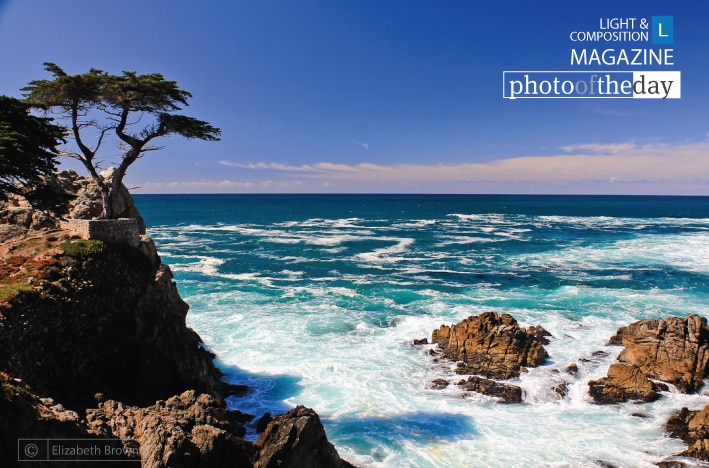
The Lone Cypress by Elizabeth Brown
Perched defiantly atop a rocky outcrop above the Pacific Ocean, the Lone Cypress stands as a testament to nature's resilience. Elizabeth Brown captures this 250-year-old Monterey Cypress, a species now threatened and restricted to this singular peninsula. By utilizing natural light, the photographer emphasizes the tree’s weathered silhouette against the vast, shifting coastal backdrop. This image is award-worthy for its masterful composition and its ability to elevate a globally recognized landmark into a poignant study of environmental fragility, highlighting the delicate balance between the ancient tree and the relentless ocean currents that define its historic home.
Elizabeth Brown
Based in Safety Harbor, Florida, Elizabeth Brown is a dedicated fine art photographer with a profound passion for coastal landscapes, wildlife, and avian subjects. Her creative process relies exclusively on natural light to reveal the authentic essence of her subjects, a technique honed since she first picked up her father’s SLR camera at age twelve. Today, her work is featured in numerous private collections and industry publications, reflecting a career defined by a deep, enduring connection to the natural world and a commitment to capturing its quiet beauty.
Resonance Score Breakdown
Transparency Note: The resonance score (14.3/20) is calculated based on social engagement metrics collected before the award announcement.
Expert Photography Reviews · 6
The Architecture of Persistence
To stand against the salt-breath of the sea is to learn the language of endurance. We often mistake stillness for weakness, forgetting that the most profound strength is found in the roots that refuse to let go of the stone.
Read the reflection →Salt on the Bark
The smell of brine always clings to the back of my throat, a sharp, metallic reminder of the tide. I remember standing on a cliff edge where the wind was so thick with moisture it felt like wearing a damp wool sweater against my skin.
Read the reflection →Reviews & Comments
Share your thoughts about this award-winning photograph. Your reviews contribute to the community engagement score.
nice!
The salt spray must have clung to her skin as she waited for the light to soften. It’s a quiet, lonely vigil. I’ve stood on those cliffs, and I know how the wind hums through those twisted needles. She didn’t force the frame; she let the Pacific’s gray expanse bow to the cypress. It’s a humble, aching portrait of endurance. Looking at it, I feel a sudden, sharp chill—the cold, ancient breath of the sea.
The Monterey Cypress clings to the rock, yet it’s the encroaching gloom that truly anchors the frame. Brown doesn’t just capture a tree; she captures the friction of existence against an indifferent horizon. I’ve stared at these shadows for an hour, and they don’t offer comfort. They’re heavy, absolute, and suffocating. It’s a brutal reminder that we are all just silhouettes waiting for the tide to reclaim our light. It’s haunting, and frankly, it terrifies me.
The frame’s geometry hinges on the cypress’s jagged silhouette against the horizon’s flat plane. It’s a precarious balance. The negative space above the canopy creates a necessary vacuum, preventing the composition from collapsing into sentimentality. The rock’s mass anchors the base, providing the structural weight the subject demands. I’ve grown weary of such clichéd landmarks, yet the sheer discipline of this framing holds my attention. It doesn’t falter. The architecture is sound.
The bruised indigo of the Pacific, a shade reminiscent of Turner’s most turbulent maritime studies, collides with the desiccated, bone-white bark of the cypress, creating a chromatic tension that’s frankly heartbreaking. One feels the salt-crusted air cooling the skin, a visceral shiver induced by those muted, melancholic greys. It’s not merely a landscape; it’s a symphony of atmospheric decay, where the light doesn’t just illuminate the scene—it mourns the very fragility of the coast itself.
The Lone Cypress is a tourist’s rite of passage, yet Elizabeth Brown has managed to avoid the usual postcard clutter. It’s a clean frame, though one wonders if she braved the salt spray for more than an hour. I’ve spent enough miserable afternoons on that peninsula to know the wind rarely permits such stillness. It’s a respectable effort, certainly. I’m almost envious of the light she caught; it’s a rare, quiet moment for such a crowded rock.
Of the thousands of coastal shots I’ve reviewed, most are just postcards. This one survives because Brown didn’t just frame a tree; she captured the friction of survival. The way the cypress leans into the negative space of the Pacific makes me feel a genuine, sharp ache for its isolation. It’s not just a landmark. It’s a portrait of endurance. In thirty years, we’ll still be looking at this, wondering how it held on.
Nice! I actually just photographed the 17 mile drive the first part of April! It is truly beautiful.