Unweaving the Robe by Ryszard Wierzbicki
Captured along the Mekong River Boulevard in Vientiane, this evocative image documents a quiet, intimate moment in the lives of young Buddhist monks. As they enjoyed a respite from their duties, the photographer observed them carefully unweaving their saffron robes to dry in the warm Laotian sun. This scene highlights the intersection of daily ritual and human connection, rendered with a keen eye for cultural authenticity. The photograph is award-worthy for its candid storytelling and the delicate balance of light and texture, which elevates a simple, everyday task into a profound reflection on monastic life and the passage of time.
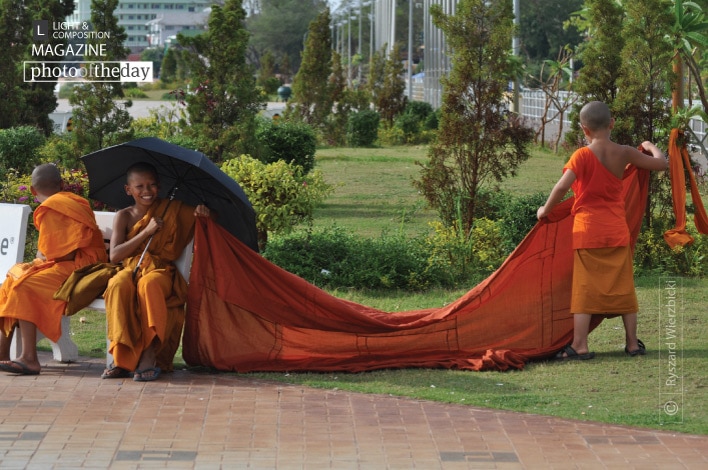
Exposure 1/350sec @ f/9.5 | ISO 200 | Focal Length 165mm
Ryszard Wierzbicki
Born in Poland in 1963, Ryszard Wierzbicki transitioned from a diverse career in education and marketing to pursue his deep-seated passions for photography, travel, and scuba diving. After emigrating to the United Kingdom in 2006, he began an extensive exploration of South-East Asia, eventually dedicating his time to volunteering with charitable organizations for orphans. As the founder of the photography forums Instant Travelling and World Around, Wierzbicki has established himself as a committed visual storyteller who captures the essence of global cultures through his lens.
Resonance Score Breakdown
Transparency Note: The resonance score (12.8/20) is calculated based on social engagement metrics collected before the award announcement.
Expert Photography Reviews · 8
The Weight of Saffron
To unmake a thing is a form of prayer. We spend our lives gathering, stitching together the fabric of our days, holding tight to the seams so the cold does not get in. We believe the structure is the person.
Read the reflection →The Saffron Thread
We are all made of layers, woven tight against the chill of the world. We wrap ourselves in habits, in the heavy cloth of our expectations, and in the routines that keep our edges from fraying.
Read the reflection →Reviews & Comments
Share your thoughts about this award-winning photograph. Your reviews contribute to the community engagement score.
Saffron fabric hangs against the heat. It’s a weightless suspension. The monks aren’t just drying cloth; they’re unraveling the day. I’ve spent minutes watching the way the light catches the threads. It’s quiet. The space between the figures holds the humidity of Vientiane. Nothing here is accidental. The empty corner is not empty. It’s a breath held in the sun. I feel a sudden, sharp ache for that stillness. It’s rare to find such peace.
Before the eye identifies the saffron fabric, something in the chest softens. It’s the quiet rhythm of the Mekong heat. Watching these monks unweave their robes, I’m struck by a sudden, sharp ache for my own lost simplicity. The image doesn’t just document a ritual; it slows my pulse. When I return to it a year later, the texture of that drying cloth still feels like a held breath, lingering in the quiet corners of my mind.
Most documentary work I’ve reviewed this year feels disposable, but this lingers. It’s the tactile reality of the saffron fabric against the river’s haze that anchors it. I’ve seen hundreds of monks in photographs, yet the mundane act of unweaving a robe feels startlingly intimate here. It’s a quiet, human rhythm that’ll still matter in thirty years. It almost failed on technical sharpness, but the emotional weight of that sun-drenched ritual makes it impossible to ignore.
The saffron of these robes, a hue reminiscent of Turner’s most fevered sunsets, vibrates against the muted, dusty ochres of the Vientiane riverbank with such startling intensity that it’s impossible not to feel a sudden, sharp ache in one’s own chest. It’s a chromatic collision, a dance of light that transforms a mundane chore into a sacred ritual, where the warmth of the sun bleeds into the fabric, turning simple cotton into something almost divine.
At f/9.5, the Nikon’s sensor captures the saffron weave with clinical sharpness, pushing the lens toward its diffraction limit. It’s a rare pleasure to see the threads resolve so clearly against the Mekong’s soft, out-of-focus bokeh. I’m genuinely moved by how the light refracts through those drying fibers; it’s a tactile, almost microscopic intimacy. Wierzbicki’s choice of 165mm compresses the space, turning a simple ritual into a study of light’s physical interaction with fabric.
1/350sec at f/9.5, 165mm, ISO 200. A tight aperture for a telephoto lens. Wierzbicki chose to prioritize depth of field over subject isolation, forcing the background into the narrative. It’s a calculated risk that pays off. The sharpness across the fabric’s weave is precise. I’ve spent years looking at soft, lazy bokeh; seeing actual texture here is a relief. It’s technically sound. He didn’t hide behind a shallow depth of field. He committed.
The saffron fabric catches the Laotian sun, turning the Mekong’s edge into a sanctuary of quiet labor. I’ve stood in that heat, waiting for the air to settle, and I recognize the stillness in these monks’ hands. It’s a slow, rhythmic unweaving of the day. Watching them, I feel a sudden, sharp ache for that kind of patience. They aren’t performing; they’re simply breathing with the light, letting the cloth surrender to the warmth.
Saffron fabric hangs heavy, a porous barrier between the sacred and the mundane. Wierzbicki captures the unweaving of these robes, yet it’s the encroaching shade that truly commands the frame. I’m struck by how the darkness clings to the folds, refusing to let the sun claim the narrative. It’s a quiet, brutal reminder that even in Vientiane, light doesn’t reveal; it merely defines the edges of what we’re terrified to lose. It’s haunting, really.