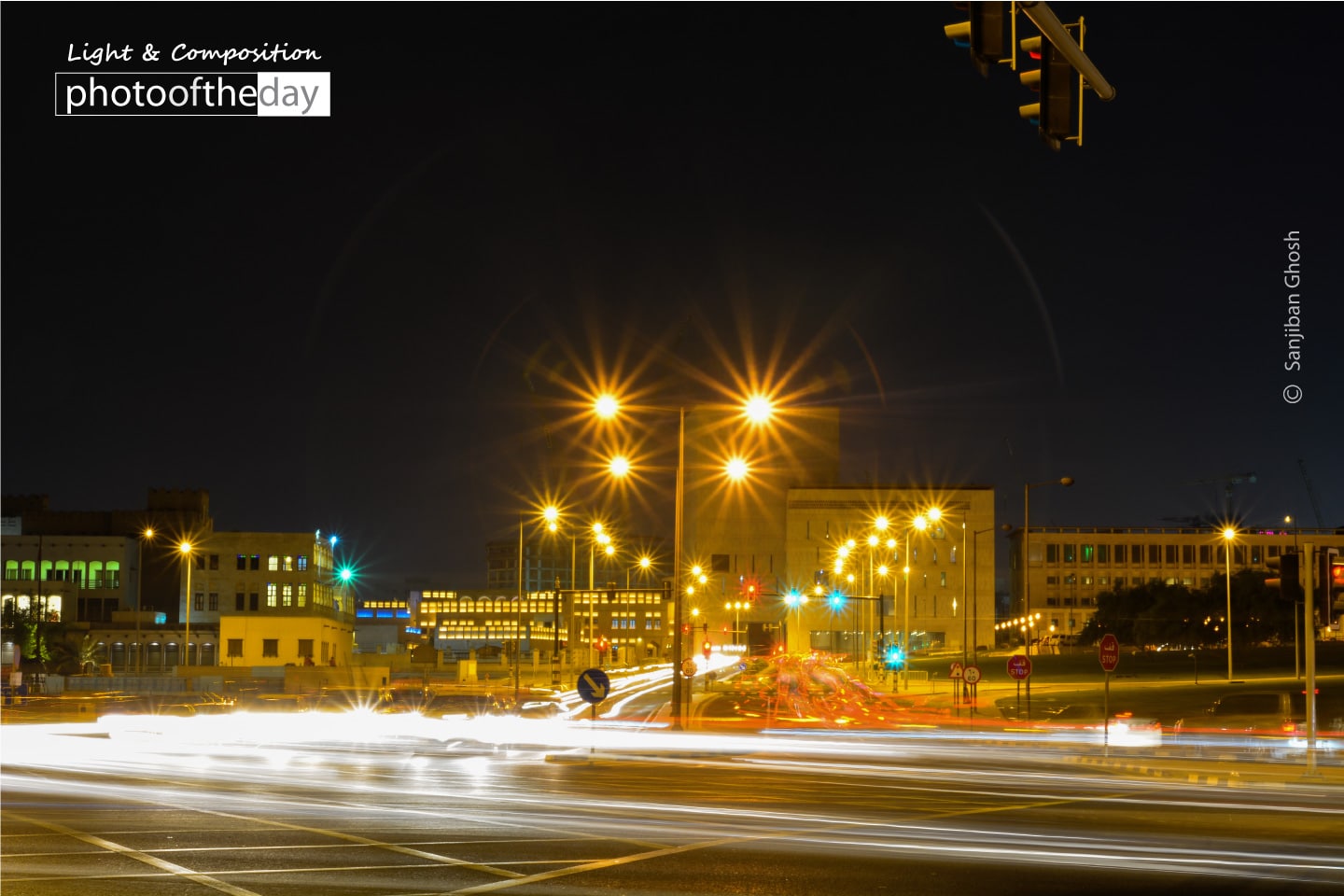
Traffic Rush by Sanjiban Ghosh
Captured on a Friday evening along the seaside corniche, this photograph masterfully documents the holiday rush hour. The photographer utilized a long exposure to transform the heavy traffic into a vibrant stream of light, while the rhythmic placement of street lamps introduces a festive, starry quality to the composition. This image is award-worthy for its technical precision in night photography, effectively balancing the chaotic energy of urban movement with the serene, glowing atmosphere of the Doha coastline at night.
Sanjiban Ghosh
Based in Doha, Qatar, Sanjiban Ghosh is an engineer who channels his creative energy into photography as a dedicated pursuit. His work spans architecture, night, travel, and landscape photography, driven by a desire to document the cultural beauty of the world. A self-taught artist who transitioned from point-and-shoot cameras to professional DSLR equipment, Ghosh continues to refine his craft, sharing his unique perspective on global events and environments with an international audience.
Resonance Score Breakdown
Transparency Note: The resonance score (12.4/20) is calculated based on social engagement metrics collected before the award announcement.
Expert Photography Reviews · 5
The River of Becoming
Seneca once remarked that life is like a river, always in motion, never the same water flowing past the same bank.
Read the reflection →The Velocity of Being Lost
It is 3:14 am. The house is holding its breath, and the silence is heavy enough to touch. In the daylight, we pretend we are moving toward something—a destination, a goal, a version of ourselves that finally makes sense.
Read the reflection →Reviews & Comments
Share your thoughts about this award-winning photograph. Your reviews contribute to the community engagement score.
Doha’s corniche is a far cry from the quiet blinds I’m used to, yet the same discipline applies. Ghosh has captured a clean, rhythmic long exposure, but it’s a sterile record of human noise. I find myself longing for the silence of the desert beyond these lights. While the technical execution is sharp, it’s an extraction of urban energy rather than a connection to the living world. It’s pretty, sure, but it doesn’t breathe.
You’ve captured the rhythm of Doha, but I’m left looking for the pulse. The light trails are technically sharp, sure, but they feel cold. Where are the people? I’ve spent enough nights on the corniche to know that rush hour isn’t just about glowing streaks; it’s about the tired faces behind those windshields. You’ve got the technical skill down, but next time, point the lens at the human story hiding inside that traffic.
Twenty-five seconds of exposure? That’s a lifetime in the street. Cartier-Bresson would’ve laughed at the lack of a decisive moment here. It’s a pretty light show, sure, but where’s the human pulse? I’m looking for the chaos of a driver’s face or a pedestrian caught in the blur. Instead, it’s just static geometry. My heart doesn’t race. It’s technically clean, but it’s missing the soul of the city. It’s too patient for my taste.
Long exposures of light trails are a tired trope, echoing the kinetic experiments of Gjon Mili without his structural rigor. Ghosh’s Doha corniche feels like a digital update to the urban abstractions of the 1950s, yet it lacks that era’s grit. While the f/20 aperture renders the street lamps with a crisp, starry precision, it’s all a bit too polished. I’ve seen this rhythm before, but I’ll admit, the sheer, electric hum of that golden curve genuinely thrills me.
Of the thousands of long-exposure cityscapes I’ve reviewed, most are just technical exercises in light trails. What separates this from the pack is the restraint in the color palette; it doesn’t scream for attention. The way those street lamps anchor the chaos of the traffic makes me feel the humid, heavy air of a Doha night. It’s a quiet, enduring document of a city in motion. I’d be glad to see this in thirty years.