The Waves Hit Your Feet by Karthick Saravanan
In the soft, golden glow of early morning, the photographer captures a poignant scene of childhood innocence on a tranquil shoreline. As waves gently caress the sand, two brothers find joy in the simple act of building sandcastles, their laughter harmonizing with the rhythmic pulse of the ocean. This image is award-worthy for its ability to freeze a fleeting moment of sibling camaraderie, transforming a mundane beach day into a timeless narrative of discovery and play. The composition emphasizes the vastness of the ocean against the small, determined figures of the children, highlighting the beauty found in life’s most uncomplicated, heartfelt experiences.
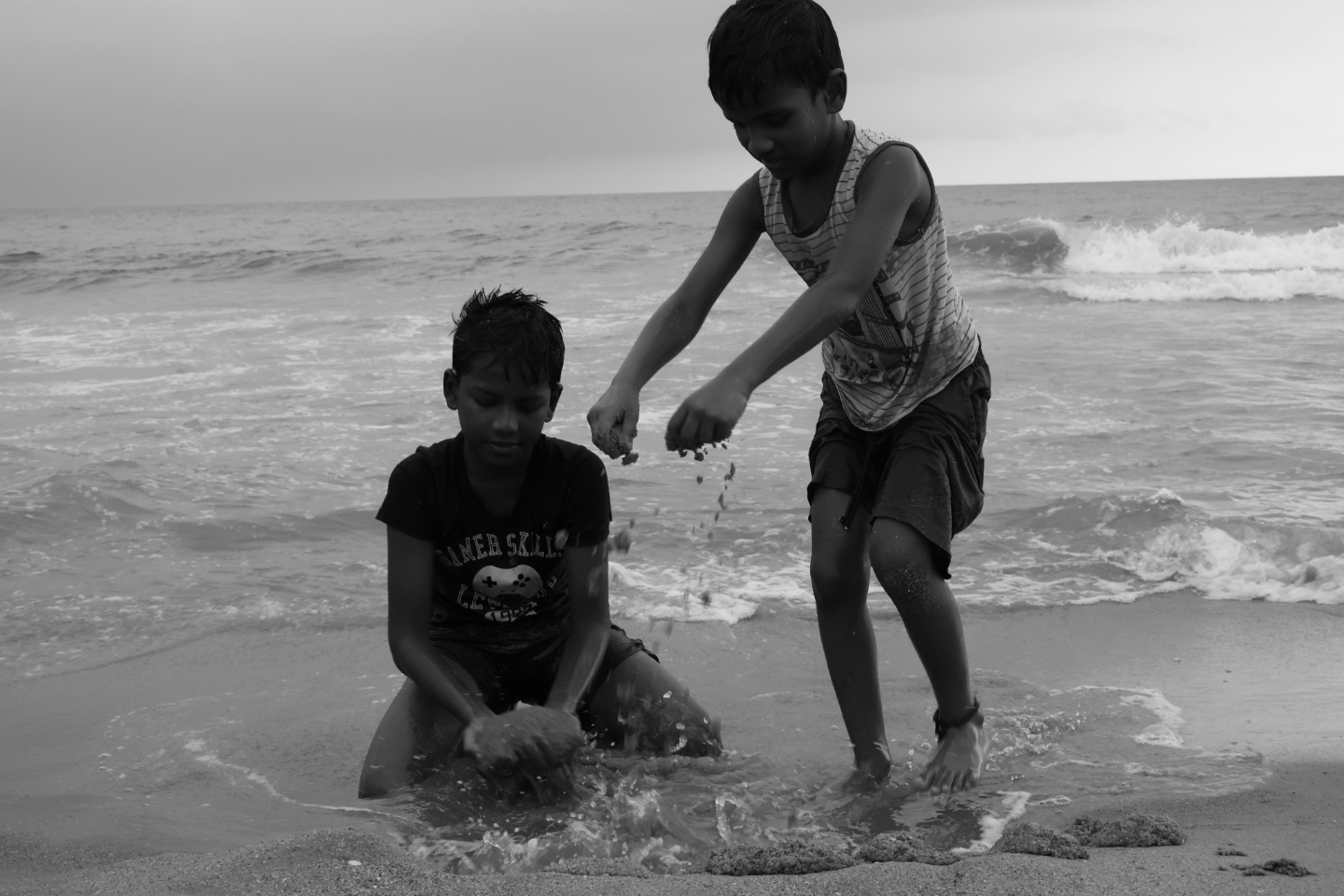
Exposure 1/125sec @ f/8 | ISO 1600 | Focal Length 28mm
Karthick Saravanan
Based in Chennai, India, Karthick Saravanan is a dedicated photographer celebrated for his evocative monochrome work. His artistic journey, which began in his youth, evolved significantly during the pandemic as he documented life on his farmland before transitioning to street photography. By focusing on the interplay of light and shadow, he captures the profound essence of both living and inanimate subjects. His work serves as a compelling testament to the enduring power of black and white imagery in storytelling, consistently resonating with audiences through its emotional depth and unique visual perspective.
Resonance Score Breakdown
Transparency Note: The resonance score (7.9/20) is calculated based on social engagement metrics collected before the award announcement.
Expert Photography Reviews · 7
The Rhythms of the Shore
The tide does not negotiate with the land; it simply arrives, a rhythmic pulse dictated by the moon’s silent pull, reshaping the shoreline with every advance and retreat.
Read the reflection →The Rhythm of the Tide
I often find myself thinking about the edges of things—where the solid, predictable pavement of the city finally gives way to the restless, unscripted uncertainty of the water.
Read the reflection →Reviews & Comments
Share your thoughts about this award-winning photograph. Your reviews contribute to the community engagement score.
The tide pulls back, and for a heartbeat, the frame breathes. It’s a wide shot, 28mm, capturing the scale of the Sundarbans against the frantic, tiny movements of those brothers. I’ve spent years watching waves crash on screen, but here, the stillness hits harder. The shutter speed at 1/125sec holds the water’s edge just long enough to feel the cold sand. It’s a perfect cut. I’d keep this frame forever; it’s pure, kinetic memory.
We look at these two brothers, small against the vast, rhythmic pulse of the Sundarbans, and we understand something about the quiet language of childhood. Karthick didn’t just point a lens; he listened to the tide. I’ve spent my life studying how we frame our kin, and this scene feels like a memory I’ve lived myself. It’s a tender, salt-sprayed conversation between brothers, and honestly, it makes my heart ache for the simplicity of home.
The tide retreats. Two brothers remain, small anchors against the vast, gray expanse. I’ve spent minutes watching the water pull away from their sandcastle. It’s quiet. The frame breathes. Most would crowd the boys, but here, the distance is the point. The emptiness isn’t a void; it’s a weight. I feel a sudden, sharp ache for the stillness of my own childhood. Nothing here is accidental. The empty corner is not empty. It is everything.
It’s a charming scene, but I can’t help but feel uneasy. The Sundarbans isn’t a playground; it’s a fragile, apex-predator habitat. Using a 28mm lens means the photographer was uncomfortably close to the water’s edge. Did they consider the risk of drawing attention to these children in a zone where tigers are known to patrol the mangroves? I’ve spent weeks in those swamps, and I’d never trade a child’s safety for a wide-angle composition. It’s reckless.
The curator calls this a timeless narrative, but I see a troubling romanticization of precarity. Why does the Sundarbans—a region defined by climate vulnerability—become a backdrop for aestheticized childhood innocence? The boys build castles while the tide encroaches, yet the frame ignores the rising water’s threat. It’s unsettling. Does their joy mask the reality of their environment, or am I projecting my own anxiety onto their play? I’d prefer a lens that acknowledges their actual world.
Most beach shots are forgettable, but this one sticks. Of the thousands I’ve reviewed, it’s the tension between the vast, encroaching tide and the boys’ fragile sandcastle that anchors the frame. It doesn’t just capture play; it captures the inevitable erosion of childhood. I felt a sharp, sudden ache in my chest looking at it. It’s a quiet, brutal reminder that time is the only thing we can’t build a wall against. It’ll endure.
One suspects the light cooperated on the first attempt. It often does, for the lucky. While the composition is tidy, I find myself questioning the commitment. Did the photographer return to this shoreline until the tide and the children’s play felt truly inevitable, or was it merely a pleasant morning stroll? I’ve spent enough hours shivering in the mud to know the difference. It’s a charming snapshot, certainly, but it hasn’t quite cost enough yet.