The Piper by Ryszard Wierzbicki
Captured during a serendipitous encounter in the mountain lake resort of Bedugul, Bali, this portrait highlights the striking character of a local piper. The photographer was drawn to the man's remarkable face and the rhythmic charm of his flute performance, choosing to document the moment with a telephoto lens to isolate the subject against the serene Indonesian landscape. The image succeeds as an award-winning piece through its authentic candid nature, capturing a fleeting, soulful connection between the traveler and the local musician, elevated by the subject's weathered features and the evocative atmosphere of the Balinese highlands.
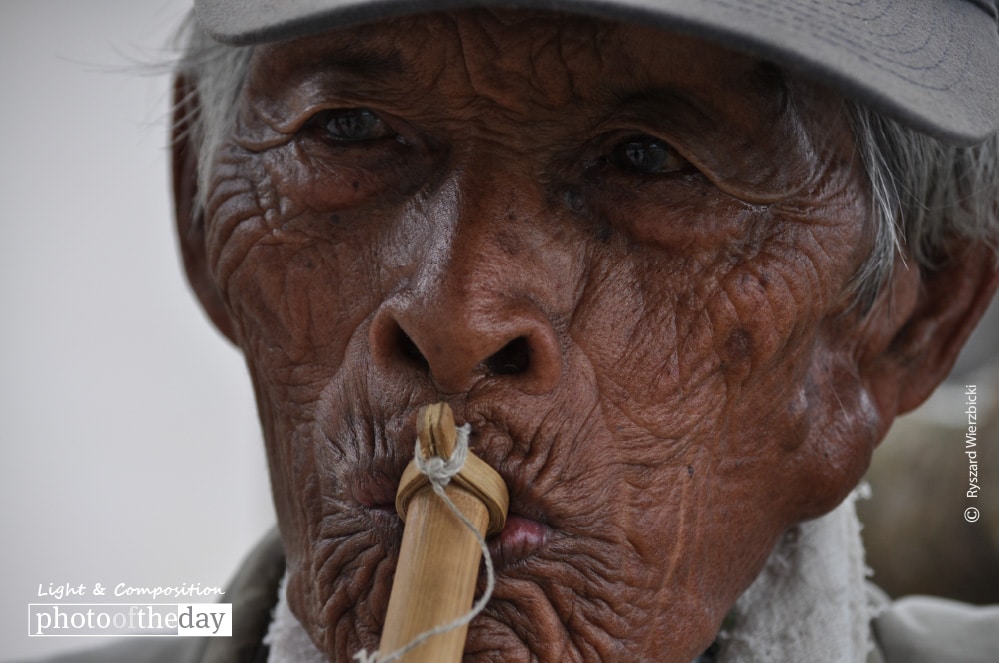
Exposure 1/180sec @ f/6.7 | ISO 200 | Focal Length 105mm
Ryszard Wierzbicki
Born in 1963, Ryszard Wierzbicki is a Polish-born photographer and traveler currently based in Swindon, United Kingdom. After a diverse professional career in social sciences, education, and marketing, he transitioned into a life dedicated to exploration, scuba diving, and photography. His work is deeply influenced by his extensive travels through South-East Asia and his commitment to humanitarian efforts, including volunteering for orphanages. Through his established travel forums, he shares his passion for documenting the world, blending his background in social care with a keen eye for human-centric storytelling.
Resonance Score Breakdown
Transparency Note: The resonance score (12.6/20) is calculated based on social engagement metrics collected before the award announcement.
Expert Photography Reviews · 8
Breath Held in Wood
The air in the mountains has a specific sharpness, a cold edge that tastes of damp earth and pine needles. It is a thin, biting sensation that settles deep in the lungs, making every inhale feel like a deliberate act of survival.
Read the reflection →The Song of the Highlands
I met an old man in a village near the mountains who spent his afternoons playing a bamboo flute that looked as worn as his hands. He didn't play for an audience, and he didn't play for money. He told me the melody was just a way to keep the mountain air from feeling too heavy.
Read the reflection →Reviews & Comments
Share your thoughts about this award-winning photograph. Your reviews contribute to the community engagement score.
The mountain air in Bedugul holds a stillness that demands silence. He stood there, waiting for the piper’s breath to align with the mist. It’s not just a portrait; it’s a conversation with the highlands. I feel a sudden, sharp ache in my chest looking at those weathered lines, as if I’ve heard the melody myself. He didn’t just capture a man; he listened until the landscape finally let the music out.
The telephoto compression here flattens the Bedugul landscape into a soft, blurred datum, stripping away the spatial context of the mountain air. It’s a portrait that ignores the threshold between the musician and his environment. I’m left wondering about the scale of the space behind him—the solid and void of the resort. It’s technically sharp, but I miss the architecture. I’d trade this isolation for one frame that reveals how his melody inhabits the structure.
The ochre of the piper’s skin, weathered like a Morandi still life, anchors the frame against the cool, verdant blur of the Balinese highlands. It’s a chromatic dialogue between the warmth of human endurance and the damp, mossy greens of the mountain mist. I’m utterly breathless at how the flute’s muted timber mirrors those earthy tones; it’s a symphony of pigment that feels like a soft, melancholic exhale against the humid, saturated Indonesian air.
The flute hits the frame and the world goes quiet. It’s a tight, 105mm cut that isolates the piper’s weathered skin against the soft, blurred Balinese highlands. I’m struck by the stillness here; it’s a long take where the breath is held, not exhaled. The shutter speed caught the exact rhythm of his performance. It’s the frame the editor keeps because the cut would have been a mistake. He’s playing for the lens, and I’m listening.
It’s a shame the jury obsessed over clarity here. By isolating the piper with a telephoto lens, Wierzbicki missed a chance to let the Bedugul mist swallow the subject’s edges. Why resolve every wrinkle when the flute’s melody is inherently fluid? I’m genuinely frustrated by the literalism; I’d have preferred a long exposure to blur the musician into the landscape. It’s too safe, too sharp, and frankly, it’s missing the music entirely.
Most portraits of local musicians feel like souvenirs, but this one lingers. I’ve seen thousands of travel shots, yet the way Wierzbicki uses that 105mm focal length to compress the mist against the piper’s weathered skin is rare. It’s the eyes—they’re looking through the lens, not at it. I felt a genuine ache seeing his focus. In thirty years, this won’t be a cliché; it’ll be a haunting record of a vanishing, quiet dignity.
The flute holds the air. It’s a thin line against the grey. I’ve spent minutes watching the mist swallow the edges of his face. It’s quiet here. The background doesn’t intrude. It recedes. I feel a sudden, sharp ache for that mountain cold. Nothing here is accidental. The empty corner is not empty. It’s the breath between notes. Wierzbicki knows the weight of what isn’t shown. He lets the silence remain.
The piper’s face is a map of erosion, carved by the very highlands he inhabits. Wierzbicki doesn’t just capture a man; he traps the silence between notes. I’m unsettled by how the shadows cling to the flute’s dark wood, refusing to yield to the mountain light. It’s a brutal, honest tension. When I look at those eyes, I don’t see a performance. I see the weight of a life that’s already retreated into the dark.