The Paradise View by Ryszard Wierzbicki
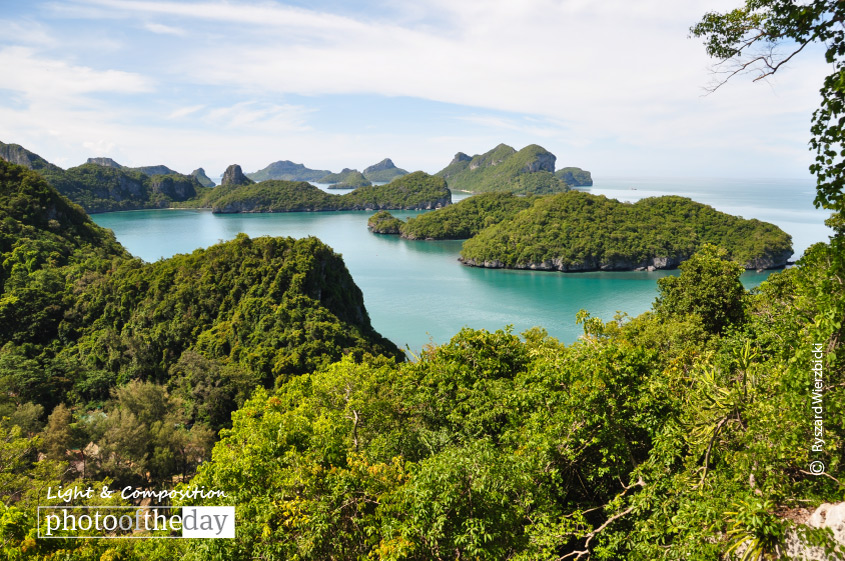
The Paradise View captures the ethereal beauty of Mu Ko Ang Thong National Marine Park, a location renowned for its breathtaking vistas. Taken with a wide-angle perspective, the photograph emphasizes the dramatic scale of the limestone islands rising from the turquoise waters of the Gulf of Thailand. The photographer carefully balanced the exposure to retain the vibrant clarity of the tropical light, showcasing the serene, untouched nature of this protected sanctuary. This image is award-worthy for its masterful composition, which perfectly frames the harmony between the rugged cliffs and the calm sea, inviting viewers into a moment of absolute tranquility.
Ryszard Wierzbicki
Born in 1963 and a graduate of the University of Gdańsk, Ryszard Wierzbicki transitioned from a diverse career in education and marketing to become a dedicated travel photographer and scuba instructor. Since relocating to the United Kingdom in 2006, he has focused his lens on the landscapes and cultures of South-East Asia, often blending his creative pursuits with humanitarian work for orphanages. As the founder of the Instant Travelling and World Around forums, Wierzbicki actively fosters a community for explorers, documenting his global adventures with a deep appreciation for the natural world.
Resonance Score Breakdown
Transparency Note: The resonance score (12.4/20) is calculated based on social engagement metrics collected before the award announcement.
Expert Photography Reviews · 4
The Geography of Exclusion
We often mistake the absence of people for the presence of peace. We look at a landscape stripped of human clutter and call it a sanctuary, a paradise, an untouched wilderness. But in the study of human geography, there is no such thing as a truly empty space.
Read the reflection →Salt on the Skin
The memory of the ocean is not in the eyes, but in the way the air clings to the back of your throat. It is the taste of salt, sharp and metallic, lingering long after you have climbed out of the surf.
Read the reflection →Reviews & Comments
Share your thoughts about this award-winning photograph. Your reviews contribute to the community engagement score.

The turquoise water here is almost aggressive in its clarity, yet it’s the limestone cliffs that haunt me. They’re too bright, too exposed, as if the photographer feared what might hide in the crevices. Where is the weight? Where is the silence? I’ve spent my life looking for the dark, but here, the light just flattens the world into a postcard. It’s beautiful, I suppose, but it’s a beauty that refuses to let me think.
At f/10, the Nikon D90 avoids the diffraction limit, keeping the limestone textures razor-sharp. The 18mm focal length stretches the perspective, yet the light’s refraction through the humid air creates a subtle, beautiful haze across the horizon. I’m genuinely moved by how the sensor resolves the turquoise gradients; it’s a rare, clinical precision that feels almost tactile. It’s not just a view; it’s a perfect calibration of light meeting the limits of the glass.
The vertical axis here is anchored by the limestone monoliths, creating a perfect 1:2 ratio between the jagged mass and the expansive sea. I’m struck by the way the diagonal shoreline pulls the eye toward the negative quadrant, balancing the frame’s visual weight. It’s a precise spatial equation where the turquoise water functions as a stabilizing constant. Honestly, the way those karst formations intersect the horizon line gives me a genuine thrill. It’s geometry solved beautifully.
The frame opens with a wide, breathless intake of air. It’s the kind of establishing shot that demands a slow pan, but Wierzbicki knows better. He holds the limestone cliffs against that turquoise expanse, refusing to cut. The light is sharp, honest, and it hits the water with a rhythm I can almost hear. I’ve stared at this for ten minutes; it’s the quiet, perfect moment before the film’s tension finally breaks. It’s a keeper.