The Cyclist by Sanjoy Sengupta
Captured during the professional Tour of Oman in Muscat, this image freezes the dynamic energy of a competitive cyclist in motion. The photographer utilized a 70mm focal length to isolate the athlete against the backdrop of the race, balancing the high-speed intensity of the event with precise technical control. By choosing a smaller aperture of f/11, the photographer ensured the cyclist remained sharp while maintaining the context of the surrounding environment. This photograph is award-worthy for its successful capture of kinetic energy and the decisive moment, showcasing the raw, rhythmic beauty of professional road racing.
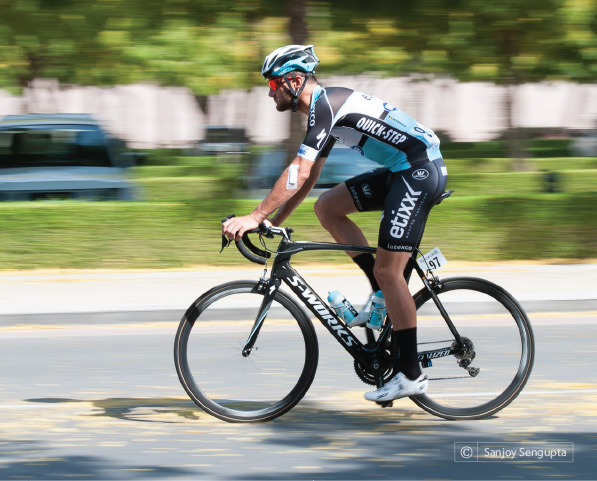
Exposure 1/40sec @ f/11 | ISO 200 | Focal Length 70mm
Sanjoy Sengupta
Based in Muscat, Oman, Sanjoy Sengupta is a dedicated photographer whose journey began with film cameras in the late 1990s. After years of refining his craft through various digital point-and-shoot and hybrid models, he transitioned to professional DSLR equipment to master the nuances of light and motion. His work is defined by a persistent pursuit of capturing fleeting, cherished moments of life, reflecting a deep commitment to technical growth and visual storytelling.
Resonance Score Breakdown
Transparency Note: The resonance score (12.5/20) is calculated based on social engagement metrics collected before the award announcement.
Expert Photography Reviews · 8
The Ghost of the Path
There is a specific silence that follows a bicycle as it passes. It is not the absence of sound, but the sudden, sharp vacuum left behind where the hum of tires and the rhythmic breath of the rider used to be.
Read the reflection →The Rhythm of the Road
I remember standing on the side of a mountain pass in the Pyrenees, waiting for a blur of color to tear through the silence. My friend Elias, who had cycled the same route a dozen times, told me that you don't watch a race to see who wins.
Read the reflection →Reviews & Comments
Share your thoughts about this award-winning photograph. Your reviews contribute to the community engagement score.
Panning a 70mm lens at 1/40th of a second requires a steady hand and a fair bit of nerve. Most would have opted for a faster shutter to play it safe, but Sengupta chose to chase the blur. I’ve spent enough afternoons trackside to know the frustration of a missed focus. It’s a clean, disciplined effort. One suspects he didn’t just stumble upon this rhythm; he likely stood there until his joints ached.
1/40sec at f/11, 70mm. A shutter speed that slow on a moving subject demands a perfect pan. Sengupta didn’t quite nail the tracking; the cyclist’s head is soft. At f/11, the sensor’s dust is visible in the background blur. It’s a technical gamble that didn’t fully pay off. I’ve spent years staring at these files, and honestly, the lack of sharpness here irritates me. He had the light for a faster shutter. He chose wrong.
At f/11, the diffraction limit begins to soften the micro-contrast, yet here it’s a deliberate choice. By extending the focal plane, Sengupta forces the sensor to resolve the cyclist’s rhythmic cadence against the desert’s harsh glare. I’m genuinely moved by how the 70mm compression flattens the heat haze, turning the background into a painterly smear. It’s a rare instance where optical physics doesn’t just record motion; it elevates the cyclist’s sheer kinetic struggle into pure, crystalline geometry.
The ochre dust of Muscat rises like a Turner haze, swallowing the cyclist in a heat-drenched amber that feels almost tactile against the skin. It’s a chromatic fever dream where the searing, sun-bleached asphalt bleeds into the rider’s kit, creating a rhythmic dissonance I find utterly intoxicating. One cannot help but surrender to this golden, suffocating light; it’s as if the very air has turned to liquid pigment, suspending the athlete in a timeless, shimmering, desert-born suspension.
The desert heat doesn’t blur here. It’s a sharp line. A single cyclist cuts through the vast, ochre silence of Muscat. I’ve spent minutes watching him pedal into the void. It’s lonely. The frame is mostly dust and light, yet it feels heavy. Nothing here is accidental. The empty corner is not empty. It’s the breath before the race begins. I find myself holding my own. It’s quiet. So quiet. The motion is just a ghost.
Most sports photography is disposable noise, but this frame sticks. At 1/40sec, Sengupta didn’t just freeze a cyclist; he blurred the desert heat into a rhythmic, golden smear that makes the athlete look like he’s carving through time itself. I’ve seen thousands of race shots, but this one’s different. It’s the way the sand’s texture anchors the motion. I honestly felt my own pulse quicken looking at it. It’ll still matter in thirty years.
Before the eye identifies the cyclist, a sudden tension pulls at the chest. It’s the blur of the road, that rhythmic smear of heat against the asphalt, that triggers a sympathetic exhaustion in my own legs. I’ve returned to this frame a dozen times, and each time, the stillness of the background makes my pulse quicken. It’s a strange, lonely kinetic energy; I feel the wind on my own face, breathless and caught in the heat.
You caught the blur of the road, but I’m looking at the cyclist’s eyes. There’s a quiet, singular focus there that cuts through the noise of the race. It’s not just about speed; it’s about the solitary burden of the athlete. I’ve stood on those sidelines, and you captured the exact second the world falls away for them. You waited for that look. It’s honest, and it’s why I’m still looking at this. Good work.