Safari by Ryszard Wierzbicki
Captured during a safari expedition through the Serengeti National Park in September 2011, this image was taken in a fleeting, spontaneous moment as the photographer’s vehicle passed another jeep on a dusty, sun-drenched track. The composition relies on a precise balance of shutter speed and focal length to freeze the action of the rugged landscape. This photograph is award-worthy for its raw, authentic depiction of the African wilderness, capturing the essence of travel and the serendipitous nature of wildlife photography, where the photographer's quick reflexes transformed a brief encounter into a timeless, evocative narrative of exploration.
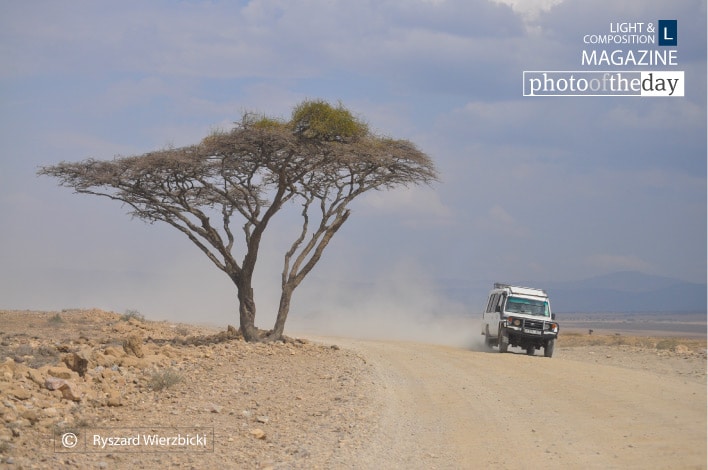
Exposure 1/2000sec @ f/6.7 | ISO 400 | Focal Length 62mm
Ryszard Wierzbicki
Born in Poland in 1963, Ryszard Wierzbicki transitioned from a diverse career in social sciences and marketing to a life dedicated to global exploration and photography. After emigrating to the United Kingdom in 2006, he shifted his focus toward documenting his extensive travels and scuba diving experiences across South-East Asia. A passionate advocate for humanitarian causes, he supports orphanages in Thailand and Burma while managing digital platforms for travelers. His work reflects a deep commitment to capturing the spirit of the natural world through a lens shaped by years of adventurous, independent discovery.
Resonance Score Breakdown
Transparency Note: The resonance score (12.8/20) is calculated based on social engagement metrics collected before the award announcement.
Expert Photography Reviews · 8
The Dust of Passing
There is a particular grace in the way the earth rises to meet our movement. When we travel, we often focus on the destination, the place where we intend to arrive. Yet, it is in the transit—the space between here and there—that the world reveals its true, unscripted nature.
Read the reflection →The Dust of Elsewhere
There is a peculiar weight to the dust kicked up by a passing vehicle on a dry road. It hangs in the air, a suspended history of the ground beneath, refusing to settle until the silence returns.
Read the reflection →Reviews & Comments
Share your thoughts about this award-winning photograph. Your reviews contribute to the community engagement score.
Dust hangs in the air. The Serengeti track stretches, a line of light against the heat. I’ve spent years looking for this stillness. It’s not in the vehicle or the movement. It’s in the space between the tires and the horizon. The emptiness isn’t a void. It’s a breath. I feel a sudden, sharp ache for that silence. Nothing here is accidental. The empty corner is not empty. It is the weight of the journey.
At f/6.7, the 62mm focal length manages the Serengeti’s heat haze with surprising clarity. The diffraction limit hasn’t compromised the fine dust particles, which hang suspended in the light like microscopic jewels. I’m genuinely moved by how the lens resolves those gritty textures against the soft bokeh of the horizon. It’s a rare moment where the optics don’t just capture a scene; they reveal the physical weight of the air itself. It’s quite beautiful.
The Serengeti’s dust isn’t merely grit; it’s a suspended, ochre veil, reminiscent of Turner’s most fevered atmospheric studies, where the light doesn’t just illuminate but consumes. It’s a chromatic collision of burnt sienna and the pale, parched gold of dried savanna grass that makes my heart ache with a sudden, sharp longing for that heat. One finds the palette isn’t decorative, but a visceral, suffocating truth that renders the vehicle’s metal frame entirely secondary.
The frame’s geometry hinges on the intersection of the dust cloud and the vehicle’s trajectory. It’s a precarious balance. The negative space provided by the Serengeti horizon anchors the chaos, preventing the composition from collapsing into mere reportage. I’m genuinely irritated by the soft focus on the peripheral brush, yet the central tension holds. It doesn’t rely on sentiment. The architecture of the frame remains disciplined, forcing the eye to resolve the motion against the stillness.
Before the eye identifies the dust or the metal of the passing jeep, a sudden, dry heat prickles the skin. It’s a visceral activation of the nerves, that sharp, held-breath moment of transit. When I return to this, I don’t see a safari; I feel the grit of the Serengeti settling in my own lungs. It’s unsettling, really—the way the light forces me to look for something that’s already vanished into the haze.
Dust hangs in the air, suspended in that harsh, unforgiving light of the Serengeti noon. Ryszard caught the grit of the track, the way the heat ripples off the earth. I’ve felt that dry wind against my own skin. It’s a frantic, fleeting encounter, yet there’s a stillness in the way the light clings to the vehicle. He didn’t just capture a safari; he listened to the land’s sudden, dusty exhale. It’s honest, raw, and deeply alive.
Most travel photography is just visual clutter, but Wierzbicki’s shot survives because it captures the frantic, gritty reality of the Serengeti track. It’s not the wildlife that anchors this; it’s the dust and the fleeting proximity of that other jeep. I’ve seen thousands of safari shots, yet this one makes me feel the grit in my own teeth. It’s a raw, unpolished moment that earns its place because it doesn’t try to be a postcard.
1/2000sec at f/6.7, ISO 400, 62mm. The shutter speed is overkill for a static vehicle, but it’s the only way to kill the vibration of a moving jeep. Wierzbicki didn’t waste time on depth of field. He prioritized the freeze. It’s technically sound, though the 55-200mm glass is clearly struggling with the Serengeti heat haze. I’ve spent enough time in the field to know that sharpness is a luxury here. He made the right call.