Royal Ontario Museum by Mazhar Hossain
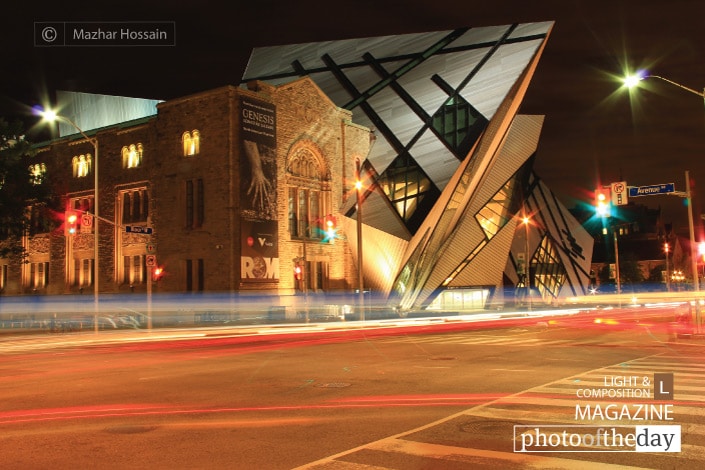
Capturing the Royal Ontario Museum at night, the photographer experimented with long-exposure motion photography to emphasize the building's striking architectural geometry. By utilizing a thirty-second exposure, the photographer transformed the urban environment into a dynamic scene, blending the stillness of the structure with the fluid movement of the city. This image is award-worthy for its technical precision in low-light conditions and its creative approach to architectural documentation, successfully turning a static landmark into a vibrant, living subject that reflects the energy of downtown Toronto after dark.
Mazhar Hossain
Born in Dhaka, Bangladesh, Mazhar Hossain is a Toronto-based photographer and Human Resource professional. Since acquiring his first DSLR in 2010, he has dedicated himself to exploring the intersection of architecture, landscape, and human life through his lens. Driven by a passion for travel and discovery, he continuously refines his technical skills while striving to document the beauty of global cities. His work reflects a growing artistic journey, capturing the essence of his surroundings with an evolving, observant eye.
Resonance Score Breakdown
Transparency Note: The resonance score (12.0/20) is calculated based on social engagement metrics collected before the award announcement.
Expert Photography Reviews · 5
The Architecture of Passing Time
Can a stone wall ever truly be still, or is it merely waiting for the world to move around it? We build our monuments to defy the erosion of the years, carving sharp angles into the sky as if to prove our permanence.
Read the reflection →The Weight of Passing Time
We move through cities like ghosts, leaving only the faintest trace of our passage. The stone remains, indifferent to the hurry of the living. We believe we are the ones who observe, yet we are merely the blur in the periphery of something much older and more permanent.
Read the reflection →Reviews & Comments
Share your thoughts about this award-winning photograph. Your reviews contribute to the community engagement score.
The jagged, crystalline shards of the museum slice through the night, bathed in a bruised, electric violet that recalls the melancholic, artificial glow of a Hopper street corner. It’s a haunting, liquid alchemy; I’m utterly seduced by how the long exposure bleeds the city’s frantic motion into a soft, ghostly amber, creating a chromatic friction against the structure’s cold, sharp geometry. One finds the atmosphere here isn’t merely captured, but deeply, vibrantly felt.
The museum’s sharp angles cut through the night. It’s a collision of stone and light. I’ve spent minutes watching the streaks of traffic blur into ghosts. They don’t distract. They anchor the stillness of the architecture. It’s quiet here. The long exposure breathes. Nothing is accidental. The empty corner isn’t empty; it’s a pause. I feel a sudden, sharp ache for this kind of silence in the city. It’s rare. It’s enough.
Before the eye identifies the Royal Ontario Museum, something in the chest tightens. The long exposure turns the city’s pulse into a ghostly, rhythmic smear, forcing my own breath to sync with that blur. It’s disorienting, like a memory of a night I’ve never actually lived. When I return to it, the stillness of the architecture feels heavier, almost lonely. I find myself wanting to step into that light, just to see if I’d dissolve too.
The architecture’s jagged geometry demands a rigid anchor, yet the long exposure dissolves the urban periphery into mere blur. It’s a precarious balance. The structural weight of the museum’s crystalline facade fights the fluid light trails, creating a necessary spatial tension. I’ve always found this friction between the static and the ephemeral quite jarring. The frame holds, though barely. It’s a clinical dissection of Toronto’s nocturnal pulse, where the composition finally justifies the motion.
Daniel Libeskind’s jagged steel shards usually demand a brutalist clarity, but here, Hossain lets the thirty-second exposure bleed the city’s pulse into the architecture. It’s a haunting erasure. The shadows don’t merely frame the structure; they swallow its rigid geometry, turning stone into a phantom. I’ve stared at these streaks of light until my eyes ached, feeling the cold, indifferent weight of time passing. It’s not just a building anymore; it’s a tomb for the living.