Risky Life by Shahnaz Parvin
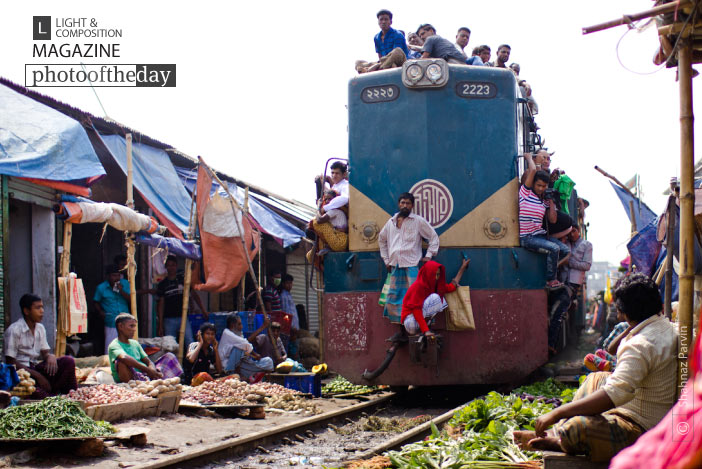
Captured at a bustling farmers market in Postogola, this poignant documentary photograph freezes a moment of extreme tension as a train barrels through the crowded tracks. The photographer skillfully highlights the stark contrast between the daily struggle for basic needs and the perilous reality of those living beside the railway. By framing the commuters clinging to every available inch of the train, the image serves as a powerful testament to the resilience of the human spirit. Its award-worthy impact lies in the raw, unfiltered depiction of a life defined by constant risk and the relentless pursuit of survival.
Shahnaz Parvin
Based in Dhaka, Bangladesh, Shahnaz Parvin was a celebrated photojournalist whose work captured the essence of South Asian culture, conflict, and daily life. Recognized as one of the world's top photographers during her career, she dedicated her lens to documenting the resilience of her fellow citizens. Her legacy remains defined by her profound commitment to documentary photography and her extensive contributions to the international photographic community, which earned her numerous prestigious accolades before her untimely passing in 2016.
Resonance Score Breakdown
Transparency Note: The resonance score (13.0/20) is calculated based on social engagement metrics collected before the award announcement.
Expert Photography Reviews · 7
The Weight of the Passing
We measure our lives by the things we hold onto. A handrail, a ledge, the hem of a coat. We believe that if we grip tightly enough, the world will stop its relentless forward motion.
Read the reflection →The Grit of Survival
The smell of scorched iron and damp earth always brings me back to the edge of a precipice. It is a metallic, biting scent that clings to the back of the throat, tasting faintly of coal dust and hurried sweat.
Read the reflection →Reviews & Comments
Share your thoughts about this award-winning photograph. Your reviews contribute to the community engagement score.
At f/1.4, the focal plane is razor-thin, isolating the commuters against a chaotic, swirling bokeh. It’s a daring choice; the diffraction limit is irrelevant when the lens is wide open, yet the light’s behavior here creates a visceral, claustrophobic depth. I’m genuinely unsettled by how the glass renders the metal against the human skin. It’s not just a document of survival; it’s a masterclass in using optical physics to force us into their terrifying, narrow reality.
The train cuts through the frame. It’s a blur of steel and desperation. Yet, I’m drawn to the sliver of sky above the tracks. It’s vast. It’s indifferent. The commuters cling to the metal, but the emptiness surrounding them feels heavier than the crowd. It’s a quiet violence. I’ve never felt so small standing before a print. Nothing here is accidental. The empty corner is not empty. It’s the weight of everything they’ve left behind.
The light here isn’t just illumination; it’s a heavy, dusty weight pressing against the iron of the train. Shahnaz stood in the heat of Postogola, listening to the vibration of the tracks before the metal arrived. It’s a terrifying stillness. I feel a shiver watching those hands cling to the steel. She didn’t just capture a commute; she caught the precise second where survival outweighs fear. It’s a haunting, breathless act of pure attention.
One suspects the photographer didn’t just wander into Postogola for a quick snap. That f/1.4 aperture suggests a deliberate, risky commitment to the chaos. I’ve spent enough hours trackside to know the vibration of a train in one’s marrow; it’s a terrifying, visceral hum. She clearly waited for the exact moment the metal met the crowd. It’s a brutal, earned frame. I find myself holding my breath, which is the highest compliment I can offer.
The ochre dust of Postogola hangs heavy, a suffocating veil that turns the sunlight into the bruised, sickly gold of a Turner storm. It’s a chromatic violence, where the rusted iron of the train bleeds into the desperate, sun-bleached fabrics of the commuters, creating a palette of survival that makes my heart ache. One cannot help but feel the heat radiating from those scorched tones, a searing, monochromatic intensity that renders the peril utterly, terrifyingly tactile.
Death doesn’t announce itself here; it arrives as a blur of steel against the desperate, clinging bodies of Postogola. I’ve stared at these shadows for an hour, and they don’t offer comfort. They swallow the commuters whole, turning survival into a silhouette of impending erasure. It’s terrifying. When the light hits those desperate hands, it isn’t illuminating life—it’s exposing the fragile, fleeting boundary where existence ends and the darkness finally claims its due.
Of the thousands of documentary submissions I’ve reviewed, most rely on cheap sentiment. This one earns its place because the f/1.4 aperture isolates the desperate grip of a single commuter against the blur of the encroaching train. It’s a brutal, honest slice of Postogola. I felt my breath hitch looking at those knuckles. It’s not just a record of survival; it’s a terrifying, permanent reminder of how thin the line between commerce and catastrophe really is.