Poultry for Sale by Ryszard Wierzbicki
Captured during a December journey through Luang Prabang, this photograph documents the vibrant atmosphere of a local market. The photographer was drawn to the sensory richness of the scene, where a kaleidoscope of colors, scents, and sounds creates a compelling narrative of daily life. By focusing on the poultry market, the image highlights the authentic, unscripted moments that define travel photography. The composition succeeds by isolating a slice of local commerce, transforming an ordinary errand into a striking visual study that captures the essence of the region's cultural landscape.
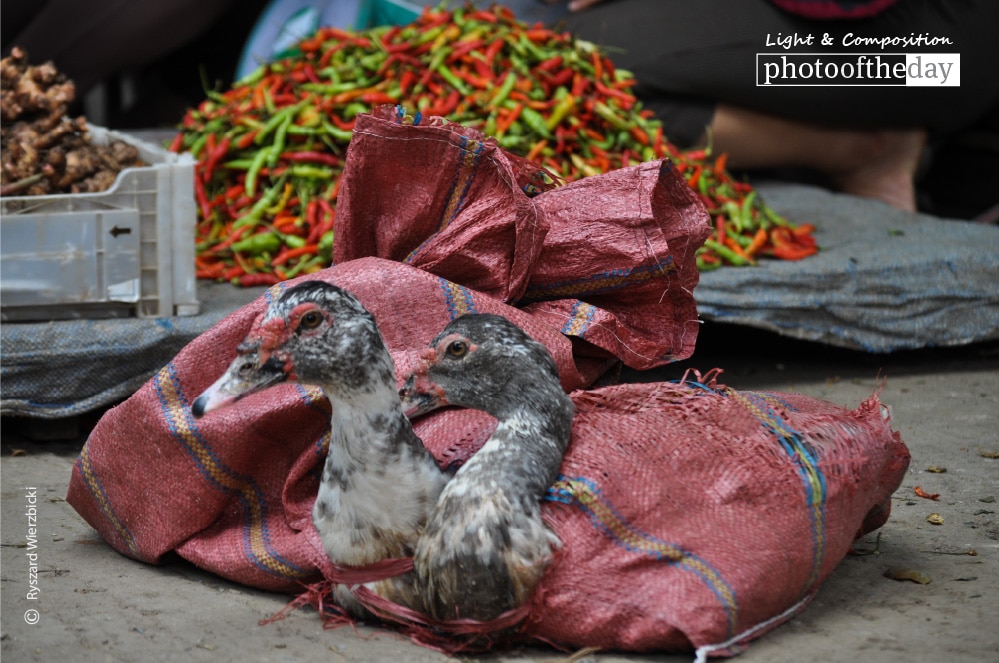
Exposure 1/125sec @ f/5.6 | ISO 250 | Focal Length 87.2mm
Ryszard Wierzbicki
Born in Poland in 1963, Ryszard Wierzbicki is a dedicated traveler and photographer currently based in Swindon, United Kingdom. After a diverse professional career in education and marketing, he transitioned to a life of exploration, focusing his lens on the cultures of South-East Asia. Beyond his photographic pursuits, he is an active scuba instructor and a committed volunteer for orphanages in Thailand and Burma. Through his online platforms, Instant Travelling and World Around, he fosters a global community for fellow travelers and visual storytellers.
Resonance Score Breakdown
Transparency Note: The resonance score (12.2/20) is calculated based on social engagement metrics collected before the award announcement.
Expert Photography Reviews · 7
The Weight of the Morning
I remember a market in Luang Prabang where the humidity clung to your skin like a damp wool blanket. I had stopped at a stall to buy a handful of rambutans, and the woman selling them didn't look up from her work.
Read the reflection →The Weight of the Market
The smell of damp feathers and earth always pulls me back to a morning I cannot quite place, where the air felt thick enough to chew. It is a metallic, dusty scent—the smell of life held in close quarters, of woven bamboo baskets pressing against calloused palms.
Read the reflection →Reviews & Comments
Share your thoughts about this award-winning photograph. Your reviews contribute to the community engagement score.
Luang Prabang’s markets have been documented since the colonial era, yet Wierzbicki’s framing feels oddly static. It lacks the kinetic, layered depth of Cartier-Bresson’s market studies or the gritty, tactile intimacy of Kertész. While the Nikon’s 87mm compression flattens the space, I’m genuinely struck by the vibrant, almost painterly saturation of the poultry’s plumage. It’s a lovely color study, but it doesn’t quite push the conversation forward. I’ve seen this scene a thousand times before.
At 87.2mm and f/5.6, the Nikon’s sensor captures a crisp focal plane that renders the poultry’s textures with startling clarity. I’m genuinely moved by how the diffraction of light across those feathers reveals details the naked eye would surely miss in the Luang Prabang heat. It’s a sharp, honest optical capture. While the bokeh doesn’t quite isolate the subject, the lens’s resolution makes the market’s grit feel visceral. It’s a beautiful, precise slice of reality.
The shutter snaps and the market’s chaos freezes into a perfect, rhythmic beat. It’s a tight, 87mm crop that forces us into the vendor’s workspace. I love the way the light catches the feathers; it’s tactile, almost visceral. The frame holds its breath, refusing to cut away to the wider scene. It’s a deliberate choice. Wierzbicki didn’t just document a sale; he captured the exact moment the motion stopped, leaving us with a film that never rolls.
The frame functions as a grid of intersecting vectors. The poultry cages establish a rigid, repetitive horizontal rhythm, effectively anchoring the lower two-thirds. I’m struck by the tension between these static, rectangular cells and the organic, chaotic movement of the birds. It’s a beautifully solved spatial equation where the vertical axis of the vendor’s posture provides the necessary counterweight. The geometry here isn’t just structural; it’s a precise, rhythmic pulse that makes the market feel alive.
We look at the vendor’s hands, steady among the crates, and we hear the low hum of the Luang Prabang market. Ryszard didn’t just snap a scene; he waited for the quiet rhythm of the trade. I’m struck by the way the light catches the feathers, turning a simple errand into a dignified exchange. It’s a portrait of patience. I feel a sudden, sharp longing for that morning air. This is a photograph that asks to be returned to.
The market’s vibrant colors feel like a convenient mask for a deeper transaction. Why does the vendor’s face remain obscured while the poultry takes center stage? It’s a classic travel trope: exoticizing commerce to satisfy a Western lens. I find myself wincing at the voyeurism here. Does this frame actually honor Luang Prabang, or does it just consume it? We’ve seen this aesthetic before, but who is really being served by this unscripted moment?
Before the eye identifies the crates of poultry, a sudden stillness settles in the chest. It’s the weight of the market’s humidity, felt in the lungs. I’ve returned to this frame three times, and each time, the vibrant, chaotic color triggers a phantom scent of damp feathers and heat. It doesn’t just document commerce; it anchors a restless anxiety in my gut. I find myself holding my breath, waiting for the birds to finally stir.