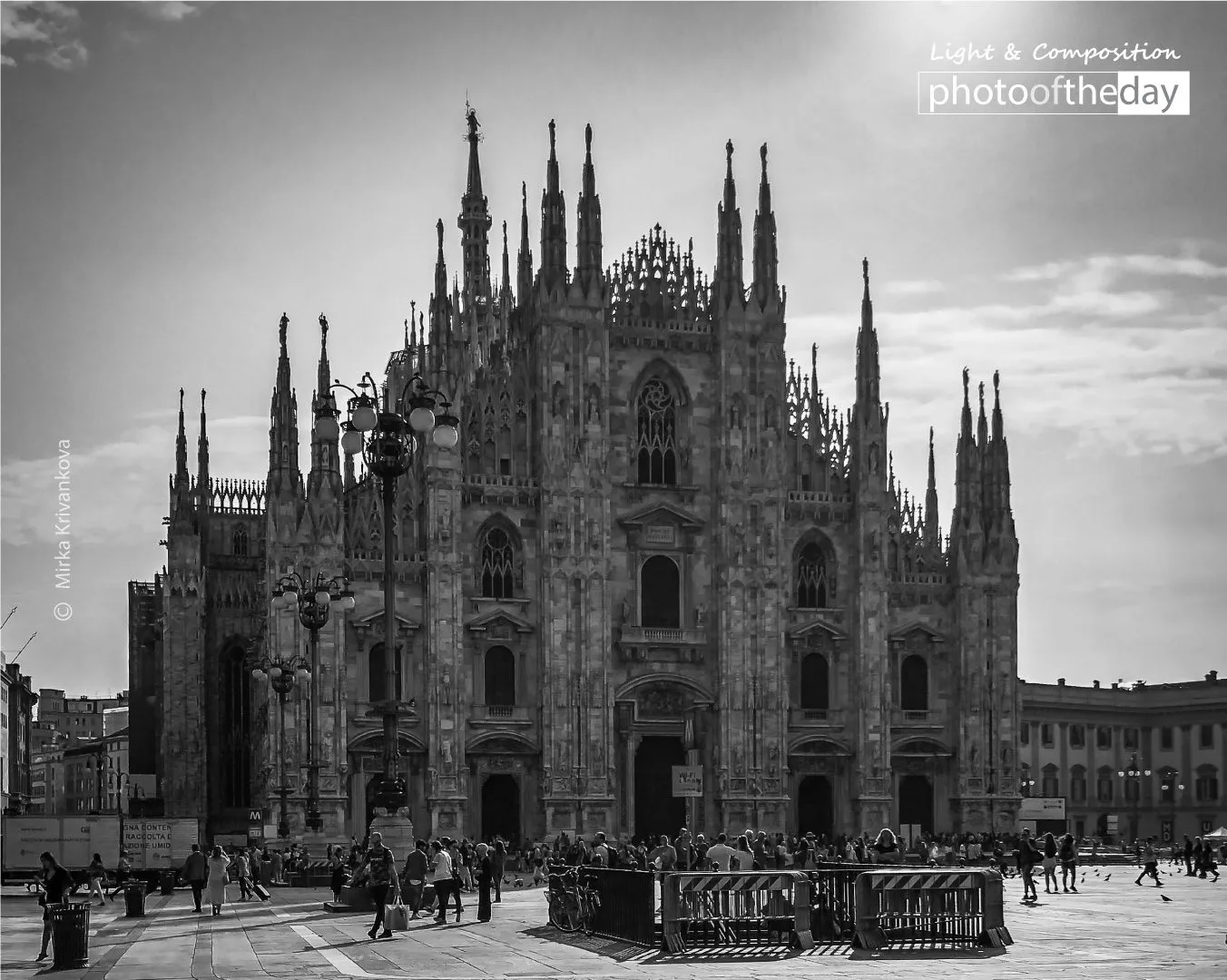
Piazza Duomo Milano by Mirka Krivankova
Captured at the iconic Piazza Duomo in Milan, this photograph highlights the architectural grandeur of the Cathedral of the Nativity of the Virgin Mary. The photographer utilized the capabilities of an iPhone X to frame the intricate details of the historic facade, focusing on the interplay of light and shadow against the stone structure. This image is award-worthy for its clean composition and the way it captures the monumental scale of one of Italy's most famous landmarks, transforming a classic tourist site into a compelling study of form and historical significance.
Mirka Krivankova
Hailing from Mestec Kralove in the Czech Republic, Mirka Krivankova is an emerging talent known for her versatile photographic range. Her work spans from the serene beauty of the Czech countryside to evocative portraits that masterfully utilize natural light and shadow to create formal interest. Constantly refining her portfolio, Krivankova demonstrates a dedicated commitment to her craft, with a growing body of work that reflects a keen eye for composition and a passion for documenting both the human experience and the architectural world.
Resonance Score Breakdown
Transparency Note: The resonance score (11.3/20) is calculated based on social engagement metrics collected before the award announcement.
Expert Photography Reviews · 8
The Weight of Stone
In the middle of the nineteenth century, a geologist might have spent a lifetime studying the slow, rhythmic accumulation of sediment, watching how time presses down on the earth until it becomes something unyielding.
Read the reflection →The Weight of Stone
There is a particular stillness in the air just before the light shifts from the high, sharp clarity of noon to the heavy, muted tones of late afternoon.
Read the reflection →Reviews & Comments
Share your thoughts about this award-winning photograph. Your reviews contribute to the community engagement score.
The Duomo’s stone is cold, but where are the people? I’ve spent my life looking for the pulse of a city in the faces of those who walk its streets. Here, the architecture is grand, sure, but it’s hollow. It’s a postcard, not a conversation. I don’t see a single soul who chose to be part of this story. It leaves me feeling lonely, honestly. A city isn’t just rock; it’s the people living inside it.
Before the eye identifies the Duomo’s spires, a sudden stillness settles in the chest. It’s the weight of stone against a pale sky that triggers this quiet. I’ve returned to this frame three times today, and each time, the shadows feel colder, more absolute. It doesn’t just document Milan; it demands a pause in my own pulse. I find myself holding my breath, waiting for the bells to ring in a city that’s already gone.
Milan’s Duomo has been documented since the daguerreotype’s infancy, yet Krivankova finds a sharp, digital geometry here that feels surprisingly fresh. It’s a stark departure from the romantic, soft-focus pictorialism of the early twentieth century. While the iPhone’s sensor lacks the depth of a large-format plate, the contrast here echoes the structural rigor of Moholy-Nagy. I’m genuinely struck by how she’s stripped away the tourist clutter, leaving only the cold, rhythmic pulse of Gothic stone.
The stone rises. It cuts the sky. I’ve spent minutes staring at the negative space above the spires. It’s quiet there. Krivankova doesn’t crowd the frame with the usual tourist noise. She lets the architecture breathe. The shadows aren’t just dark; they’re anchors. I feel a sudden, sharp ache for that stillness. Nothing here is accidental. The empty corner is not empty. It’s a pause. A breath. It’s exactly what Milan needs.
Most photographers treat the Duomo like a postcard, but Krivankova captures the stone’s weight. Of the hundreds of Milan submissions I’ve reviewed, this one avoids the usual clutter by pinning the architecture against a stark, high-contrast sky. It’s the iPhone’s aggressive sharpening that almost ruined it for me, yet the geometry holds. I find myself wanting to touch the cold marble. It’s a rare, quiet study that’ll still feel relevant when the tourists have long gone.
You’ve captured the Duomo’s scale, but I’m looking for the pulse of Milan. It’s technically sharp, sure, but where’s the life? I’ve stood in that piazza and felt the frantic, beautiful chaos of people moving through history. You’ve given me stone and shadow, but it feels a bit cold. And honestly, I wanted to see someone—anyone—lost in that grandeur. You’ve got the eye for form, but next time, find the human heartbeat in the frame.
The vertical axis here is a masterclass in recursive symmetry. Krivankova aligns the cathedral’s spires against a 1:2 ratio of negative space, creating a rigid, triangular tension that anchors the frame. I’m genuinely breathless at how the stone’s jagged geometry resolves into such perfect equilibrium. It’s not just architecture; it’s a solved equation of light and shadow. The way those repeating arches pull the eye toward the center of gravity is mathematically sublime. It’s pure, structural bliss.
Milan’s Duomo is a beast, but you’ve got to hunt for the heartbeat. Krivankova finds the geometry, sure, but where’s the life? I’m looking for the human friction that Winogrand lived for. It’s clean, it’s sharp, but it’s too quiet. One tenth of a second later, a pigeon takes flight or a tourist stumbles—that’s the chaos I crave. It’s a beautiful postcard, but it doesn’t bleed. I wanted to feel the city’s pulse, not just its stone.