Kambala, a Village Sports by Achintya Guchhait
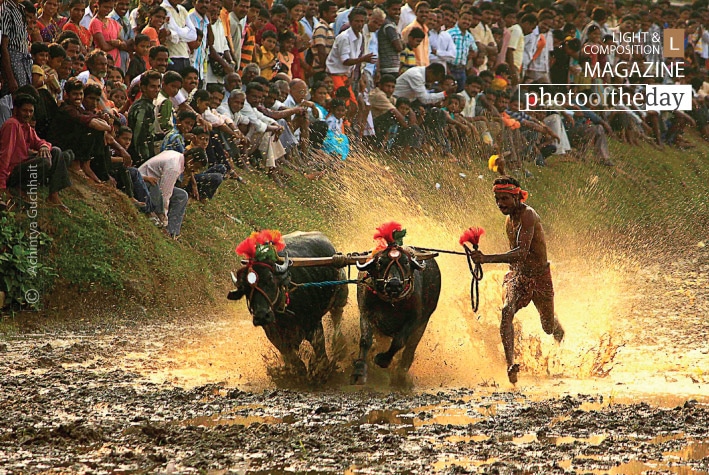
In the remote village of Vandar, India, the traditional sport of Kambala unfolds as a high-stakes display of strength and speed. The photographer captures the raw energy of farmers racing their buffaloes across a muddy track, where the true measure of victory is found in the thunderous cheers of the local crowd. By utilizing a telephoto lens to compress the action, the photographer isolates the intensity of the moment, freezing the motion against the chaotic backdrop. This image is award-worthy for its authentic portrayal of a cultural tradition, masterfully balancing the grit of the sport with the vibrant spirit of the community.
Achintya Guchhait
Based in Bangalore, India, Achintya Kumar Guchhait is a dedicated photographer who transitioned from childhood experimentation with film to a serious pursuit of digital storytelling. A tech professional by trade, he balances his career with a passion for documenting human life and the coexistence of nature and society. His work, which spans from cultural traditions to portraiture, reflects his identity as a perpetual student of the craft who draws inspiration from the diverse environments he encounters during his travels.
Resonance Score Breakdown
Transparency Note: The resonance score (12.2/20) is calculated based on social engagement metrics collected before the award announcement.
Expert Photography Reviews · 4
The Weight of the Earth
In the ancient texts of the soil, there is a rhythm that precedes the written word.
Read the reflection →The Weight of Earth
There is a rhythm to the soil that we often forget. It is not the rhythm of the clock, but of the pulse. When the ground is turned, when the mud rises to meet the air, something ancient is disturbed.
Read the reflection →Reviews & Comments
Share your thoughts about this award-winning photograph. Your reviews contribute to the community engagement score.
Mud is the primary actor here, swallowing the buffaloes’ legs until they’re mere ghosts of kinetic force. It’s a violent, churning darkness that refuses to yield to the shutter. I’ve stared at these sprays of silt until my own eyes ache, feeling the weight of the earth pulling the beasts back into the primordial. It doesn’t celebrate speed; it documents the struggle against gravity. When the light hits that spray, it’s not beauty—it’s a desperate, fleeting defiance.
Mud. Buffaloes. The blur of motion. It’s loud, yet I find myself looking for the stillness. The compression of the lens pulls the chaos tight. It’s almost too much. I’ve spent minutes staring at the dark, wet earth beneath the hooves. It’s the only place where the eye can rest. Nothing here is accidental. The empty corner isn’t empty. It’s a breath. I’d trade the roar of the crowd for just one more inch of silence.
The compression of the 208mm focal length forces the buffaloes into a singular, kinetic mass. It’s a brutal geometry. The mud spray creates a diagonal vector that anchors the frame, preventing the chaos from dissolving into mere noise. I’ve rarely seen such violent motion contained with this much discipline. The spatial tension between the lead animal’s snout and the frame’s edge is precise. It doesn’t just hold; it demands total visual submission. The architecture is absolute.
Of the thousands of sports entries I’ve reviewed, most rely on chaotic blur to hide a lack of focus. Guchhait doesn’t hide; he compresses the mud and muscle into a singular, claustrophobic wall of intensity. It’s the buffaloes’ strained eyes that haunt me—I can almost smell the wet earth and panic. That’s why this survives. It isn’t just a race; it’s a visceral, thirty-year document of a tradition that refuses to be forgotten.
Thanks Sabbir
nicely present with a great shot………………………….
Thanks Hirak.
Excellent shot.