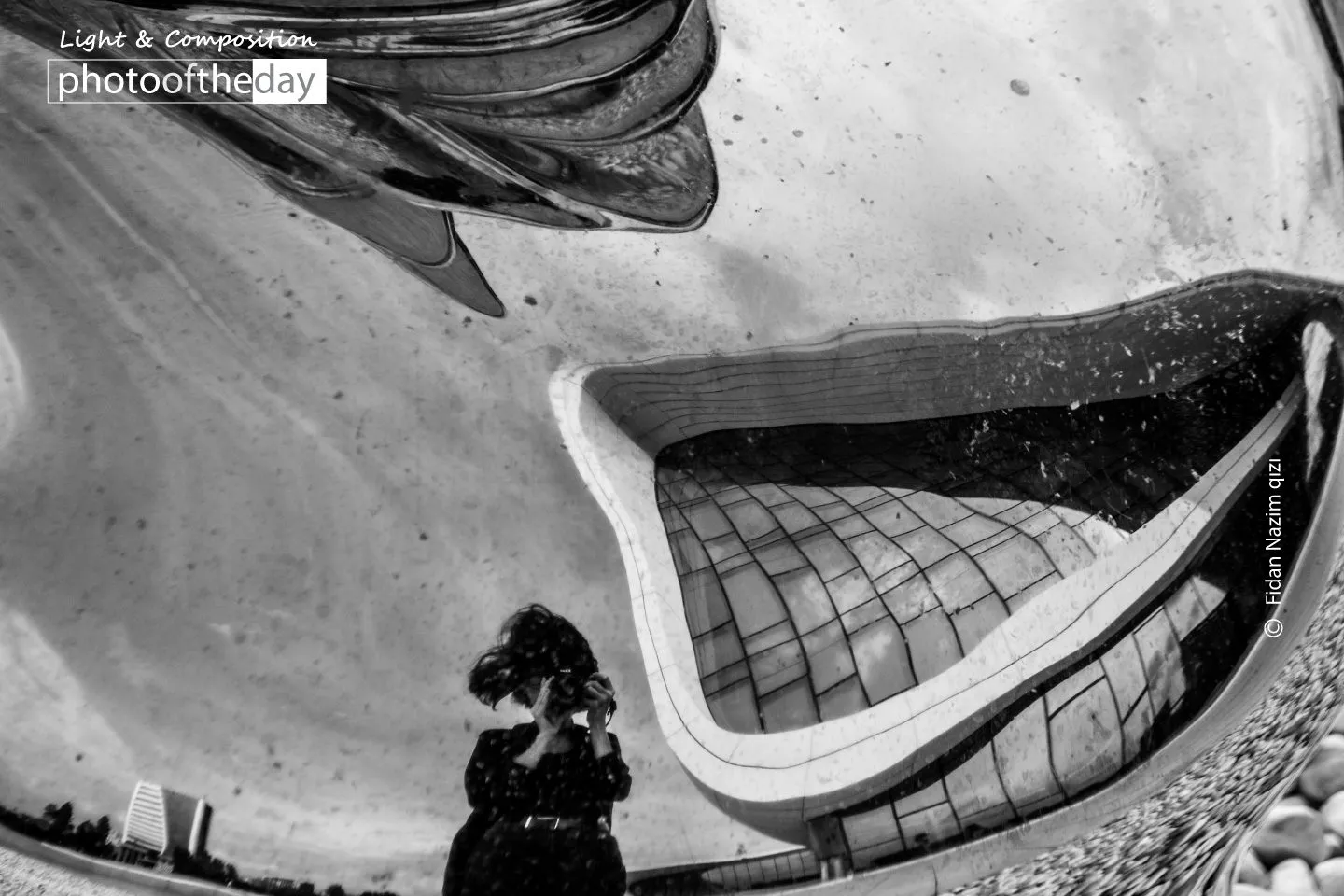
Illusion by Fidan Nazim Qizi
In 'Illusion,' Fidan Nazim Qizi explores the fascinating intersection of sensory perception and reality. By capturing a scene that challenges the viewer's interpretation of visual stimuli, the photographer invites an investigation into how the human brain organizes and processes the world. The image stands out for its conceptual depth and artistic execution, transforming a simple subject into a profound visual puzzle. This work is award-worthy for its ability to transcend mere documentation, instead offering a compelling, thought-provoking experience that resonates with the universal human tendency to seek meaning within the distortions of our senses.
Fidan Nazim Qizi
Born and based in Baku, Azerbaijan, Fidan Nazim Qizi is a dedicated photographer whose work is deeply influenced by the evocative black-and-white aesthetic of Vivian Maier. Her creative practice is driven by a profound belief in the power of photography to provide inspiration, energy, and emotional resonance. An avid hiker with a deep appreciation for nature and mountainous landscapes, she frequently travels abroad to capture the world through her lens. Her commitment to the monochromatic medium reflects a timeless approach to storytelling, focusing on the essential feelings and narratives found within her subjects.
Resonance Score Breakdown
Transparency Note: The resonance score (10.0/20) is calculated based on social engagement metrics collected before the award announcement.
Expert Photography Reviews · 8
The Soft Edge of Knowing
We often walk through the world with a firm grip on what we believe to be true. We trust our eyes to map the terrain, to define the solid from the shadow, and to name the things we encounter. But there is a quiet grace in letting that certainty dissolve.
Read the reflection →The Architecture of a Whisper
If the eye is a mirror, why does it so often reflect a world that does not exist? We move through our days with a quiet arrogance, believing that what we touch is solid and what we see is absolute.
Read the reflection →Reviews & Comments
Share your thoughts about this award-winning photograph. Your reviews contribute to the community engagement score.
Baku’s light pollution usually drowns the heavens, yet here, Fidan captures a phantom reality. It’s a strange, sensory friction. While I’m accustomed to the cold, precise math of a low focal ratio and the inevitable creep of thermal noise at high ISO, this work feels different. It’s a puzzle of perception. I find myself staring at these distortions, wondering if the light itself is playing tricks on us. It’s hauntingly beautiful, and honestly, it makes me shiver.
Most entries in this category rely on cheap digital tricks, but here, the distortion feels earned. It’s the way the light bleeds across the frame that caught me; I found myself squinting, trying to find the edge of the glass. It’s a rare, unsettling puzzle that won’t lose its sting in thirty years. While others chase trends, this work forces us to question our own eyes. It’s exactly the kind of friction I look for.
The focal plane here is razor-thin, pushing the limits of the sensor’s resolution. I’m captivated by how the diffraction of light across those distorted surfaces creates such a haunting, ethereal blur. It’s a masterclass in managing spherical aberration to manipulate our perception of depth. Honestly, it’s dizzying—I’ve spent hours trying to resolve the geometry, but the lens simply refuses to let my eyes settle. It’s a brilliant, optical subversion of reality that I find deeply moving.
Before the eye identifies the fractured geometry of Baku’s glass, something in the chest hitches. It’s a sensory dissonance that forces the brain to stall. I’ve spent weeks returning to this, and it still triggers a phantom vertigo, a sudden, sharp intake of breath. It doesn’t just show a reflection; it dismantles the viewer’s sense of orientation. When I look at it now, I feel that same quiet, unsettling hum of a world coming undone.
The frame pulls back. It doesn’t crowd the eye. I find myself holding my breath, waiting for the distortion to settle. It won’t. The void isn’t just space here; it’s a weight. I’ve spent minutes staring at the blur, feeling a strange, quiet ache in my chest. It’s honest. Nothing here is accidental. The empty corner is not empty. It’s a pause that demands everything from you. It’s beautiful, really. I’m finally still.
The geometry here doesn’t collapse. It’s a rigid architecture of light and shadow that forces the eye into a singular, claustrophobic path. The negative space functions as a fulcrum, balancing the distortion with clinical precision. It’s rare to find such structural integrity in a conceptual piece. I’ve spent ten minutes tracing these lines, and honestly, the way the frame refuses to resolve into a comfortable reality is the only thing that keeps me looking.
The vertical axis here is perfectly bisected by a sharp, diagonal shear, creating a tense 1:1 ratio between solid form and reflected void. It’s a rigorous spatial equation where the negative quadrant anchors the composition, forcing the eye to reconcile conflicting planes. I’m genuinely thrilled by how the geometry destabilizes the horizon line; it’s a brilliant, calculated disruption of depth. When the math resolves this cleanly, the resulting visual tension feels almost like a physical weight.
The frame hits you like a jump cut in a dream. It’s disorienting, a flicker of light that refuses to settle. I love how the distortion pulls the eye, forcing a rhythm that doesn’t exist in reality. It’s a sequence frozen mid-blink. The shutter speed here is perfect; it’s the exact moment the editor decides to hold the shot rather than cut away. It’s haunting, really. I’ve been staring at it for ten minutes.