Groyne by Jens Hieke
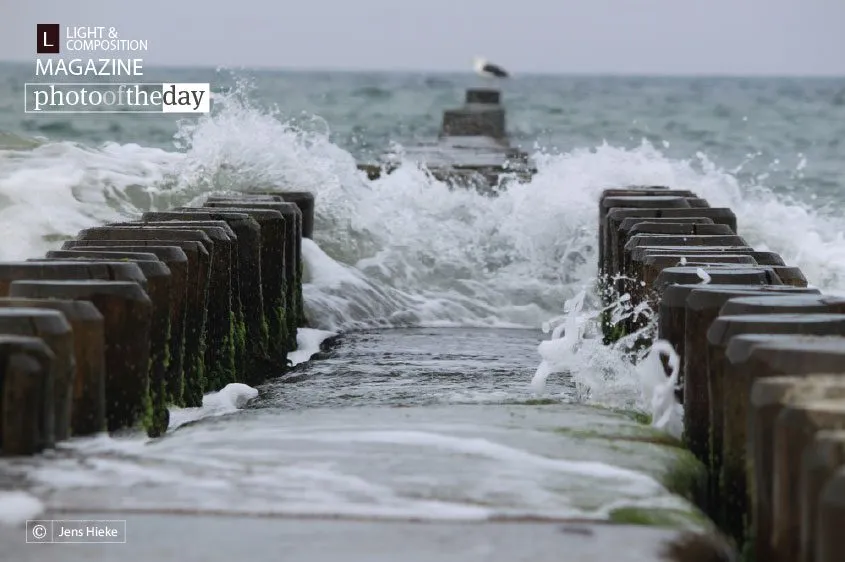
Captured during an autumn day in 2011, this image documents the raw interaction between the Baltic Sea and the coastal defenses of Mecklenburg-Western Pomerania. The photographer focused on the dramatic moment when incoming waves strike the groynes, dissipating their kinetic energy into a fine, ethereal spray. By isolating the structural geometry of the groyne against the turbulent water, the image transforms a functional coastal barrier into a study of motion and natural power. The composition is award-worthy for its ability to freeze the chaotic energy of the sea while maintaining a serene, balanced perspective on the landscape.
Jens Hieke
Born in 1967, Jens Hieke is a German photographer based in Leipzig, Saxony. A former librarian and media professional, he transitioned into photography as a means to document the transient beauty of the natural world, viewing the medium as a visual extension of his lifelong passion for literature. His work is characterized by a keen observational eye, capturing the shifting dynamics of landscapes and living subjects with a thoughtful, narrative-driven approach.
Resonance Score Breakdown
Transparency Note: The resonance score (13.5/20) is calculated based on social engagement metrics collected before the award announcement.
Expert Photography Reviews · 7
The Resistance of Wood
The sea does not negotiate. It arrives with a weight that ignores the shore, carving lines into the earth that were never meant to stay. We build barriers of timber and stone, believing we can dictate the terms of the tide.
Read the reflection →Salt on the Skin
The air before a storm tastes of iron and wet stone. I remember standing on a shoreline where the wind felt like a rough wool blanket dragged across my shoulders, heavy and damp.
Read the reflection →Reviews & Comments
Share your thoughts about this award-winning photograph. Your reviews contribute to the community engagement score.
The Baltic pulls back. It leaves the groyne exposed, a splintered spine against the grey. I’ve spent minutes watching the spray dissolve. It’s not just water hitting wood. It’s the friction of time. The frame breathes. I feel a sudden, sharp ache for the stillness I’ve lost in the city. Nothing here is accidental. The empty corner is not empty. It holds the weight of the tide. It’s quiet. Finally, I can hear myself think.
1/250sec at f/7.1, 135mm. ISO 100. It’s a safe, clinical choice. The shutter speed is just fast enough to arrest the spray, but it lacks the bite I’d prefer for true kinetic energy. At f/7.1, the diffraction on a 500D sensor is negligible, yet the depth of field feels slightly indecisive. I’ve seen this exact coastal geometry a thousand times. It’s technically competent, but it doesn’t challenge the sensor. It’s just… fine.
At f/7.1, the 135mm focal length resolves the Baltic spray with clinical precision. You’re seeing the diffraction of light across water droplets, captured just before they lose coherence. It’s a rare moment where the lens’s resolution perfectly matches the turbulence of the sea. I’m genuinely moved by how the glass isolates those chaotic, crystalline structures against the timber. It’s not just a barrier; it’s a masterclass in freezing kinetic energy that our eyes simply can’t track.
We look at these wooden pilings and we don’t see mere barriers; we see a conversation between the land and the tide. Jens Hieke has listened to the Baltic’s rhythm, capturing the spray as if it were a breath held in anticipation. It’s a portrait of resilience, really. I find myself shivering, feeling the cold salt air against my own skin. It’s a photograph that asks to be returned to, time and again.
The Baltic in autumn is a miserable, biting place to stand for hours. One suspects Hieke didn’t just stumble upon this spray; he likely endured a dozen grey, flat afternoons before the light finally caught the water just so. It’s a clean, disciplined study of kinetic energy. I’ve spent enough time shivering on similar shores to recognize the patience required here. He didn’t just take a picture; he waited until the sea decided to cooperate.
The shutter speed is perfect. It’s a violent, beautiful collision. The water doesn’t just hit the wood; it shatters into a fine, ghostly mist that hangs in the air like a held breath. I’ve watched this frame for ten minutes, waiting for the motion to resume, but it stays locked in that kinetic struggle. It’s the shot the editor keeps because the cut would have been a mistake. I can almost hear the Baltic roar.
Most coastal shots are forgettable clutter, but Hieke’s groyne holds its own. By pinning the wooden structure against the Baltic’s violent spray, he forces a confrontation between human permanence and liquid chaos. It’s the shutter speed that does the heavy lifting here; that 1/250sec choice keeps the water’s texture visceral rather than ghostly. Honestly, it makes me feel the bite of the autumn wind. In thirty years, this clarity will still matter more than any trendy filter.