Fishing in the Forest by Rahat Azim Chowdhury
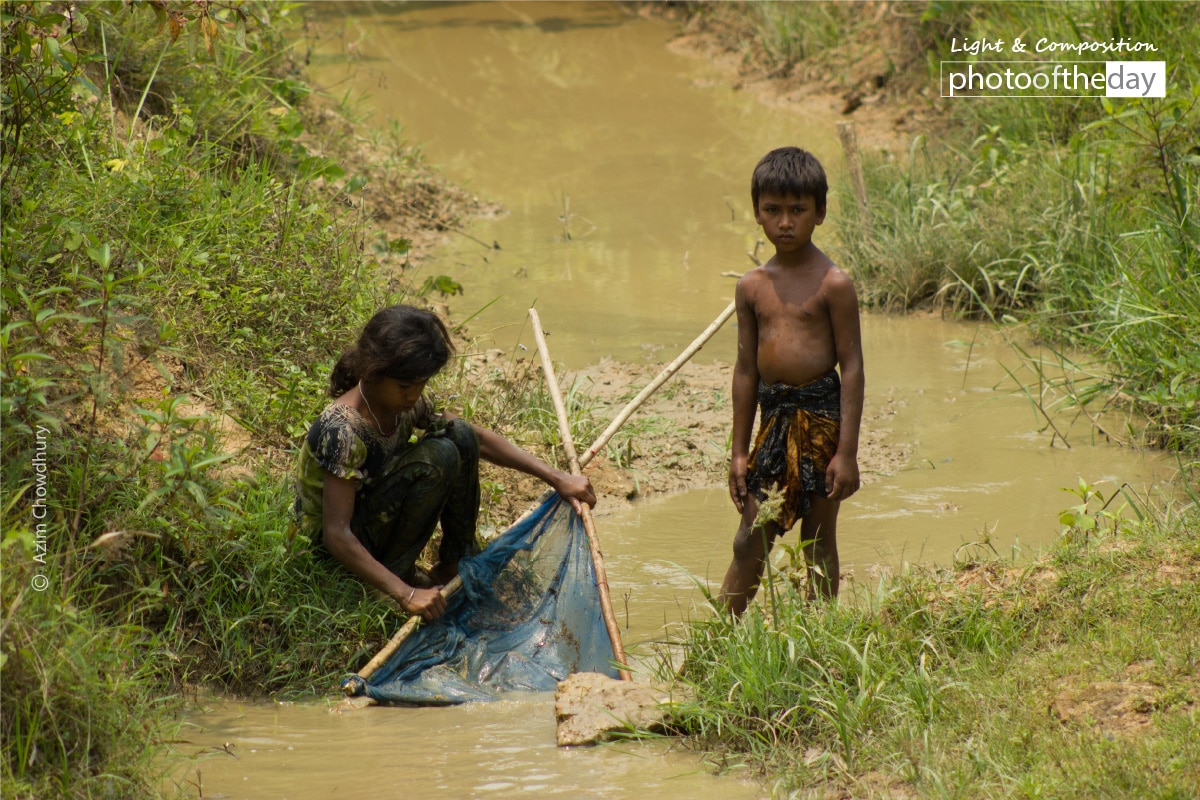
In the remote, lush expanse of the Rema-Kalenga wildlife sanctuary, the photographer captures a poignant glimpse into a way of life far removed from urban existence. The image documents local children who, balancing education with the demands of survival, engage in traditional fishing within the dense forest. By utilizing a 210mm focal length, the photographer maintains a respectful distance, allowing the natural action to unfold candidly. This work is award-worthy for its authentic portrayal of human resilience and the harmonious, albeit difficult, relationship between these children and their wild environment, elevated by a sharp, well-composed technical execution.
Rahat Azim Chowdhury
Born in 1984 and based in Dhaka, Bangladesh, Rahat Azim Chowdhury is a computer engineer who transitioned into a dedicated documentary photographer. Inspired by his peers and a rigorous self-taught approach supplemented by professional coursework, he specializes in capturing the nuances of human lifestyle, nature, and social patterns. Driven by a desire to explore the cultural and architectural landscapes of the developing world, he seeks to create a unique visual signature that prioritizes artistic integrity and storytelling over commercial gain.
Resonance Score Breakdown
Transparency Note: The resonance score (12.0/20) is calculated based on social engagement metrics collected before the award announcement.
Expert Photography Reviews · 5
The Quiet Currency of Survival
There is a specific kind of silence that belongs only to the woods.
Read the reflection →The Weight of the Water
There is a specific silence that belongs to the woods, a quiet that is not an absence of sound, but a presence of something held back.
Read the reflection →Reviews & Comments
Share your thoughts about this award-winning photograph. Your reviews contribute to the community engagement score.

The frame opens in the humid, filtered light of Rema-Kalenga. It’s a long lens study, compressed and quiet. The children move with a rhythm that feels ancient, their focus absolute. I’ve spent hours in editing suites, but I’d never cut this. The 210mm focal length holds the distance perfectly, keeping the forest’s weight intact. It’s a scene that doesn’t need a sequel. Honestly, it makes me miss the silence of the woods. A beautiful, still sequence.
The frame’s geometry is compromised by the chaotic foliage. While the subjects occupy the lower third, the verticality of the trees doesn’t anchor them; it swallows them. The 210mm compression flattens the spatial tension, turning the forest into a muddy, indistinct backdrop. It’s frustrating. I’ve seen better balance in far less demanding environments. The composition lacks a clear fulcrum, leaving the eye to wander without purpose. It doesn’t hold. The structure simply collapses under its own weight.
The vertical axis here is anchored by the boy’s posture, creating a perfect counterweight to the dense, chaotic foliage. I’m struck by the 1:3 ratio between the subject’s dark silhouette and the negative space of the water. It’s a rigorous spatial equation where the diagonal of the fishing rod bisects the frame, forcing the eye toward the center of gravity. It’s mathematically elegant, and honestly, the precision of that intersection makes my pulse race.
You waited for them to settle into that green silence, and it shows. There’s something honest happening here. I’ve spent enough time in the brush to know that stillness isn’t easy, but you caught it. Watching these kids fish in the Rema-Kalenga, I feel the humidity and the weight of their day. You didn’t intrude; you just watched them exist. And that’s the hardest part of this job. You’ve got a real eye for the quiet struggle.
In the deep green of Rema-Kalenga, we find these children wading through the quiet. They aren’t just fishing; they’re negotiating with the forest for their next meal. I’m struck by the stillness in their posture, a patience born of necessity. Rahat didn’t intrude; he listened to the rhythm of their work before he clicked. It’s a haunting, beautiful reminder that survival is a language all its own. This is a photograph that asks to be returned to.
This photography reminds me my trip around Siem Reap area in Cambodia, where I had seen the same seen when local family of 4 was fishing in the muddy river bend trying to catch fish by building a dam from mud to stop them in the stream of water. This opened my eyes for the discrepancy in between poor and rich in our world. I really respect different cultures and their struggling with life in contradiction to our comfort and prosperity in Western Europe.