The Quiet Currency of Survival
There is a specific kind of silence that belongs only to the woods. It is not an absence of sound, but a density of it—the rustle of unseen movement, the drip of moisture from a canopy that has never known the weight of a city skyline, and the rhythmic, patient pulse of water against earth. We often speak of childhood as a time of protected innocence, a season meant for play, yet history reminds us that for most of humanity, the early years were defined by a necessary, quiet labor. To be small in a vast landscape is to learn the language of the terrain before you learn the language of books. It is a strange, ancient trade: the exchange of one’s time and energy for the simple, immediate sustenance of the day. We look at such scenes and wonder if we have lost the ability to be truly present in our own survival, or if we have merely traded the forest floor for a different, more frantic kind of wilderness. What does it mean to be at home in a place that asks so much of your hands?
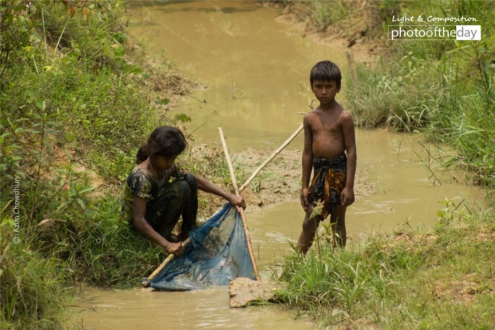
Rahat Azim Chowdhury has captured this delicate balance in his work titled Fishing in the Forest. It is a reminder of how deeply tethered we remain to the earth, even when we think we have moved beyond it. Does this stillness feel like a burden to you, or like a form of grace?