Fighting for Greece by Konstantinos Liakos
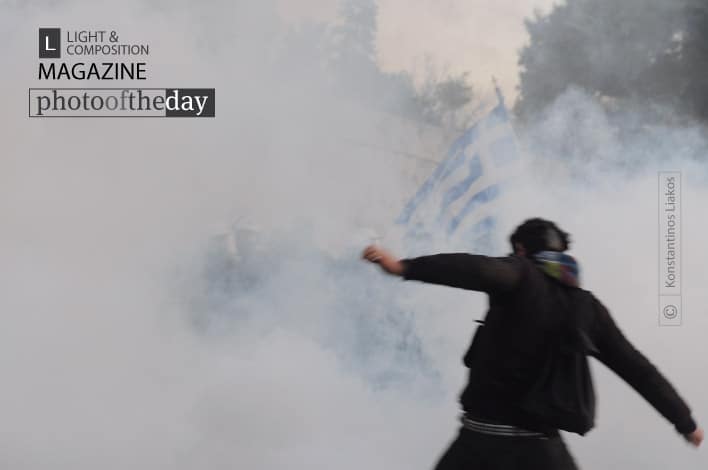
Captured during the fourth day of intense civil unrest in Athens, this powerful documentary image depicts the raw confrontation between protesters and riot police in front of the Greek parliament. As tear gas fills the air, the photographer captures a striking moment of defiance: one individual stands resolute with the Greek flag, while another attempts to kick a canister back toward the authorities. The image is award-worthy for its visceral portrayal of courage amidst chaos, freezing a volatile historical moment with technical precision and a profound sense of human resilience in the face of adversity.
Konstantinos Liakos
Based in Athens, Konstantinos Liakos is a self-taught photographer who holds a degree in applied mathematics from the National Kapodistrian University of Athens. Driven by a lifelong passion for visual storytelling that began in childhood, he transitioned to digital photography in 2009. Despite facing personal and professional challenges, he has dedicated himself to documenting the human experience, refining his craft through independent study and practical experience to capture the poignant narratives unfolding within his home country.
Resonance Score Breakdown
Transparency Note: The resonance score (13.1/20) is calculated based on social engagement metrics collected before the award announcement.
Expert Photography Reviews · 6
Standing in the Smoke
I dropped my keys in the hallway this morning, and for a second, I just stared at them lying on the floor. It was such a small, clumsy thing, but it felt like the final straw in a week that has been heavy with noise.
Read the reflection →The Weight of the Banner
In the quiet corners of history, we often find that the most profound shifts do not begin with a roar, but with the simple, stubborn act of standing still.
Read the reflection →Reviews & Comments
Share your thoughts about this award-winning photograph. Your reviews contribute to the community engagement score.
Tear gas clouds the frame. It’s a thick, white wall. The chaos is loud, yet I’m drawn to the stillness of the flag bearer. He holds his ground. The canister arcs through the air. It’s a violent geometry. I feel a sudden, sharp ache in my chest watching him. Nothing here is accidental. The empty corner isn’t empty. It’s the weight of the silence before the next strike. Restraint in the middle of a riot.
Tear gas isn’t exactly conducive to steady framing, yet Liakos held his ground while others likely retreated. It’s a messy, frantic business, and one can practically taste the acrid smoke. I’ve spent enough time in volatile crowds to know that getting this close to a flying canister isn’t luck; it’s a deliberate, dangerous choice. He didn’t just find this moment; he survived it. It’s a rare, gritty bit of work that actually feels earned.
The air here isn’t just smoke; it’s a heavy, suffocating veil. I’ve spent my life watching light settle over quiet hills, but this scene demands a different kind of listening. The harsh, artificial glare catching that flying canister feels like a jagged wound in the frame. It’s terrifying, really. He stood in the heat of that chaos, waiting for the flag to snap against the grey. It’s a brutal, necessary stillness amidst the fire.
The frame’s architecture is fractured by the diagonal thrust of the protester’s leg. It’s a violent geometry. The flag provides a necessary vertical anchor, preventing the composition from collapsing into the haze of tear gas. I’m genuinely unsettled by how the negative space around the canister dictates the viewer’s trajectory. It doesn’t offer comfort. The spatial tension is absolute, forcing the eye to reconcile the chaos of the foreground with the rigid, indifferent stone of the parliament.
Most protest photography is noise, but this frame cuts through. Of the thousands of riot shots I’ve reviewed, this one endures because of the tension between the flag-bearer’s stillness and that desperate, mid-air kick. It’s the contrast that kills me; the flag represents a nation, while the canister represents its collapse. I’ve seen enough chaos to know that most photographers lose the plot, but here, the geometry of the struggle is perfectly, painfully clear.
The tear gas creates a suffocating, bruised ochre haze, reminiscent of Turner’s most turbulent skies, yet it’s the flag’s defiant, saturated cerulean that truly anchors the soul. It’s a violent, chromatic collision where the cold, metallic grey of the riot gear quarrels with the warmth of human desperation. I’ve felt my own pulse quicken at that blue; it’s the colour of a fragile, fading hope, refusing to be swallowed by the suffocating, sickly yellow of the smoke.