The Weight of the Banner
In the quiet corners of history, we often find that the most profound shifts do not begin with a roar, but with the simple, stubborn act of standing still. There is a physics to defiance that we rarely discuss; it is not merely the force exerted against an obstacle, but the internal gravity required to remain upright when the air itself has turned against you. We are taught that surrender is the path of least resistance, a fluid motion that saves the vessel from breaking. Yet, there are moments when the vessel chooses to harden, to become a fixed point in a swirling, chaotic tide. It is a strange, heavy dignity, this refusal to be moved. It asks us to consider what we would hold onto if the ground beneath us began to shudder, and whether the symbols we carry—those scraps of cloth or fragments of belief—become lighter or heavier when the world demands we drop them. Is it the flag that gives the hand its strength, or does the hand lend the flag its meaning?
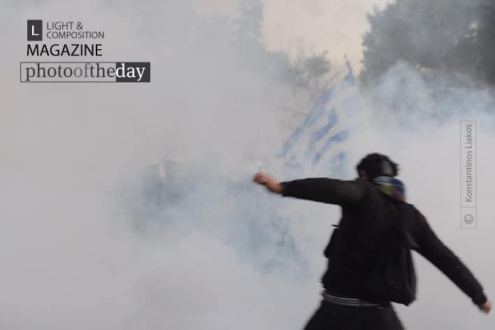
Konstantinos Liakos has captured this tension in his powerful image titled Fighting for Greece. It is a stark reminder of how we anchor ourselves when the atmosphere grows thick with uncertainty. Does the sight of such resolve make you feel more fragile, or does it stir something steady within your own chest?