Evening Aarti by Achintya Guchhait
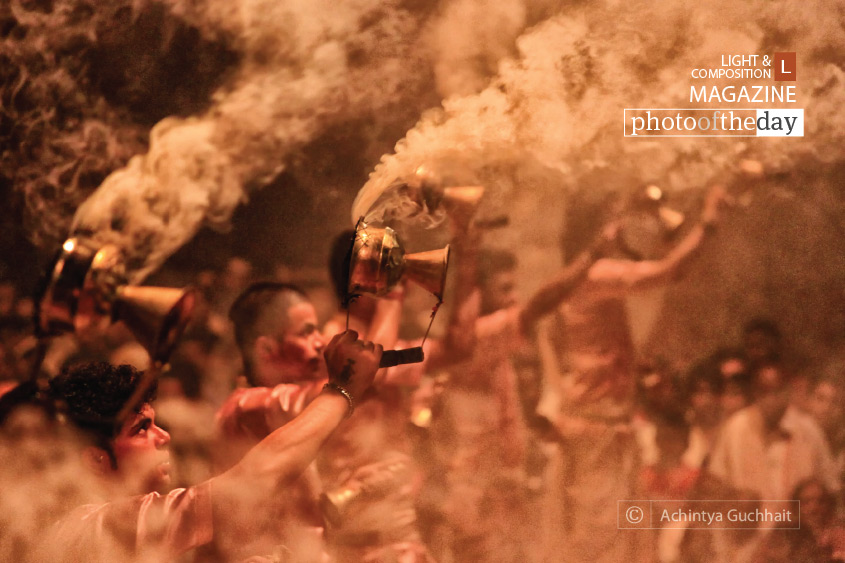
The evening aarti at the banks of the Ganges in Varanasi is a profound spiritual ritual, captured here with evocative precision. The photographer utilized a telephoto lens to isolate the priests amidst the flickering light and sacred atmosphere, effectively compressing the scene to emphasize the intensity of the ceremony. By choosing a high ISO to manage the challenging low-light conditions, the image retains a raw, documentary authenticity. This photograph is award-worthy for its ability to transport the viewer into the heart of the ritual, balancing the chaotic energy of the Ganges with the solemn, rhythmic devotion of the practitioners.
Achintya Guchhait
Based in Bangalore, India, Achintya Kumar Guchhait is a dedicated photographer who balances a professional career in technology with a deep-seated passion for visual storytelling. His work is defined by a documentary approach, focusing on the coexistence of human life and the natural world in everyday environments. A lifelong student of the craft, Guchhait has evolved from his early days with film cameras to becoming a Getty contributor, constantly refining his technical skills while traveling to capture the authentic essence of the human experience.
Resonance Score Breakdown
Transparency Note: The resonance score (12.8/20) is calculated based on social engagement metrics collected before the award announcement.
Expert Photography Reviews · 7
The Weight of Fire
The river does not care for our prayers. It flows, indifferent to the heat we cast against the dark. We gather at the edge, holding small flames, hoping the light will carve a path through the uncertainty of the night.
Read the reflection →The Weight of the Flame
In the ancient world, fire was not merely a tool for warmth or the cooking of grain; it was a conversation. To light a flame was to invite a witness into the room, a flickering presence that demanded a certain posture of the soul.
Read the reflection →Reviews & Comments
Share your thoughts about this award-winning photograph. Your reviews contribute to the community engagement score.
Varanasi breathes through these priests. We look at their faces, caught in the flickering glow, and we understand they’ve been listening to the river long before the shutter clicked. The compression of the lens pulls their devotion tight, turning the chaotic Ganges into a private, sacred space. It’s a heavy, rhythmic silence that hits me right in the chest. I find myself wanting to sit beside them, just to hear what the fire is whispering.
Varanasi’s humidity is a beast, and I’ve spent enough nights in that heat to know the priests don’t perform for tourists. Guchhait didn’t just snap a frame; he’s clearly endured the press of the crowd and the stinging smoke to find this alignment. The 250mm compression is a clever choice, pulling the ritual’s intensity into focus. It’s a gritty, honest piece of work. One suspects he didn’t get this on his first trip. I’m impressed.
Before the eye identifies the priests, the chest tightens. It’s the heat of the flickering lamps, I think, that triggers this sudden, shallow breath. The compression of the frame forces a claustrophobic intimacy, pulling the Ganges’ chaotic energy into my own pulse. When I return to this a year later, the grain feels like static against my skin. It’s a haunting, rhythmic ache that doesn’t leave me, even when I finally close my eyes.
At 250mm, the compression flattens the depth of field, forcing the flickering flames into a tight, luminous plane. Shooting at ISO 3200 on a 500D introduces significant sensor noise, yet it mimics the grain of the ritual’s own smoke. I’m genuinely moved by how the diffraction of light across the priests’ robes creates such tactile texture. It’s a raw, optical struggle against the darkness, and honestly, it’s a beautiful, gritty triumph of glass over shadow.
The heat of the lamps hits you first. It’s a tight, claustrophobic frame, compressed by that 250mm lens until the smoke and fire become a single, rhythmic pulse. Guchhait didn’t just shoot a ritual; he held the shutter until the chaos settled into a perfect, devotional loop. I’ve watched this frame for ten minutes, and I still feel the urge to wait for the next movement. It’s the cut that never came, and honestly, it’s perfect.
Varanasi isn’t just a place; it’s a confrontation with the void. Guchhait’s frame doesn’t merely capture fire; it forces us to acknowledge the encroaching blackness that defines the ritual. I’m unsettled by how the grain swallows the priests’ faces, turning devotion into a silhouette of survival. It’s not about the light they hold, but the darkness they’ve failed to banish. When I look at this, I don’t see a ceremony. I see the struggle against oblivion.
Varanasi is usually a riot of noise. Here, the lens pulls back. It finds the stillness between the flames. The compression flattens the chaos into a singular, rhythmic breath. I’ve spent minutes watching the dark edges of the frame. They don’t just hold the light; they define it. Nothing here is accidental. The empty corner is not empty. It’s a relief. It’s the silence I’ve been searching for in the middle of the river.