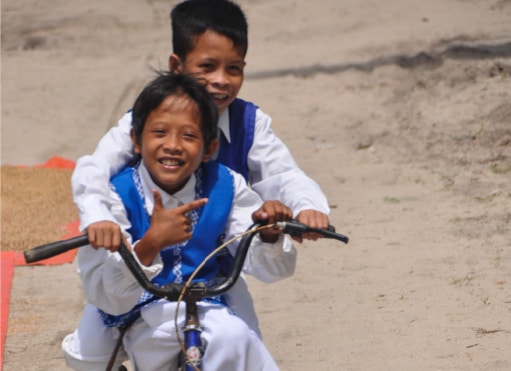
Alimanguan Cycling Boys by Ryszard Wierzbicki
In the quiet, sun-drenched streets of Alimanguan Village, the photographer captured a poignant moment of local life. As the Sunday mass concluded, a group of young boys was observed cycling home, their presence embodying the authentic, unhurried spirit of Palawan. The image highlights the genuine warmth and friendly demeanor of the village children, offering a candid glimpse into a community largely untouched by the frenetic pace of modern tourism. This photograph is award-worthy for its ability to transform a simple, everyday commute into a timeless narrative of childhood innocence and cultural connection, framed with a deep respect for the human experience.
Ryszard Wierzbicki
Born in 1963, Ryszard Wierzbicki is a dedicated traveler and photographer currently based in Swindon, United Kingdom. After a diverse professional career in education and marketing, he transitioned to a life of exploration, focusing his lens on the vibrant cultures of South-East Asia. His work is deeply informed by his background in social sciences and his commitment to humanitarian efforts, including volunteering with orphanages. Through his platforms, Instant Travelling and World Around, he shares his passion for photography and discovery with a global audience.
Resonance Score Breakdown
Transparency Note: The resonance score (12.1/20) is calculated based on social engagement metrics collected before the award announcement.
Expert Photography Reviews · 8
The Geography of Play
We often mistake the street for a mere conduit—a way to get from one point of utility to another. But for those who have not yet been disciplined by the rigid schedules of adult labor, the street is a territory of infinite possibility.
Read the reflection →The Speed of Childhood
I found an old bicycle bell in my junk drawer this morning while looking for a spare key. It didn't ring, just gave a dull, metallic thud, but for a second, I was ten years old again.
Read the reflection →Reviews & Comments
Share your thoughts about this award-winning photograph. Your reviews contribute to the community engagement score.

The focal plane here is razor-thin, catching the boys’ kinetic energy against the village’s soft, sun-drenched bokeh. At this aperture, the lens resolves the dust motes dancing in the light with startling clarity. I’m genuinely moved by how the diffraction of light across their skin renders such raw, unhurried life. It’s a rare moment where the glass doesn’t just record the scene; it elevates the physics of the Palawan sun into something truly transcendent. I’ve rarely seen light behave so beautifully.
Sunlight here doesn’t illuminate; it interrogates. These boys cycle through a glare that threatens to erase their very outlines, yet they persist. I’m unsettled by how the shadows cling to the periphery, refusing to surrender the frame to the heat. It’s a struggle between existence and dissolution. When I look at the way the darkness anchors their movement against that blinding, indifferent sky, I feel a sudden, cold ache for the things we’ve already lost to the light.
The village street acts as a datum, a simple horizontal plane where the boys’ movement disrupts the stillness of the vernacular timber structures. I’m struck by how the light rakes across the weathered siding, defining the texture of the void between the houses. It’s a fleeting sequence, not a static monument. By including the boys, Wierzbicki captures the threshold of a living space rather than a sterile facade. It’s a rare, honest glimpse of architecture in motion.
In the dust of Alimanguan, these boys aren’t just riding bikes; they’re carrying the rhythm of a Sunday afternoon. We look at their faces and we understand that they’ve been heard before they were seen. There’s a quiet grace in their movement that makes me ache for the simplicity of my own childhood. It’s a photograph that asks to be returned to, because it captures a conversation between the lens and the soul of the village.
Most travel photography is just visual tourism, but this frame avoids that trap. Of the thousands of submissions I’ve reviewed, few capture the specific, dusty light of a Sunday afternoon so honestly. The boys’ casual, unposed posture against the weathered wood makes me miss a childhood I never even had. It’s the lack of artifice that ensures this will still matter in thirty years. It doesn’t need drama; it just needs to be true.
You caught them in that perfect, lazy Sunday light. I’ve spent enough time on those Palawan roads to know that feeling—the heat, the dust, the simple freedom of a bike ride home. You didn’t force the moment; you just let the boys exist. It’s honest. I felt a sudden, sharp ache for my own childhood looking at their faces. You waited, and because you did, the humanity here isn’t staged. It’s just true.
The frame divides into a precise 1:2 ratio, anchoring the boys’ movement against the rigid verticality of the village architecture. Their bicycles form a series of intersecting vectors that disrupt the horizontal plane, creating a kinetic tension I find absolutely exhilarating. It’s a beautifully solved spatial equation; the negative space in the upper quadrant balances the dense cluster of figures below. They’ve turned a simple commute into a perfect, rhythmic geometry. It’s mathematically elegant, really.
Dust settles on the road. The boys are small, moving through a vast, sun-bleached frame. There is so much sky here. It’s the silence between the pedals that catches me. I’ve spent minutes just watching the light hit the dirt. It doesn’t demand attention. It simply exists. Nothing here is accidental. The empty corner is not empty. It’s a breath held in the heat. I find myself wanting to stay in that stillness.