A Cute Little Girl by Karan Zadoo
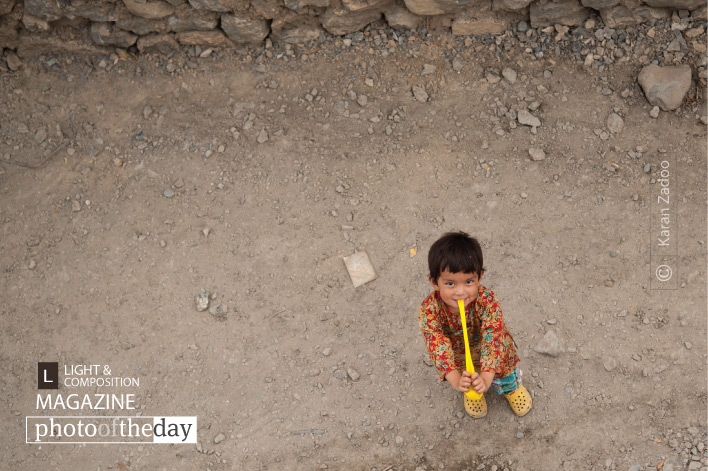
In the remote, high-altitude landscape of Kaza, Spiti Valley, the photographer encountered a young girl playing with a balloon. Captured against the stark, rugged backdrop of the Western Himalayas, the image highlights a fleeting, innocent moment of childhood joy in a challenging environment. The technical execution, utilizing a 60mm prime lens at f/3.5, creates a shallow depth of field that isolates the subject from the vast, arid surroundings. This photograph is award-worthy for its ability to bridge the gap between the harsh, dramatic terrain of Himachal Pradesh and the soft, universal charm of a child’s simple pleasure.
Exposure 1/640sec @ f/3.5 | ISO 200 | Focal Length 60mm
Karan Zadoo
Born in Srinagar and raised in New Delhi, Karan Zadoo transitioned from a career in advertising to professional photography after discovering a profound connection to the Himalayan landscape. His work is defined by a deep curiosity for the diverse cultures and people of India, ranging from the bustling streets of Delhi to the quiet villages of the mountains. Driven by a philosophy of constant evolution and learning, Zadoo utilizes his Nikon equipment to document the authentic lives of his subjects, striving to capture the essence of the human experience through his lens.
Resonance Score Breakdown
Transparency Note: The resonance score (12.9/20) is calculated based on social engagement metrics collected before the award announcement.
Expert Photography Reviews · 8
The Weight of a Breath
There is a particular stillness found in the high places of the world, where the air is thin and the earth feels closer to the sky. In such vast, quiet spaces, the small movements of life take on a profound weight.
Read the reflection →The Weight of a Breath
In the high places, where the air thins and the earth turns to stone, time behaves differently. It does not rush. It waits.
Read the reflection →Reviews & Comments
Share your thoughts about this award-winning photograph. Your reviews contribute to the community engagement score.
The high-altitude air in Kaza is thin, yet it carries the weight of silence. He stood there, waiting for the light to soften against those jagged peaks. When the girl finally turned, the balloon became a fragile anchor in that vast, arid emptiness. I’ve felt that same stillness in the mountains, where time simply stops. It’s a quiet, holy intersection of human joy and the ancient, unyielding earth. I find myself holding my breath.
The balloon’s saturated, synthetic crimson—a shade reminiscent of a Turner sunset bleeding into the arid, dust-choked ochre of the Spiti Valley—creates a dissonance that I find utterly ravishing. It’s a violent, joyous interruption against the muted, Morandi-esque greys of the Himalayan stone. One can’t help but feel a sudden, sharp ache in the chest, watching that fragile, plastic sphere defy the crushing, monochromatic indifference of such a desolate, high-altitude horizon. It’s simply sublime.
The shallow depth of field isolates the subject, yet the background’s arid texture threatens to overwhelm the frame. It’s a precarious balance. The balloon acts as a necessary fulcrum, anchoring the girl’s gaze against the vast, indifferent Himalayan expanse. I’m honestly exhausted by the sentimentality of the subject, but the geometry holds. The 60mm lens compresses the space just enough to prevent the composition from collapsing into mere travelogue. It’s a rigid, disciplined success.
1/640sec at f/3.5 on a 60mm prime. It’s a calculated isolation. At f/3.5, the depth of field is thin enough to detach the subject from the Spiti Valley’s harsh textures without losing the context of the terrain. I’ve seen too many portraits blurred into oblivion, but this choice is precise. It’s technically sound. Honestly, the way the light hits that balloon makes me miss the mountains. The exposure is exactly where it needs to be.
The mountain air in Kaza is thin. It’s cold. Yet, the girl holds a red balloon. The vast, arid backdrop doesn’t swallow her. It frames her. I’ve spent minutes staring at the blur of the rocks behind her head. It’s a quiet ache. Nothing here is accidental. The empty corner is not empty. It’s a breath held in the high altitude. She is small. The silence around her is heavy. It’s perfect.
At f/3.5, the 60mm prime renders the focal plane with a surgical precision that isolates the subject from the Spiti Valley’s harsh, arid geometry. The bokeh, a function of that wide aperture, softens the rugged background into a creamy, indistinct blur. I’m genuinely moved by how the lens resolves the fine, dusty texture of her skin against the balloon’s smooth surface. It’s a rare, beautiful intersection where optical physics meets the fragile, fleeting nature of childhood.
Most travel portraits in Spiti Valley rely on the exoticism of the landscape to do the heavy lifting. This one succeeds because it doesn’t. By choosing f/3.5, Zadoo keeps the rugged texture of the mountains present but soft, ensuring the girl’s balloon remains the anchor of the frame. It’s a quiet, fragile joy. I’ve seen thousands of portraits, but this one makes me smile every time. It’s a rare, enduring slice of human innocence.
Before the eye identifies the child, something in the chest tightens. It’s the contrast—that fragile, rubbery sphere against the brutal, arid silence of Kaza. My pulse slows, mirroring the stillness of the Spiti Valley. I’ve returned to this frame three times today, and each time, the girl’s gaze pulls me into a quiet, aching nostalgia. It’s not just a portrait; it’s a sudden, sharp reminder of how joy survives in the thinnest, coldest air.
what is so unique about the photograph is the composition, the empty space behind the little girl and the mood of the child,which is not easy to capture. Moreover to compose and shoot such photographs is most difficult because of the constant movement of the subject.
It’s an honor to receive a thoughtful comment on this moment. It was just a random scene made a well composition.
Thanks.