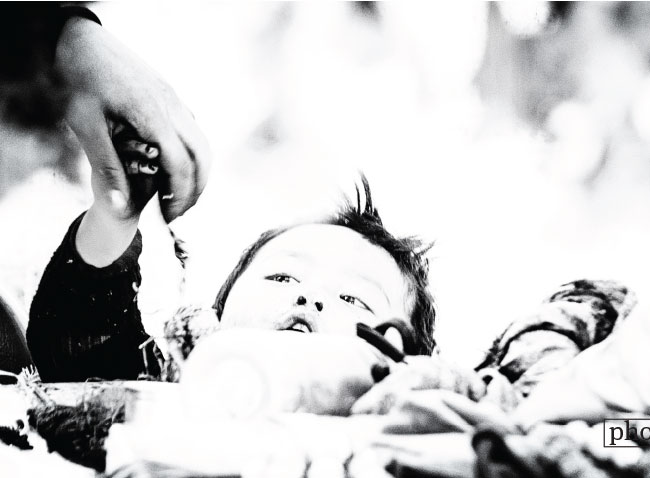
Give Me a Hand by Shirren Lim
While exploring the streets of Shigatse, the photographer was struck by a tender, intimate moment between a young boy and his mother. Dropping to her knees to capture the scene from the child's perspective, she framed the boy reaching for his mother’s hand amidst the backdrop of their market stall. This image is award-worthy for its raw emotional resonance and the photographer's ability to find profound human connection in a fleeting, everyday interaction. The composition highlights the sincerity of the subjects, turning a simple gesture into a powerful, universal narrative of love and security.
Shirren Lim
Born in Penang Island, Malaysia, in 1970, Shirren Lim is a Jakarta-based photographer who discovered her true passion for the craft in 2009. Specializing in portraiture, she is celebrated for her ability to capture the uncovered sincerity of human expression through an intense and earthy aesthetic. Inspired by the iconic work of Steve McCurry, Lim strives to document humanity in its many forms, aiming to create images that resonate with the depth and emotional impact of the classic photojournalism that first ignited her creative journey.
Resonance Score Breakdown
Transparency Note: The resonance score (11.7/20) is calculated based on social engagement metrics collected before the award announcement.
Expert Photography Reviews · 4
The Anchor of Skin
The smell of damp wool always brings me back to the winters of my childhood, when the air was thick with the scent of woodsmoke and wet earth.
Read the reflection →The Architecture of Belonging
In the study of ancient masonry, there is a concept known as the dry-stone wall. It relies on no mortar, no binding agent, no artificial glue to hold its weight.
Read the reflection →Reviews & Comments
Share your thoughts about this award-winning photograph. Your reviews contribute to the community engagement score.
The frame’s geometry succeeds where sentiment fails. The vertical axis of the mother’s arm creates a rigid fulcrum, anchoring the boy’s reach against the chaotic market backdrop. It’s a disciplined spatial arrangement that prevents the narrative from dissolving into mere anecdote. The negative space around their joined hands provides necessary relief, forcing the eye to acknowledge the structural weight. I’ve grown weary of such subjects, yet the tension here holds. It’s a rare, precise equilibrium.
The market stall fades. It’s just a blur of grey. The boy’s fingers reach out. They don’t grasp; they hover. It’s the space between skin that holds the weight. I’ve felt that ache before, that quiet pull of a hand. Nothing here is accidental. The empty corner is not empty. It’s the breath before the touch. Lim trusts the silence. It’s enough. It’s everything. I’m left standing here, perfectly still.
Dropping to one’s knees in a Shigatse market isn’t merely a compositional choice; it’s an admission of humility. Most would have snapped from the hip and moved on, but Lim clearly lingered until the boy’s reach felt inevitable rather than staged. It’s a quiet, aching bit of humanity. I’ve spent enough hours shivering in the dirt to know when someone has truly committed to the scene. She didn’t just find this; she earned it.
Before the eye identifies the market stall, a sudden stillness settles in the chest. That small hand reaching upward triggers a primal, somatic recognition of safety. It’s the weight of the mother’s palm that anchors the frame. When I return to this, I don’t see Tibet; I feel the phantom ache of my own childhood grip. It’s a quiet, visceral activation that lingers long after I’ve turned away, pulling me back into that held-breath moment.