Fiery Protest by Ashik Masud
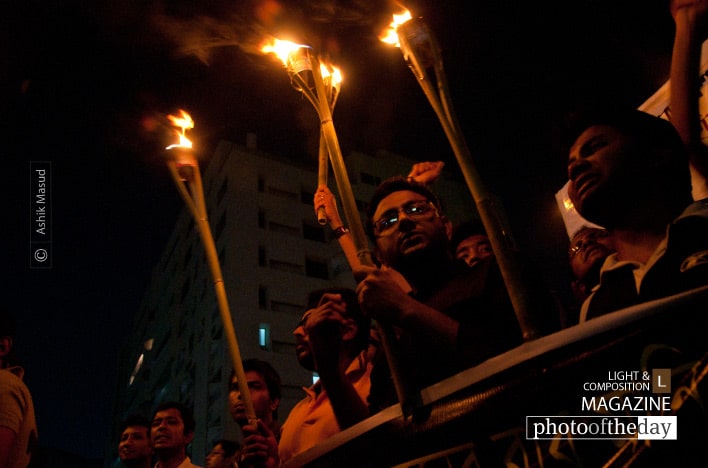
Captured during the historic Shahbag protests in Dhaka on February 6, 2013, this image documents a pivotal moment of national awakening. As thousands gathered to demand justice for war crimes committed during the 1971 Liberation War, the photographer focused on the raw energy and collective resolve of the demonstrators. By utilizing a wide-angle perspective and low-light settings, the image conveys the intensity of the sit-in. The photograph is award-worthy for its powerful historical significance and its ability to distill a complex, emotionally charged mass movement into a single, evocative frame that captures the spirit of a generation seeking accountability.
Ashik Masud
Based in Dhaka, Bangladesh, Ashik Masud is a dedicated documentary photographer who balances his creative pursuits with a career as an IT professional. A self-taught artist, he specializes in capturing colorful and energetic imagery that highlights the human experience and the cultural richness of his homeland. Through his lens, Masud seeks to foster connection and understanding, documenting the interactions between people and their environments with deep respect. His work serves as a vibrant testament to his belief that photography is the most effective medium for discovery and storytelling.
Resonance Score Breakdown
Transparency Note: The resonance score (12.9/20) is calculated based on social engagement metrics collected before the award announcement.
Expert Photography Reviews · 6
The Salt of Collective Breath
The air in a crowd has a specific weight, a thickness that clings to the back of the throat like the metallic tang of a coming storm.
Read the reflection →The Ember and the Wind
History is rarely written in books; it is written in the friction of bodies moving together toward a singular, burning point. We often imagine change as a sudden thunderclap, a bolt from the blue that alters the landscape overnight. But look closer at the way a fire begins.
Read the reflection →Reviews & Comments
Share your thoughts about this award-winning photograph. Your reviews contribute to the community engagement score.
Most protest photography is noise, but this frame holds the silence of conviction. I’ve seen thousands of crowds, yet the way Masud uses that 27mm lens to pull the viewer into the fire’s glow creates a visceral, claustrophobic intimacy. It’s not just a rally; it’s a pulse. I felt my own breath hitch looking at those faces. It’ll endure because it captures the exact moment a generation stopped asking and started demanding their history back.
The air in Shahbagh was thick with a collective pulse that night. Ashik didn’t just document a protest; he listened to the flickering, amber glow of the torches against the encroaching dark. It’s a restless light, one that demands a steady hand and a quiet heart. I feel a strange ache in my chest looking at it—the weight of thousands waiting for justice. He stood there, patient, until the fire finally spoke for them all.
The frame’s geometry is chaotic, yet the central torch provides a necessary fulcrum. It’s a messy, kinetic sprawl that barely contains the density of the protest. The low-light tonality creates a claustrophobic spatial tension, forcing the eye toward the flickering light. I’m exhausted by the lack of discipline here, but the sheer weight of the crowd against the dark periphery holds the composition together. It’s a fragile balance, but it doesn’t collapse under its own gravity.
The crowd swells, yet the edges hold. A blur of motion against the dark, unyielding pavement. I’ve spent minutes staring at the void beneath the protest signs. It’s quiet there. The chaos doesn’t touch that corner. It’s a relief. A breath taken in the middle of a scream. Nothing here is accidental. The empty space isn’t empty; it’s where the weight of history settles. It’s heavy. I feel the stillness pulling me in.
Shadow isn’t merely the absence of light here; it’s the suffocating weight of history pressing against the frame. Masud’s lens captures the Shahbagh fire not as a spectacle, but as a desperate struggle against the encroaching dark. It’s haunting. I’ve stared at the way the flickering glow carves faces out of the void, and I’m struck by a sudden, cold dread. We aren’t watching a protest; we’re watching the abyss fight back against the inevitable silence.
The ochre glow of the torches bleeds into the night like Turner’s late, feverish sunsets, casting a visceral, bruised violet across the crowd’s faces. It’s a chromatic collision that makes one’s pulse quicken; I’ve rarely felt such raw, molten urgency in a frame. The way the deep, ink-stained shadows swallow the edges of the protest creates a claustrophobic, Morandi-esque stillness, even as the flickering, amber heat of the fire demands our absolute, undivided attention.