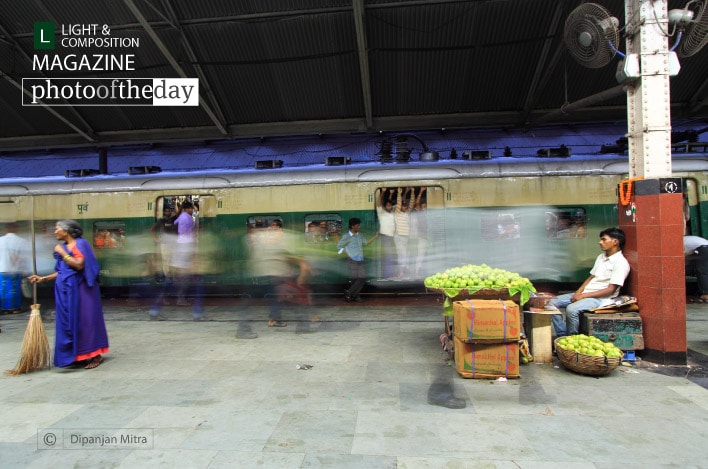
A Local Railway Station by Dipanjan Mitra
Captured at the bustling Howrah station in West Bengal, this image masterfully employs a long exposure to contrast the frantic energy of India’s busiest railway hub with moments of stillness. By utilizing a one-second shutter speed, the photographer successfully blurs the movement of the daily crowds while keeping specific architectural elements sharp and defined. This creative decision transforms a chaotic transit point into a poetic study of motion and time. The photograph is award-worthy for its technical precision in managing light and exposure, turning a mundane urban scene into a compelling, ethereal narrative of human transit.
Roberto Pagani
Roberto Pagani is a self-taught photographer who enjoys taking pictures since 1978 after a vacation with friends in Sicil. He started with a Yashica FR and he used a Contax 139X. He has fully converted to digital since 2006 using a Canon EOS 350D and then a Canon EOS 7D. He loves shooting nature, street photography, macro, landscape and travel photography. Some of his works have been published on magazines or featured around the web. [caption id="" align="alignnone" width="145"]Roberto Pagani[/caption] Camera Gear: CANON EOS 350D with EF 100mm Current Location: Monza, Italy Website: http://www.alookthroughlens.com/ Flikcr: http://www.flickr.com/photos/alookthroughlens/ 500px: http://roberto_pagani.500px.com/#/0 Twitter: https://twitter.com/#!/Roberto_Pagani Facebook: http://www.facebook.com/people/Roberto-Pagani/100001765234172 Tumblr: http://rp-photographer.tumblr.
Resonance Score Breakdown
Transparency Note: The resonance score (14.4/20) is calculated based on social engagement metrics collected before the award announcement.
Expert Photography Reviews · 8
The Architecture of Passing Through
In the old maps of the world, transit points were often marked with a simple cross, a place where paths intersected but never truly met.
Read the reflection →The Ghost of Arrival
Why do we feel the need to stand still when everything around us is rushing toward a conclusion? We spend our lives waiting on platforms, watching the blur of other people’s urgency, convinced that our own stillness is a form of progress. Yet, time does not care for our pauses.
Read the reflection →Reviews & Comments
Share your thoughts about this award-winning photograph. Your reviews contribute to the community engagement score.
Very meaningful frame
The architecture of Howrah station provides a rigid grid, yet the motion blur threatens to dissolve the frame. It’s a precarious balance. The static pillars anchor the composition, preventing the chaos from bleeding outward. I’m genuinely unsettled by how the blur mimics a ghost-like erasure of the commuters. The spatial tension holds because the geometry remains absolute. It doesn’t collapse into sentimentality. The frame is disciplined, and for that, it earns its place on the wall.
Before the eye identifies the station, a sudden stillness pulls at the lungs. The blur of commuters creates a phantom rhythm, a collective heartbeat that feels almost lonely. I’ve stared at these streaks of light for hours, and they still make my pulse drop. It’s the tension between the static pillars and the rushing ghosts that haunts me. When I return to this, I feel the weight of every departure I’ve ever had to endure.
1sec at f/14.5, 12mm, ISO 100. The aperture choice is aggressive, forcing a diffraction limit that softens the architectural edges. It’s a calculated risk. At 12mm, the distortion is managed, but the shutter speed doesn’t fully dissolve the crowd; it just smears them into ghosts. I’m frustrated by the lack of total motion blur. Still, the exposure is technically sound. It’s a precise, cold calculation of light that barely keeps the chaos under control.
The ochre of Kolkata’s station walls bleeds into the ghostly, translucent whites of commuters, creating a chromatic dissonance that feels like a fever dream painted by Turner. It’s a haunting, kinetic blur where the shadows aren’t merely dark, but possess the bruised, heavy violet of a storm-tossed sky. I’ve found myself breathless before these shifting, spectral tones; they don’t just record transit, they dissolve the very architecture of reality into a shivering, golden-hued light.
The platform hums with a frantic, invisible pulse. Dipanjan stood here as the light flattened against the concrete, waiting for the rush to dissolve into ghosts. It’s a quiet ache, watching these commuters blur into streaks of color while the iron pillars remain anchored in time. I’ve felt that same stillness in the middle of a storm. He didn’t just capture a station; he listened to the rhythm of the city until it finally exhaled.
The platform blurs. A ghost of a commute. I’ve stood on these platforms in Kolkata, feeling the weight of the rush. Here, the chaos dissolves into a soft, grey hum. It’s quiet. The architecture holds firm against the blur of bodies. Nothing here is accidental. The empty corner is not empty. It’s a breath held in the middle of a scream. I find myself wanting to step into that stillness. It’s a rare, beautiful silence.
At f/14.5, the diffraction limit begins to soften the fine architectural edges, yet it’s precisely this trade-off that renders the motion blur so ethereal. By stretching the exposure to one second at 12mm, the lens captures a temporal smear that the human retina simply can’t resolve. I’m genuinely moved by how the static pillars anchor the chaos; it’s a beautiful collision of physics and fleeting life. It doesn’t just record transit; it quantifies the passage of time.
Most long exposures of transit hubs are just blurry gimmicks, but this one works because of the architecture. By anchoring the frame with those rigid, iron-wrought pillars, Mitra forces the chaos to orbit something permanent. I’ve seen thousands of station shots, yet this one makes me feel the actual weight of the Kolkata heat. It’s not just motion; it’s the friction of a million lives passing through a single, enduring frame. That’s why it’ll last.