Bromo Crater by Ismawan Ismail
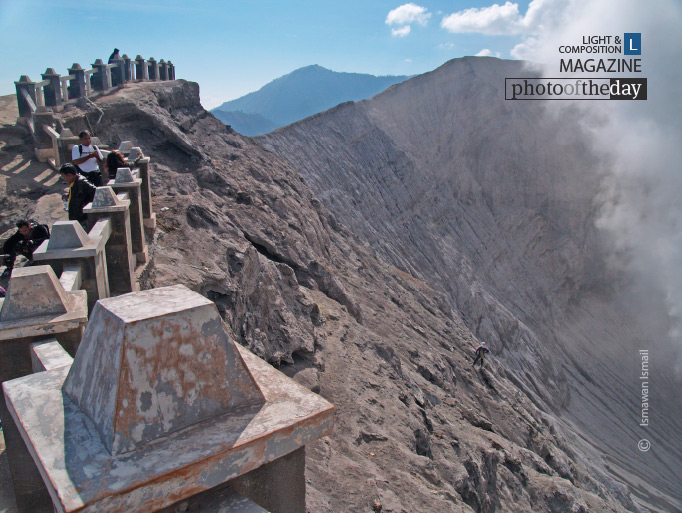
Captured at the iconic Tengger caldera, this photograph showcases the majestic Mount Bromo rising from the vast volcanic landscape known as the Sand Sea. The photographer navigated the challenging terrain of East Java to reach the crater's edge, timing the shot to emphasize the dramatic scale and rugged texture of the caldera. By utilizing a wide-angle perspective, the image captures the ethereal atmosphere of this Indonesian landmark, balancing the harsh volcanic environment with the serene beauty of the sunrise. This work is award-worthy for its technical precision in documenting one of the world's most visually arresting geological formations.
Ismawan Ismail
Born in 1972, Ismawan Arief Ismail is an IT executive based in Kuala Kencana, Papua, Indonesia. His photographic journey began during his high school years with a simple pocket camera, eventually evolving into a professional pursuit that includes stock photography and commissioned assignments. Balancing his technical career in the mining industry with his creative passion, he continues to refine his craft, aiming to transition his long-standing hobby into a full-time career.
Resonance Score Breakdown
Transparency Note: The resonance score (14.9/20) is calculated based on social engagement metrics collected before the award announcement.
Expert Photography Reviews · 4
The Earth Breathing Still
We often mistake the silence of the earth for emptiness, forgetting that beneath the crust of our daily lives, the world is constantly rehearsing its own creation. There is a patience in stone that we, in our frantic rush, have long forgotten.
Read the reflection →The Weight of the Earth
I spent this morning trying to fix a wobbly chair in the kitchen. I kept tightening the screws, but the floor itself seemed to be the problem—it just wasn't level.
Read the reflection →Reviews & Comments
Share your thoughts about this award-winning photograph. Your reviews contribute to the community engagement score.
Very nice photo!! It shows different angle of Bromo, not the common angle that we can find easily on the Internet!
Nice picture. However, I find that the surroundings are more impressive than the volcano itself. The sea of sand and the whole plateau have something special. It feels like walking on the moon.
Still in East Java, I would also recommend to visit kawah ijen for amazing pictures with the colors (yellow from the sulfur and blue from acidic lake). Amazing place, truly.
Bromo’s caldera is a well-trodden path, yet Ismail has managed to avoid the usual tourist snapshots. The light here isn’t merely convenient; it’s earned through the grit of that volcanic dust. I’ve spent enough mornings shivering in similar craters to know the effort required to keep the horizon level while the wind bites. It’s a respectable effort. One suspects he didn’t just arrive and click. He stayed until the mountain finally decided to behave.
At f/10, the Zuiko glass avoids the diffraction limit, rendering the volcanic grit with startling micro-contrast. The 14mm focal length stretches the caldera’s geometry, yet the focal plane remains remarkably crisp across the crater’s rim. I’m genuinely moved by how the light catches those jagged textures; it’s a rare moment where the sensor’s resolution finally meets the earth’s raw complexity. It doesn’t just document the landscape; it forces the eye to resolve what’s usually lost in the haze.
The caldera floor stretches. It’s a vast, grey silence. I feel a sudden, sharp chill looking at the ash. Ismail doesn’t crowd the frame with the mountain. He lets the emptiness breathe. The crater edge sits heavy, yet the space around it holds the weight. Nothing here is accidental. The empty corner is not empty. It’s a pause. I’ve stood in places like this, and finally, someone has captured the quiet. It’s enough.
The wide-angle lens stretches the caldera, yet the horizon line doesn’t collapse. It’s a precarious balance. The volcanic mass exerts a heavy downward pull, countered only by the sharp, jagged ridge cutting across the frame. I’ve grown weary of travel shots that rely on sunrise hues, but the spatial tension here holds. The negative space isn’t empty; it’s a vacuum. It’s a cold, calculated geometry that finally forces the eye to respect the crater’s scale.