On the Street of Kathmandu by Ashik Masud
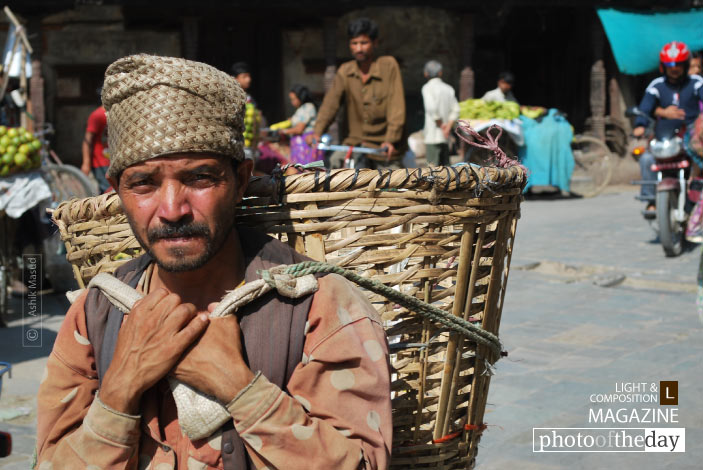
Captured on the bustling streets of Kathmandu, this evocative portrait highlights the resilience and warmth of the local people. The photographer, drawn to the man’s steady gaze and the heavy load he carried, seized a fleeting moment of connection amidst the urban chaos. By utilizing a 55mm focal length, the image maintains an intimate perspective that bridges the gap between the subject and the viewer. The photograph is award-worthy for its authentic portrayal of human spirit, showcasing how a simple, respectful interaction can transform a candid street scene into a powerful narrative of cultural beauty and shared humanity.
Ashik Masud
Based in Dhaka, Bangladesh, Ashik Masud is a dedicated documentary photographer and IT professional who uses his camera to explore the vibrant cultures of the world. His work is defined by colorful, energetic imagery that captures people in their natural environments, reflecting his belief in photography as a medium for connection and respect. As a self-taught artist, Masud continuously refines his craft by documenting the human experience, striving to represent his home country and beyond through a lens of empathy and discovery.
Resonance Score Breakdown
Transparency Note: The resonance score (13.4/20) is calculated based on social engagement metrics collected before the award announcement.
Expert Photography Reviews · 8
The Weight of the Unspoken
In the physics of the everyday, we rarely consider the burden of the unseen. We carry our histories in the way we hold our shoulders, in the set of a jaw, or in the quiet rhythm of a walk that has traversed the same pavement for a lifetime.
Read the reflection →The Weight We Carry
I was walking to the grocery store this morning when I saw a man struggling with a stack of cardboard boxes. He was leaning forward, his face tight with the effort of keeping everything balanced.
Read the reflection →Reviews & Comments
Share your thoughts about this award-winning photograph. Your reviews contribute to the community engagement score.
The frame’s geometry is compromised. While the subject’s gaze anchors the center, the surrounding urban clutter lacks the necessary spatial tension to justify its presence. It’s a messy arrangement. The load carried by the man creates a vertical axis that fights the background’s chaotic tonality. I’ve seen this composition fail to resolve its own weight too often. It doesn’t hold. The frame is simply too porous to contain the subject’s gravity. It’s a missed opportunity for rigor.
At f/8, the Nikon’s sensor resolves the man’s skin texture with clinical honesty. The 55mm focal plane sits perfectly across his eyes, rendering the chaotic Kathmandu background into a soft, manageable blur. It’s the diffraction of light across his weathered features that truly moves me; I’ve rarely seen such raw, optical clarity in street work. It doesn’t just capture a face; it maps the topography of a life. The lens has done its job beautifully here.
The ochre dust of Kathmandu clings to the subject’s skin like the muted, earthy pigments of a Morandi still life, grounding the frame in a tactile, sun-baked warmth. It’s the bruised, atmospheric violet lurking in the shadows of his heavy load that truly captures me, creating a dissonant, melancholic vibration against the street’s golden heat. One feels the weight of the light itself, a dense, shimmering amber that makes the air feel thick, ancient, and achingly alive.
Most street portraits are forgettable noise, but this one sticks. It’s the weight of that basket against the man’s weary, unblinking stare that anchors the frame. I’ve seen thousands of Kathmandu shots, yet this one avoids the usual tourist trap of exoticism. The 55mm focal length forces an intimacy that feels earned, not stolen. It makes me ache for the man’s quiet dignity. In thirty years, we’ll still be looking at his eyes, wondering what he carried.
The light here isn’t the harsh glare of a Kathmandu noon; it’s the soft, diffused glow of a city breathing. He stood there, waiting for the man’s burden to align with the rhythm of the street. I feel a sudden, quiet ache in my own shoulders looking at that weight. It’s not just a portrait; it’s a moment of stillness carved out of chaos. He didn’t rush. He listened to the light until it finally spoke.
The street noise of Kathmandu fades. I’m left with the weight on his back and the stillness in his eyes. It’s a quiet gravity. The frame doesn’t crowd him. It gives him room to breathe. I’ve spent minutes just watching the way the light hits his skin. Nothing here is accidental. The empty corner is not empty. It’s a pause. It’s a breath. I feel a sudden, sharp ache for that kind of peace.
One suspects the photographer didn’t just stumble upon this man. That steady, weary gaze suggests a conversation preceded the shutter, not just a frantic grab for a candid. It’s a rare thing to see such stillness in Kathmandu’s chaos. I’ve spent enough mornings shivering in doorways to know that look; it’s earned through patience, not luck. It’s a quiet, decent piece of work. I find myself wanting to buy the man a tea, which is high praise indeed.
Shadows here don’t merely frame the man; they consume the periphery, forcing us into the gravity of his burden. It’s a claustrophobic intimacy. When I look at those deep, ink-stained recesses behind him, I feel a sudden, cold ache in my own chest. Masud hasn’t just captured a street scene; he’s carved a silence out of the chaos. It’s a heavy, uncompromising gaze that refuses to let us look away from the weight of existence.