My Bangla Alphabet by Shahnaz Parvin
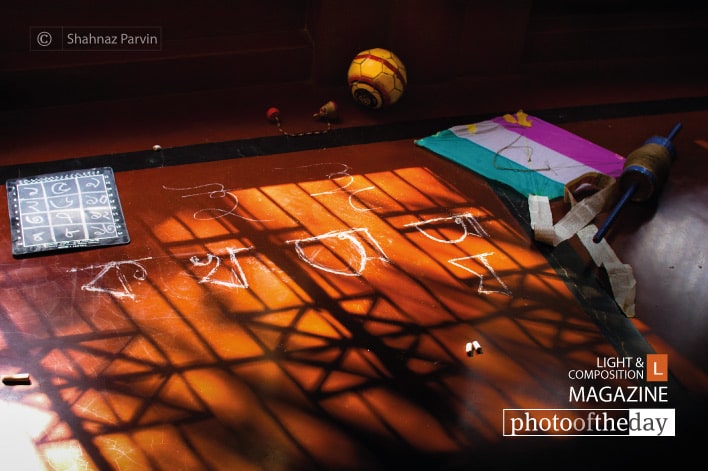
This poignant still life captures the essence of the Bangla alphabet, serving as a visual tribute to the Language Movement of 1952. By focusing on these characters, the photographer honors the sacrifices made by students who fought for the right to speak their mother tongue. The image is composed with a deep sense of historical reverence, utilizing soft lighting to highlight the intricate forms of the script. It stands as an award-worthy piece not only for its technical execution but for its profound ability to bridge the gap between artistic expression and the collective memory of a nation's struggle for identity and independence.
Shahnaz Parvin
Shahnaz Parvin was a highly acclaimed photojournalist and a dedicated documentarian based in Dhaka, Bangladesh. Recognized as one of the premier photographers of her generation, she consistently ranked among the world's top 100 photographers, celebrated for her evocative work capturing the culture, conflict, and spirit of South Asia. A prolific contributor to Light & Composition, her legacy remains defined by her unwavering passion for visual storytelling and her commitment to representing the history and heart of her homeland through the lens.
Resonance Score Breakdown
Transparency Note: The resonance score (14.6/20) is calculated based on social engagement metrics collected before the award announcement.
Expert Photography Reviews · 7
The Weight of a Sound
We often forget that language is not merely a tool for trade or a vessel for instruction. It is, at its core, a physical inheritance—a collection of shapes that carry the breath of our ancestors.
Read the reflection →The Weight of a Sound
A child learns to speak by mimicking the wind, the water, the shifting of stones. We are taught that words are merely tools for trade, for naming the things we wish to possess. But there are sounds that carry the marrow of a people.
Read the reflection →Reviews & Comments
Share your thoughts about this award-winning photograph. Your reviews contribute to the community engagement score.
At f/3.5, the 30mm focal plane is razor-thin, isolating the Bangla characters with a surgical precision that defies the sensor’s noise floor. The bokeh, a function of that wide aperture, renders the background into a soft, historical hum. I’m genuinely moved by how the light clings to the ink’s texture; it’s a tactile resolution of history itself. It doesn’t just capture script; it resolves the very weight of a language fought for in the light.
The light here doesn’t demand attention; it hums with the soft, diffused weight of a Dhaka afternoon. Shahnaz waited for the shadows to settle against these characters, letting the script breathe. I’ve spent enough time in quiet rooms to recognize that stillness—it’s the patience of a prayer. Looking at these curves, I feel a sudden, sharp ache for the voices lost in 1952. She didn’t just capture ink; she listened to the history held within the paper.
The ochre warmth here feels like a sun-drenched wall in a Morandi still life, grounding these delicate Bangla characters in a sepia-toned reverence that I find deeply moving. It’s not merely ink on paper; it’s the amber glow of a fading afternoon, where the shadows don’t just fall, they linger with a quiet, historical weight. One can’t help but ache for the soft, bruised gold of that light, which breathes life into every curve.
Ink on paper. The characters rest in the light. I’ve spent minutes watching the shadows crawl across the curves. It’s quiet here. The frame doesn’t crowd the script; it lets the language breathe. I feel a sudden, sharp ache for the voices lost to history. Nothing here is accidental. The empty corner is not empty. It holds the weight of everything they couldn’t say. It’s a rare, still grace. I’m grateful for the silence.
Soft light on ink and paper is a deceptive business; it’s easy to make it look precious, yet harder to make it feel heavy with history. One wonders how many afternoons were spent chasing that particular, muted glow before the composition settled. It’s a quiet, deliberate piece of work. I’ve spent enough time shivering in damp fields to recognize when someone has actually sat with their subject. It’s a rare, earned stillness. Well done.
Most entries I’ve seen this year treat history as a prop, but here, the soft light on these characters feels like a quiet, deliberate act of preservation. It’s the restraint that wins me over; by avoiding grandiosity, Parvin lets the script carry the weight of 1952. I’ll admit, it made me pause and reflect on my own heritage. It’s a rare piece that’ll still matter in thirty years because it doesn’t shout—it simply remembers.
Light here doesn’t merely illuminate; it interrogates the ink. The Bangla characters emerge from a gloom that feels heavy with the ghosts of 1952. I’ve stared at these curves until my eyes ached, feeling the suffocating weight of a silence that demands to be heard. It’s not just a still life; it’s a confrontation. When the shadows swallow the edges of the script, they aren’t hiding anything. They’re protecting the memory of a struggle that refuses to fade.
Beautiful photograph..
Fantastic…