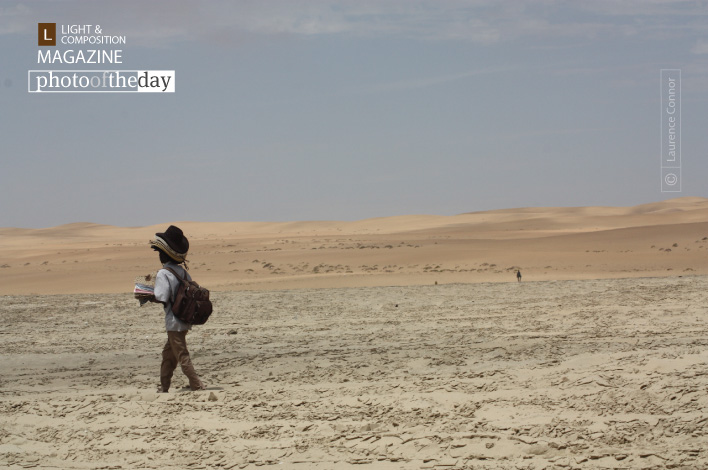
33 Hats & a Rucksack by Laurence Connor
Captured along the desolate Namib coast near Swakopmund, this image documents a poignant intersection of geography and human endurance. As the world’s oldest desert meets the turbulent South Atlantic, a local vendor traverses the stark, windswept dunes to sell his wares. The photographer masterfully utilizes the vast, bleak landscape to emphasize the vendor’s solitary journey, creating a striking contrast between the harsh environment and the resilience of the human spirit. This award-worthy composition succeeds through its evocative storytelling, capturing a fleeting moment of daily life against the backdrop of one of the planet's most unforgiving and beautiful wildernesses.
Laurence Connor
Raised in the coastal landscapes of Norfolk and Kent, Laurence Connor developed an early affinity for nature and exploration. After training as a professional Nature Guide in South Africa and working extensively in wildlife conservation across Namibia and the Zambezi region, he transitioned his deep environmental expertise into the realm of professional photography. His work, notably featured in 'The Bush & Beach Series,' reflects a profound attention to detail and a commitment to documenting the natural world. Connor now balances his time between his conservation efforts and providing expert photographic tutoring.
Resonance Score Breakdown
Transparency Note: The resonance score (12.9/20) is calculated based on social engagement metrics collected before the award announcement.
Expert Photography Reviews · 7
The Weight of the Horizon
We carry our lives like bundles tied to our shoulders, heavy with the things we think we might need for the journey ahead.
Read the reflection →The Weight of the Wayfarer
In the quiet corners of a house, we often find ourselves carrying more than we need. We hoard the small, heavy things—the extra keys to doors that no longer exist, the coats for winters that have long since thawed, the memories that have grown brittle with age.
Read the reflection →Reviews & Comments
Share your thoughts about this award-winning photograph. Your reviews contribute to the community engagement score.
The ochre of these dunes, a parched, sun-bleached pigment reminiscent of Morandi’s dustiest still lifes, collides with the Atlantic’s bruised, slate-grey melancholia, creating a chromatic tension that’s frankly breathtaking. One finds the vendor’s vibrant, chaotic collection of hats—a riot of synthetic primaries—piercing the desert’s monochromatic exhaustion like a fever dream. It’s a jarring, beautiful dissonance; I’ve stared at these saturated, lonely shapes until my own eyes ache with the sheer, arid weight of it all.
The horizon line bisects the frame with clinical indifference. It’s a rigid fulcrum. The vendor’s verticality disrupts the desert’s horizontal sweep, yet the rucksack’s weight lacks sufficient counter-balance. The negative space is vast, but it doesn’t breathe; it merely empties. I’m irritated by the lack of geometric tension. The hats provide a necessary rhythm, but they don’t anchor the composition. It’s technically competent, yet the frame fails to hold the weight of its own emptiness.
The dunes of Swakopmund aren’t merely sand; they’re an abyss waiting to swallow the vendor’s fragile inventory. Connor’s shadows don’t just fall—they interrogate the man’s persistence. I’ve stared at those thirty-three hats, and I feel a sudden, cold dread for his solitude. It’s not a travelogue; it’s a confrontation with the void. When the light refuses to soften the edges of that rucksack, we finally see the weight of a life spent chasing the horizon.
At f/11, the Tamron’s optics push toward the diffraction limit, yet it’s precisely this micro-contrast that renders the sand’s texture with such clinical, biting sharpness. The focal plane holds the vendor’s silhouette against the Namib’s vastness, where the light’s refraction across those hats creates a subtle, shimmering halo. I’m genuinely moved by how the lens resolves that solitary figure against the desert’s heat haze. It’s a rare, beautiful intersection where physics and human endurance finally collide.
The dunes swallow the horizon. A man walks, burdened by thirty-three hats. It’s a heavy, rhythmic march against the void. I feel a sudden, sharp ache in my chest watching him. The rucksack is a small anchor in a sea of sand. Nothing here is accidental. The empty corner is not empty. It’s the weight of the wind. It’s the silence of the desert. He doesn’t need to arrive. The journey is enough.
Most travel photography is just visual noise, but Connor’s frame survives because of that absurd, precarious stack of hats. It’s a quiet, heavy irony against the Namib’s indifference. I’ve seen thousands of desert shots, yet this one sticks because the vendor’s silhouette isn’t just a figure; it’s a stubborn refusal to vanish. It makes me ache for the sheer effort of existing in such emptiness. In thirty years, we’ll still be looking for that rucksack.
Before the eye identifies the vendor, a sudden, dry constriction tightens in my throat. It’s the weight of those thirty-three hats against the infinite, indifferent dunes. The scale triggers a primal, lonely activation; I feel the grit of Swakopmund in my own lungs. When I return to this a year later, the rucksack feels heavier, a quiet anchor in a shifting world. It’s a haunting, persistent reminder of how we carry our lives through the sand.