Zanskar Old Age by Nakul Sharma
Captured in the rugged, high-altitude terrain of the Zanskar Valley, this portrait offers a poignant meditation on the passage of time. The photographer utilized a 105mm focal length to isolate the subject, creating an intimate connection that emphasizes the weathered textures of the woman's face against the stark Himalayan backdrop. By choosing a shallow depth of field at f/4, the photographer effectively softened the environment, ensuring the viewer’s focus remains entirely on the subject’s evocative expression. This image is award-worthy for its raw, candid honesty and the profound sense of humanity it extracts from one of the world's most remote landscapes.
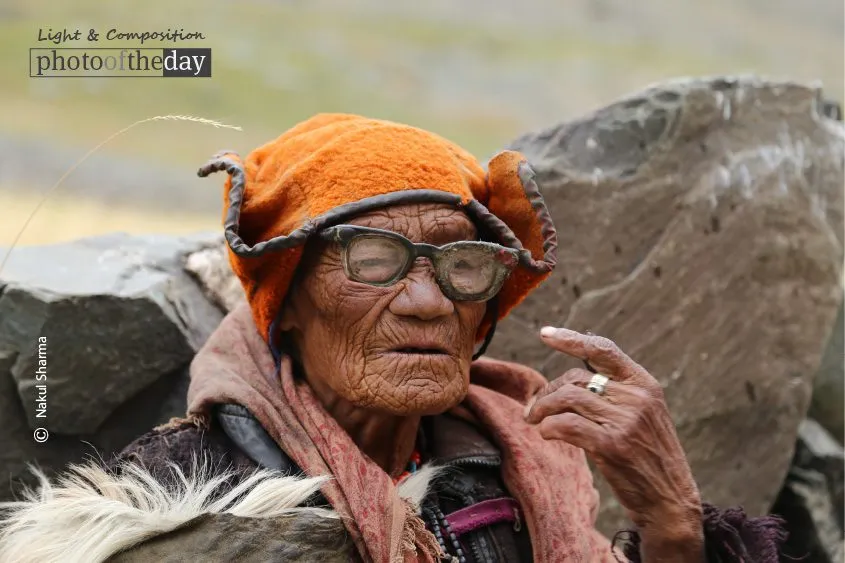
Exposure 1/125sec @ f/4 | ISO 100 | Focal Length 105mm
Nakul Sharma
Born and raised in Delhi, Nakul Sharma is a dedicated traveler and professional photographer who has been documenting the world's most culturally rich and adventurous landscapes since 2009. Currently based in Faridabad, Haryana, he balances his creative pursuits with a career as a freelance tour leader for prominent travel agencies across India. His work is deeply influenced by his constant exploration of diverse environments, reflecting a lifelong passion for capturing the beauty of the human experience in remote corners of the globe.
Resonance Score Breakdown
Transparency Note: The resonance score (13.9/20) is calculated based on social engagement metrics collected before the award announcement.
Expert Photography Reviews · 7
The Map of Years
We measure time in clocks, but the body keeps a different count. It is written in the skin, in the way the hands fold when there is nothing left to hold. We spend our youth trying to smooth the surface, to erase the lines that experience carves into us.
Read the reflection →The Geography of Skin
There is a specific silence that settles in the skin after the years have finished their work. It is not the silence of a room where someone has left, but the silence of a map that has finally been drawn.
Read the reflection →Reviews & Comments
Share your thoughts about this award-winning photograph. Your reviews contribute to the community engagement score.
1/125sec at f/4, 105mm. It’s a calculated isolation. At 105mm, the compression is aggressive, forcing the subject against the Zanskar backdrop. The f/4 aperture is a gamble I’d usually call lazy, but here, it’s precise. It keeps the skin texture sharp while rendering the mountain a soft, non-distracting blur. I’ve seen enough portraits ruined by excessive bokeh, but this one actually holds my attention. It’s a technically sound argument for intimacy in a harsh environment.
You didn’t just take a picture of a woman in Zanskar; you sat with her. I can see the weight of those high-altitude years etched into her skin. It’s the way you’ve blurred the background that hits me—it makes the rest of the world fall away until it’s just her eyes. And honestly, it makes me feel small. You waited for the right moment, and you didn’t blink. There’s something deeply honest happening here.
The high-altitude sun here doesn’t just illuminate; it carves. Nakul waited for that flat, honest light to settle into the deep lines of her face, turning skin into a map of the Zanskar range itself. I feel a sudden, quiet ache in my chest looking at her eyes. He stood there, patient and still, listening to the silence of the valley until she finally let him see her. It’s a rare, holy kind of stillness.
At 105mm and f/4, the focal plane is razor-thin, isolating the subject’s skin texture with clinical precision. The lens resolves the micro-contrast of every weathered wrinkle, pushing past what the naked eye registers in the Zanskar light. I’m genuinely moved by how the bokeh, a function of that wide aperture, renders the harsh Himalayan backdrop into a soft, atmospheric blur. It’s a rare moment where optical physics perfectly captures the profound, fragile weight of human existence.
Shadows aren’t merely gaps in the frame; they’re the geography of a life lived at the edge of oxygen. In Sharma’s portrait, the darkness clinging to the subject’s skin feels like the weight of the Zanskar peaks themselves. It’s a brutal, honest erosion. I’ve stared at those deep, cavernous lines for an hour, and I’m genuinely unsettled by how much of her soul is hidden in the black. It doesn’t invite us; it demands our silence.
The mountain air doesn’t just surround her. It occupies the frame. I’ve spent minutes looking at the blurred rock behind her head. It’s a soft, grey void. Nothing here is accidental. The empty corner is not empty. It’s the weight of Zanskar pressing against her skin. I feel a sudden, sharp ache in my own chest. She isn’t waiting for anything. She is simply existing within the silence. It’s a rare, quiet grace.
The lens pulls tight, isolating the subject like a close-up in a slow-burn drama. It’s a quiet, heavy frame. The 105mm compression flattens the Zanskar peaks into a soft, blurred bokeh, forcing us to stare directly into those weathered eyes. I’ve seen a thousand portraits, but this one hits me—it’s the stillness of a life lived at the edge of the world. The cut would have been a mistake. This is the frame the editor keeps.