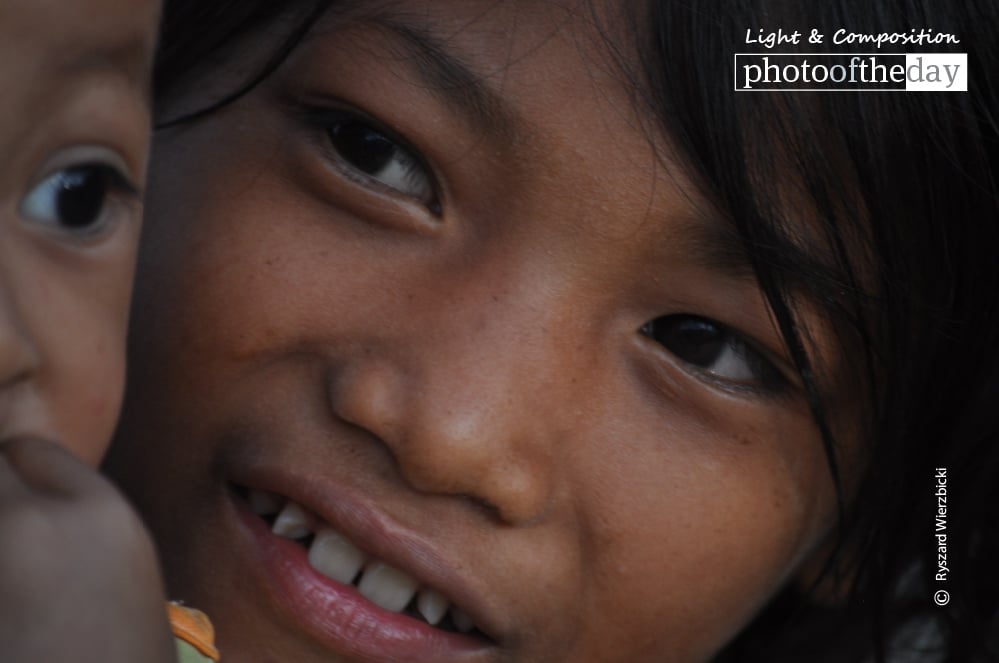
Young Nanny and Little Brother by Ryszard Wierzbicki
In the remote villages of the Ngong Khiew region, accessible only by river, Ryszard Wierzbicki captured a poignant moment of familial devotion. The photograph highlights the cultural tradition in South-East Asia where elder siblings take on the role of caregivers for their younger brothers and sisters. By focusing on a young girl tenderly looking after her little brother, the image serves as a powerful testament to the supportive bonds within these isolated communities. Its award-worthy quality lies in the photographer's ability to document a candid, intimate human connection while navigating the challenging, remote landscapes of North Laos.
Ryszard Wierzbicki
Born in Poland in 1963, Ryszard Wierzbicki transitioned from a career in social sciences and education to a life dedicated to global exploration and photography. After relocating to the United Kingdom in 2006, he shifted his focus toward documenting the diverse cultures of South-East Asia, often combining his travels with volunteer work for orphanages. A passionate scuba diving instructor and traveler, he founded multiple online forums to share his experiences, eventually trading his corporate career for a life of adventure, storytelling, and visual documentation.
Resonance Score Breakdown
Transparency Note: The resonance score (12.2/20) is calculated based on social engagement metrics collected before the award announcement.
Expert Photography Reviews · 5
The Weight of Small Hands
I was folding laundry this morning when my youngest niece climbed onto the sofa, dragging her heavy, oversized blanket behind her. She didn't ask for help.
Read the reflection →The Weight of Small Hands
There is a specific weight to a child’s hand when they are tasked with holding another. It is not the weight of a burden, but the weight of a promise.
Read the reflection →Reviews & Comments
Share your thoughts about this award-winning photograph. Your reviews contribute to the community engagement score.
Getting to Ngong Khiew isn’t a weekend jaunt; it’s a commitment to mud and river currents. One suspects Wierzbicki didn’t just stumble upon this. The girl’s posture suggests she’s long since stopped noticing the lens, which is the mark of a photographer who sat still long enough to become part of the furniture. I’ve spent enough damp mornings waiting for a scene to settle to know that look. It’s a quiet, earned piece of humanity.
At 175mm, the compression flattens the Ngong Khiew background, pushing the bokeh into a soft, creamy wash that isolates the subjects. The lens resolves the girl’s eyelashes with clinical precision, yet there’s a gentle chromatic aberration along the edges of the boy’s tunic that softens the digital edge. It’s physically exquisite. I’m genuinely moved by how the light catches their skin; it’s a rare moment where the optics don’t just record, they truly feel.
The shutter snaps, and the frame holds its breath. It’s a tight 175mm compression, isolating the girl’s gaze against the soft, blurred chaos of the village. I’ve spent years watching editors hunt for this exact beat of stillness. The rhythm here is perfect; she’s the anchor, the brother her quiet gravity. It’s a scene that doesn’t need a cut. Honestly, it makes my chest ache. Wierzbicki knew exactly what he was holding when he clicked.
The threshold here isn’t just a physical boundary; it’s the transition between the harsh, unfiltered light of the Laotian exterior and the cool, protective void of the dwelling. Wierzbicki captures how the timber structure frames their intimacy, using the deep shadow to anchor the figures. I’m struck by how the light rakes across the rough-hewn planks, defining the mass of the wall. It’s a rare, honest glimpse of how architecture actually holds life, not just space.
The jury’s obsession with clarity here feels stifling. Wierzbicki’s 175mm compression flattens the Ngong Khiew landscape into a soft, painterly abstraction that I find genuinely moving. Why resolve the background when the emotional weight lies in the girl’s blurred periphery? It’s closer to a Hiroshi Sugimoto study of time than a standard travel snap. I’m tired of perfect focus; I’d rather see what the photographer chose to leave unresolved. It’s a brave, quiet defiance of convention.