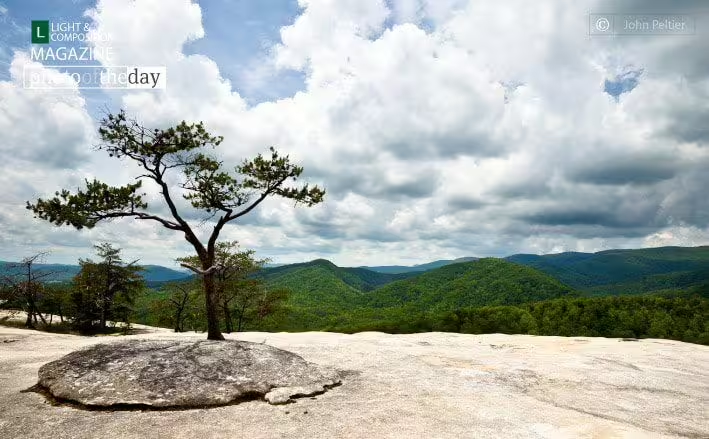
Wolf Rock by John Peltier
Captured at Stone Mountain, North Carolina, this image highlights the dramatic contrast between lush green pine trees and the expansive, slick faces of white granite. The photographer navigated a steep climb to document how nature tenaciously thrives, with trees emerging directly from the rock's fissures. By utilizing a wide-angle lens and a narrow aperture, the photographer achieved deep depth of field, ensuring both the immediate foreground textures and the sweeping mountain vista remain sharp. This composition is award-worthy for its masterful balance of geological scale and organic detail, effectively capturing the rugged, quiet beauty of the American wilderness.
John Peltier
Based in Clayton, North Carolina, John Peltier discovered his passion for photography during his youth in Lake Tahoe, an area renowned for its vast natural beauty. After transitioning from casual hobbyist to a dedicated artist in 2009, he has refined his focus on the technical and compositional nuances of landscape photography. Peltier frequently ventures into remote environments—from deserts to dense jungles—to document hidden landscapes and weave historical narratives into his work, aiming to share the world's most inaccessible corners with a global audience.
Resonance Score Breakdown
Transparency Note: The resonance score (13.3/20) is calculated based on social engagement metrics collected before the award announcement.
Expert Photography Reviews · 3
The Breath of Granite
The smell of cold stone after a long rain is a scent that settles deep in the lungs, sharp and mineral-heavy.
Read the reflection →The Weight of Stone
There is a patience in granite that we cannot replicate. It does not hurry to exist. It waits for the ice to fracture it, for the wind to scour it, for the slow, persistent roots of a pine to find a way into the dark.
Read the reflection →Reviews & Comments
Share your thoughts about this award-winning photograph. Your reviews contribute to the community engagement score.
Stone Mountain doesn’t give up its secrets to the casual hiker. Peltier’s choice of f/22 suggests he spent a fair bit of time shivering on that granite, waiting for the light to settle across those fissures. It’s a sharp, honest bit of work. I’ve spent enough mornings on similar rock faces to know that ache in the knees. He didn’t just find this; he earned it. It’s a decent, quiet piece of craft.
The granite’s pallor, a chalky, sun-bleached bone, collides with the needles’ deep, resinous emerald, creating a tension that feels almost like a Morandi still life stretched across a mountain face. It’s the way the light clings to those fissures, turning the stone into a cold, lunar expanse, that truly haunts me; I’d swear the air itself tastes of damp moss and ancient, cooling minerals. One finds here a quiet, chromatic ache that lingers long after looking.
Granite isn’t merely stone here; it’s a cold, indifferent silence that swallows the light. Peltier’s fissures don’t just host pines; they’re wounds where life desperately clings to the void. I’ve stared at these shadows until my eyes ached, feeling the crushing weight of that mountain’s indifference. It’s a brutal, honest confrontation with mortality. Most photographers fear this darkness, but here, the shadows don’t hide the truth—they force us to finally look at it.