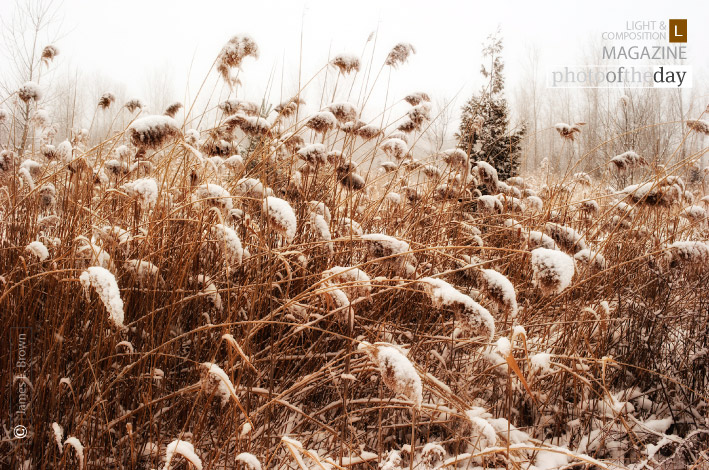
Winter Wonderland by James L. Brown
Captured amidst the serene trails of the Marthaville Habitat Area, this photograph showcases the ethereal beauty of a Southern Ontario winter. James L. Brown utilized a precise aperture priority setting to balance the bright, reflective snow with the intricate textures of the landscape. The image reflects the photographer's deep connection to his local environment, transforming a quiet, snowy day into a compelling visual narrative. Its award-worthy quality lies in the masterful handling of light and the ability to find profound stillness in nature, inviting viewers to appreciate the quiet majesty of the season through a thoughtful, artistic lens.
James L. Brown
Based in Petrolia, Ontario, James L. Brown is a self-taught photographer dedicated to uncovering the inherent beauty within simple, everyday subjects. While he maintains a keen interest in photographic equipment, he prioritizes the development of a unique artistic vision above technical gear. Beyond his creative pursuits, Brown is committed to humanitarian efforts, utilizing his photography as a platform to support those in need through his involvement with the KIVA Photographerfriends lending team.
Resonance Score Breakdown
Transparency Note: The resonance score (14.0/20) is calculated based on social engagement metrics collected before the award announcement.
Expert Photography Reviews · 5
The Silence of White
Winter is a patient teacher. It strips the world back to its skeleton, removing the vanity of color until only the essential lines remain.
Read the reflection →The Silence of Cold Breath
The air in mid-January has a sharp, metallic edge that catches in the back of the throat, tasting faintly of iron and frozen pine needles.
Read the reflection →Reviews & Comments
Share your thoughts about this award-winning photograph. Your reviews contribute to the community engagement score.
Why thank you for the RT Loretta. Sorry for the late reply – jimmy
The frame’s geometry is compromised. While the Nikkor 50mm renders the Marthaville textures with clinical sharpness, the spatial tension collapses under the weight of an unanchored horizon. It’s a missed opportunity for structural equilibrium. The negative space doesn’t breathe; it merely drifts. I’d have preferred a more aggressive fulcrum to ground the composition. It’s technically proficient, yet it lacks the rigorous architecture required to hold the viewer’s eye. The frame simply doesn’t lock.
Most winter scenes are just white noise, but Brown’s work here avoids the usual trap of overexposure. By stopping down to f/16, he’s forced the lens to resolve the brittle, crystalline texture of the snow rather than letting it wash out into a flat, featureless void. I’ve seen thousands of snowy landscapes, yet this one feels cold enough to touch. It’s that tactile honesty that ensures it’ll still matter thirty years from now.
Winter in Marthaville isn’t just cold; it’s a confrontation with the void. Brown’s frame captures the snow’s blinding indifference, yet it’s the shadows clinging to the brush that haunt me. They don’t merely exist; they anchor the light, forcing it to earn its place. I’ve stared at these dark, jagged lines for an hour, feeling the weight of a silence that refuses to be comforted. It’s a stark, shivering reminder that nature doesn’t care if we’re watching.
The palette here evokes Morandi’s muted stillness, where the white of the snow isn’t merely absence, but a complex, bruised silver like the underside of a willow leaf. It’s a frigid, monochromatic ache that makes me shiver, yet I’m drawn to the subtle, charcoal-grey shadows creeping across the drifts. One finds a haunting, spectral harmony in these tones, a quietude so profound it feels as if the very air has frozen into light.
The air in Marthaville must have been brittle that day. He stood there, listening to the silence of the snow, waiting for the light to soften against those dark, skeletal branches. It’s a quiet, humble frame. I find myself shivering just looking at it; I’ve felt that exact, biting cold in my own bones. He didn’t rush the shutter. He let the winter settle into the frame, finding a stillness that most of us simply walk past.