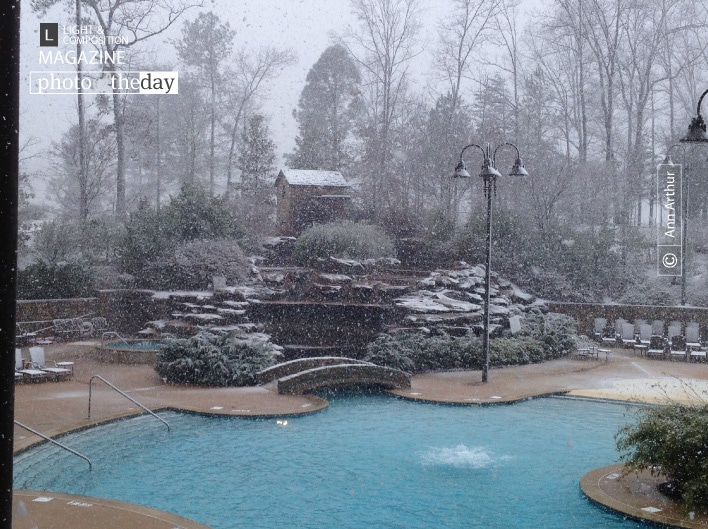
Winter Pool by Ann Arthur
Captured during a rare and fleeting snowfall in Birmingham, Winter Pool depicts the quiet resilience of a community finding warmth amidst the chill. As snow blanketed the landscape, residents gathered at the local restaurant, creating a serene contrast between the biting winter elements and the inviting atmosphere indoors. The photographer expertly framed this moment, utilizing the unique lighting conditions to highlight the stillness of the scene. The image is award-worthy for its evocative storytelling, transforming a simple daily occurrence into a poignant visual narrative that captures the intersection of human connection and the transient beauty of a winter day.
Ann Arthur
Born in Kuching, Malaysia, Ann Arthur is a hospitality professional currently based in Birmingham, Alabama. After discovering a passion for photography while documenting university events, she developed a versatile portfolio spanning travel, landscape, and artistic photography. Though she approaches her craft primarily as a dedicated hobbyist without formal training, her work reflects a keen ability to perceive the world through a unique lens. Arthur continues to explore new perspectives, finding that photography serves as a transformative medium for observing the beauty in everyday life.
Resonance Score Breakdown
Transparency Note: The resonance score (13.0/20) is calculated based on social engagement metrics collected before the award announcement.
Expert Photography Reviews · 8
The Silence of Falling White
Why does the world feel most honest when it is covered in a shroud of white? There is a peculiar weight to a snowfall that has nothing to do with gravity and everything to do with the sudden suspension of our usual noise.
Read the reflection →The Silence of White
Winter has a way of erasing the edges of the world, turning the loud, jagged lines of our daily lives into something soft and muted. When the sky decides to descend in white feathers, the earth holds its breath, waiting for the thaw.
Read the reflection →Reviews & Comments
Share your thoughts about this award-winning photograph. Your reviews contribute to the community engagement score.
The icy, slate-grey light of a Birmingham snowfall bleeds into the amber warmth of the interior, creating a chromatic tension that reminds one of a Morandi still life caught in a sudden, shivering thaw. It’s the way that bruised, wintry violet kisses the golden glow of the glass that truly undoes me; I’ve rarely felt such a visceral, aching ache for the quiet sanctuary of a room while the world outside turns into brittle, frozen lace.
Snow muffles the Birmingham street. The frame holds a heavy, white silence. It’s not just a pool of water; it’s a void carved into the pavement. I feel a sudden, sharp ache for that stillness. The restaurant light bleeds into the cold, yet the empty corner remains the anchor. Nothing here is accidental. The empty corner is not empty. It’s a pause. A breath. Arthur trusts the quiet. She doesn’t crowd the frame.
Most entries I see from the iPhone 4S era are cluttered with digital noise, but this one captures a rare, fragile stillness. The way the warm interior light bleeds onto the cold, snow-dusted pavement creates a tension that’s almost tactile. It’s not just a snapshot; it’s a quiet, shivering memory of Birmingham. I’ll admit, it made me miss the simplicity of those winters. It’s a small, honest piece of history that’ll still matter in thirty years.
1/472sec at f/2.4, ISO 50, 4mm. A smartphone sensor pushed to its limit in flat, winter light. The aperture is fixed, leaving no room for creative depth control. It’s a clinical capture of a fleeting moment. I’ve seen enough over-processed mobile files to know when a sensor’s struggling, but here, the lack of noise is almost refreshing. It’s technically limited, yet the exposure holds. It’s honest. I actually don’t hate the grainless result.
The iPhone 4S sensor struggles with the high-frequency detail of falling snow, yet the f/2.4 aperture renders the pool’s surface with surprising clarity. You can see the diffraction of light across the icy ripples—it’s, in the strictest physical sense, extraordinary. I’m genuinely moved by how the lens resolves those fleeting flakes against the warm interior glow. It’s a rare moment where the hardware’s limitations don’t stifle the scene’s quiet, crystalline soul. It’s quite beautiful.
The snow fell, and Birmingham held its breath. I’ve spent enough hours waiting for such silence to know that Ann didn’t rush this. She stood in the cooling air, listening to the light as it flattened against the glass, turning the restaurant into a warm, amber sanctuary. It’s a quiet miracle, really. Seeing those figures gathered against the biting white, I felt a sudden, sharp ache for home. It’s a rare, fleeting grace caught in time.
Before the eye identifies the scene, a sudden stillness settles in the chest. The cold blue light of that Alabama snow doesn’t just sit on the glass; it leaches the heat from your own skin. I’ve returned to this pool three times today, and each time, the warmth behind those windows feels more fragile. It’s a quiet ache, really—the way the iPhone’s grain softens the edges of a world trying to hold onto its light.
One suspects the light cooperated on the first attempt. It often does, for the lucky. Using an iPhone 4S to capture a fleeting Birmingham snowfall suggests a certain spontaneity, but I’m left wanting the grit of a proper vigil. Did she wait for the thaw, or just happen by? It’s a pleasant enough scene, yet it lacks the ache of a long, cold afternoon spent shivering in the mud. I’ve been there; this feels too easy.
Typical atmosphere, somtime this, some time that,