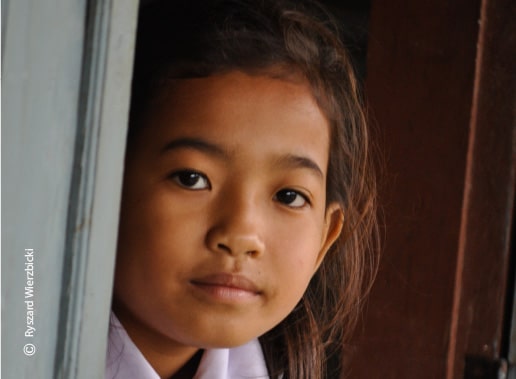
Who’s that …? by Ryszard Wierzbicki
Captured during a visit to a primary school near the Mekong River, this portrait reflects a poignant moment of connection between the photographer and the local children. Accompanied by a guide, the photographer documented the students while delivering school supplies, finding beauty in their candid expressions. The image stands out for its intimate composition and the genuine humanity it conveys, effectively bridging the gap between the viewer and the subjects. The technical choice of a 200mm focal length allows for a respectful distance, ensuring the children remain natural and unposed, which ultimately captures the authentic spirit of the community.
Ryszard Wierzbicki
Born in 1963, Ryszard Wierzbicki is a Polish-born photographer and educator currently based in Swindon, United Kingdom. After a diverse career spanning social sciences, marketing, and child care, he transitioned into full-time travel photography and exploration, with a particular focus on South-East Asia. His work is deeply influenced by his passion for humanitarian volunteering and his extensive experience as a PADI scuba instructor. Through his platforms, Instant Travelling and World Around, he shares his unique perspective on global cultures, blending his background in social education with a keen, observant eye for portraiture.
Resonance Score Breakdown
Transparency Note: The resonance score (12.2/20) is calculated based on social engagement metrics collected before the award announcement.
Expert Photography Reviews · 5
The Unspoken Hello
I remember sitting on a low stone wall in a village outside Luang Prabang, waiting for a rain shower to pass. A young boy, no older than seven, wandered over and stood about three feet away. He didn't speak, and I didn't reach for my notebook.
Read the reflection →The Weight of a Gaze
We spend our lives looking away. It is a defense, a way to keep the world at a manageable distance. To look directly at another is to invite a collision.
Read the reflection →Reviews & Comments
Share your thoughts about this award-winning photograph. Your reviews contribute to the community engagement score.
You didn’t just take a picture; you waited for that look. Using the 200mm lens was the right call. It kept you back, letting their curiosity stay raw and unfiltered. When I look at those eyes, I feel a sudden, sharp pang of my own childhood. It’s not about the school supplies or the Mekong. It’s about that fleeting, unguarded moment of wonder. You caught something true here. I really respect that.
The ochre dust of Luang Prabang clings to the skin like a Morandi still life, yet it’s the sudden, piercing cerulean of the child’s shirt that truly arrests one’s breath. It’s a chromatic shock against the muted, sun-baked earth, a vibrant, electric blue that feels like a cool draught of water in the heat. I’ve found myself utterly transfixed by this tension; it’s a quiet, aching harmony that makes my own heart flutter with such unexpected, fragile grace.
The 200mm compression flattens the picture plane, forcing the subject against a chaotic, bokeh-heavy background. It’s a precarious balance. The child’s gaze anchors the frame, yet the surrounding visual noise threatens to dissolve the structural integrity of the portrait. I’m frustrated by the lack of geometric discipline here. While the focal length maintains distance, it doesn’t resolve the spatial tension. The composition holds, but only just. It’s a near miss that leaves me wanting more rigor.
The light here isn’t just illumination; it’s a soft, diffused presence filtering through the schoolhouse, catching the curiosity in those eyes. Ryszard stood back, letting the 200mm lens hold the space between them. I’ve felt that same stillness, waiting for a child to forget I’m there. It’s quiet, isn’t it? Looking at this, I feel a sudden, sharp ache for the simplicity of that Mekong morning. He didn’t rush the moment; he simply let it breathe.
1/250sec at f/5.6, 200mm, ISO 720. The Nikon D5000 struggles here; ISO 720 introduces noise that muddies the skin tones. At 200mm, the compression is necessary, but f/5.6 leaves the background distracting. It’s a safe distance, sure, but it lacks the surgical sharpness I crave. I’ve seen enough soft portraits to know when the gear hit a wall. It’s technically mediocre, yet the child’s gaze actually caught me off guard. That’s rare.