When it Comes to Colors by Zahraa Al Hassani
In this vibrant exploration of color, Zahraa Al Hassani meticulously arranges crayon crumbs to create a striking, kaleidoscopic composition. By focusing on the raw texture and saturation of the wax fragments, the photographer transforms mundane art supplies into a sophisticated study of light and pigment. The image captures a deliberate, playful interaction between form and hue, demonstrating a keen eye for detail and color theory. This work stands out for its creative use of everyday objects, elevating a simple tabletop arrangement into an award-worthy display of artistic vision and technical precision.
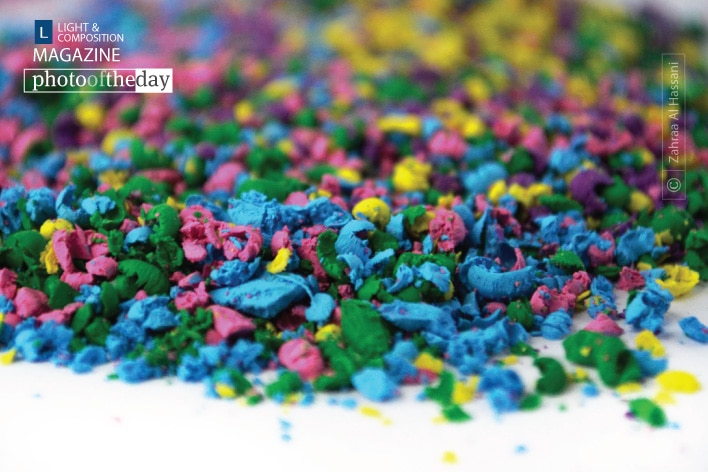
Exposure 1/60sec @ f/5.6 | ISO 800 | Focal Length 55mm
Zara Otaifah
Based in Baghdad, Iraq, Zahraa Al Hassani is a dedicated graphic designer and photographer who balances a professional career at Zain Telecommunications with her creative pursuits. A graduate of the University of Technology in Baghdad, she leverages her extensive background in graphic design to refine her unique photographic perspective. Her work is deeply influenced by her professional experience in visual communication, leading her to explore the intersection of design and photography. Committed to continuous learning, she strives to master the nuances of purist photography while documenting the vibrant world around her.
Resonance Score Breakdown
Transparency Note: The resonance score (12.8/20) is calculated based on social engagement metrics collected before the award announcement.
Expert Photography Reviews · 5
The Dust of Creation
We often look for beauty in the grand and the permanent, forgetting that the world is built from the smallest fragments. There is a quiet grace in the broken pieces—the remnants of a task finished, the dust of a dream once held in the hand.
Read the reflection →The Alchemy of Dust
We are taught that to create is to build, to stack stone upon stone until a structure rises to meet the sky. But there is a quieter, more honest way to exist: the way of the fragment.
Read the reflection →Reviews & Comments
Share your thoughts about this award-winning photograph. Your reviews contribute to the community engagement score.
There’s a quiet patience in these scattered wax fragments, a stillness I recognize from the desert at dawn. She didn’t rush the arrangement; she listened to the pigment. It’s rare to find such reverence for the mundane. Looking at these vibrant, broken crumbs, I feel a sudden, sharp ache for the simplicity of childhood. She’s captured the light not as a tool, but as a conversation between color and the cooling, shadowed surface of the table.
At f/5.6, the focal plane is razor-thin, forcing the Nikon’s sensor to resolve the chaotic geometry of these wax fragments. The diffraction of light across the jagged edges of the crayon crumbs is, in the strictest physical sense, extraordinary. I’m genuinely moved by how the lens captures the waxy translucence; it’s a tactile brilliance the naked eye usually misses. It’s not just color—it’s the physics of pigment rendered with such sharp, clinical intimacy.
It’s a tidy bit of tabletop geometry, isn’t it? One suspects the wax was arranged in a climate-controlled room, far from the biting wind that usually defines a proper day’s work. There’s no shivering here, no waiting for the sun to break a storm. It’s clever, certainly, but I find myself missing the grit of the street. I prefer my color earned in the dust of Baghdad, not scraped from a child’s crayon box.
Crayon crumbs aren’t merely pigment; they’re the debris of childhood’s lost architecture. Al Hassani forces us to confront the waxen remains of a world that’s already fractured. I’m unsettled by how these vibrant shards refuse to coalesce, shivering against the encroaching dark. It’s a violent geometry. When I look at these jagged edges, I don’t see playfulness. I see the heavy, suffocating weight of a Baghdad afternoon where even color must fight to exist.
Before the eye identifies the wax, something in the chest tightens. It’s the sudden, sharp memory of a classroom floor, the smell of heat and crushed pigment. These crumbs don’t just sit there; they vibrate against the retina, triggering a sensory overload that feels like childhood impatience. I’ve returned to this frame three times today, and each time, the chaos of the color settles into a quiet, aching nostalgia for things we’ve long since broken.