We All Have to Eat by Stephen Chu
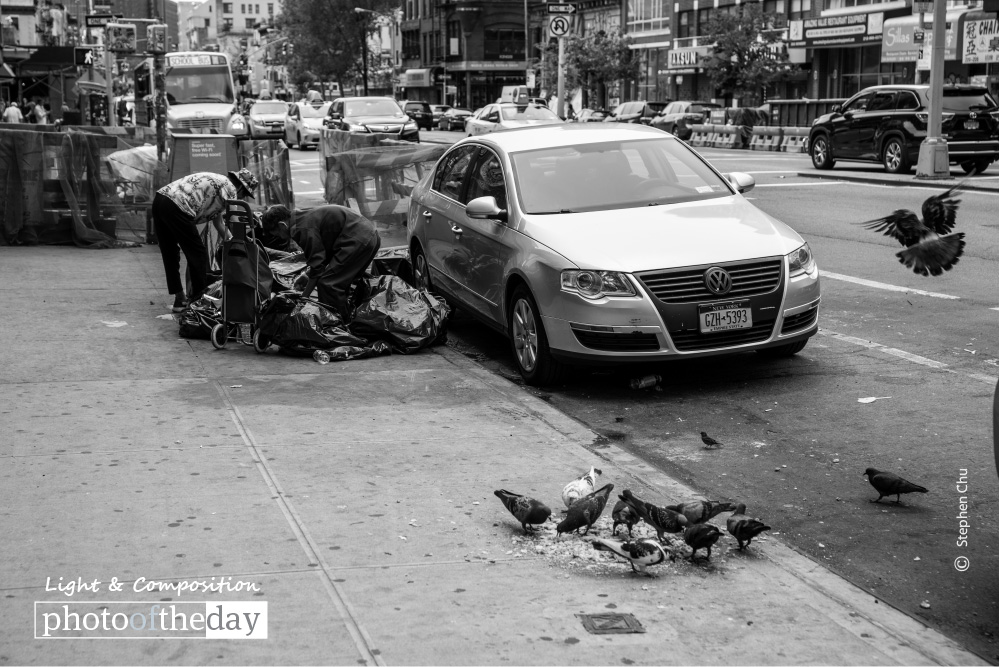
Captured during a summer visit to Manhattan, this poignant street photograph documents two elderly women foraging for recyclables alongside pigeons scavenging for food scraps. The photographer was struck by the stark parallel between the human struggle for survival and the animal instinct to feed within the city's relentless, throwaway culture. By framing this scene, the image serves as a powerful meditation on the universal necessity to eat and survive. The work is award-worthy for its raw, empathetic observation of urban life, transforming a fleeting moment of social reality into a profound narrative about humanity's shared existence.
Stephen Chu
Born in Toronto, Canada, Stephen Chu is a dedicated street photographer and lifelong student of the world who spent many years living in the United States before returning to his hometown. Known for his compassionate, observational approach, he specializes in documenting the raw, serendipitous moments of urban life and the diverse emotions of humanity. Through his lens, Chu strives to capture the quiet whispers of society, honing his craft to imbue every frame with a deep sense of empathy and a profound connection to the human experience.
Resonance Score Breakdown
Transparency Note: The resonance score (12.7/20) is calculated based on social engagement metrics collected before the award announcement.
Expert Photography Reviews · 4
The Weight of the Daily
I keep a small, rusted tin box in my desk drawer, filled with the silver foil wrappers of candies I shared with my father years ago. They are thin, crinkled things, useless to anyone else, yet they hold the shape of his thumbprints and the quiet rhythm of our afternoons.
Read the reflection →The Common Table
In the quiet hours of the morning, before the city finds its voice, there is a rhythm to the streets that goes unnoticed. It is the rhythm of the gatherer.
Read the reflection →Reviews & Comments
Share your thoughts about this award-winning photograph. Your reviews contribute to the community engagement score.
The light here is harsh, unforgiving, reflecting off the concrete like a mirror of urban indifference. I’ve spent enough time in city canyons to know that glare; it’s a lonely, flat exposure. Watching these women stoop alongside the pigeons, I feel a sudden, sharp ache in my chest. They aren’t just scavenging; they’re waiting for the city to yield its scraps. It’s a quiet, brutal communion. He stood there, patient, listening to their shared, silent hunger.
Comparing elderly women to pigeons scavenging for scraps feels lazy, not profound. Why does Chu equate human survival with animal instinct? It’s a reductive gaze that strips these women of their dignity, turning their struggle into a convenient visual metaphor for his own narrative. I find the comparison deeply uncomfortable. Does this framing actually honor their reality, or does it just make the photographer feel observant? It’s a hollow observation that ignores the systemic failures forcing them there.
Shadows here don’t merely define the pavement; they swallow the dignity of the scavenging women. It’s a brutal alchemy. When I look at those dark, encroaching voids, I feel a sudden, cold ache in my own chest—the realization that we’re all just waiting for the light to fail. Chu doesn’t offer comfort. He forces us to confront the hunger that persists long after the sun retreats. It’s a haunting, necessary descent into the urban abyss.
The frame is anchored by a rigid vertical axis, bisecting the human subjects from the avian cluster. Chu’s geometry relies on a 3:2 ratio of negative pavement space to the active foraging zone, creating a heavy gravitational pull toward the lower-left quadrant. I’m genuinely moved by how the diagonal lines of the women’s posture echo the pigeons’ frantic vectors. It’s a perfectly solved spatial equation where the chaos of survival is contained within such precise, calculated boundaries.