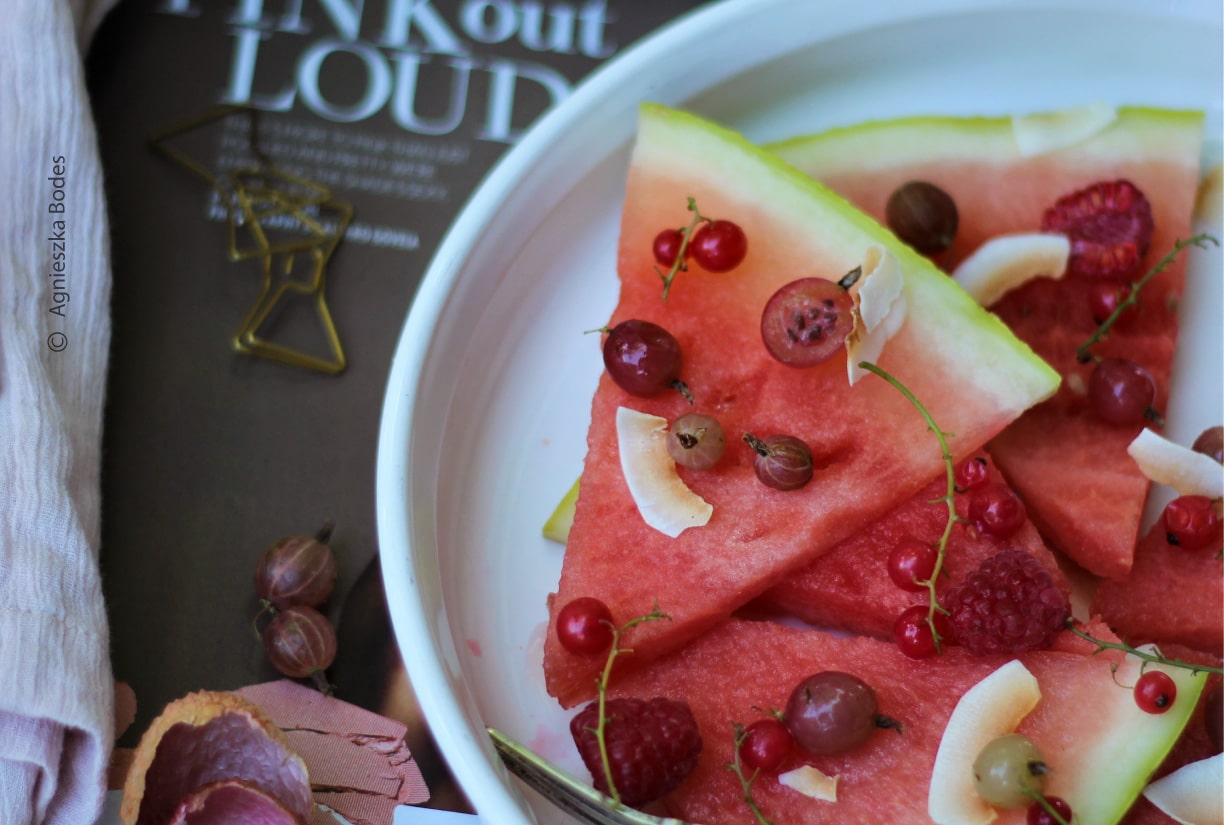
Watermelon Pizza by Agnieszka Bodes
Captured to celebrate the vibrant simplicity of seasonal produce, this image presents a watermelon pizza as a refreshing, guilt-free summer indulgence. The photographer utilized soft natural light to illuminate the dish, carefully arranging magazine pages and delicate hydrangea flowers in the background to evoke the essence of a lazy, sun-drenched afternoon. By focusing on organic textures and a bright, airy aesthetic, the composition transforms a humble snack into a sophisticated culinary portrait. Its award-worthy quality lies in the harmonious balance of color and the intentional, relaxed atmosphere that invites the viewer to savor the fleeting beauty of the season.
Agnieszka Bodes
Born in Poland and currently based in Ottawa, Canada, Agnieszka Bodes transitioned from a background in fashion blogging to become a dedicated food photographer. Her creative process is deeply rooted in a passion for natural light and the use of self-painted backdrops and vintage props to craft evocative culinary narratives. Bodes views food as a complex tapestry of textures, colors, and childhood memories, consistently striving to capture the unseen details of daily life through her lens.
Resonance Score Breakdown
Transparency Note: The resonance score (11.1/20) is calculated based on social engagement metrics collected before the award announcement.
Expert Photography Reviews · 7
The Weight of a Season
Why do we insist on capturing the things that are meant to vanish? There is a peculiar melancholy in the way we try to hold onto summer, as if by freezing a moment of abundance we could somehow stall the inevitable turning of the leaves.
Read the reflection →The Sweetness of Staying Still
I spent this morning trying to clear off my kitchen counter, moving stacks of mail and half-finished projects to make space for a simple breakfast.
Read the reflection →Reviews & Comments
Share your thoughts about this award-winning photograph. Your reviews contribute to the community engagement score.
The watermelon slice anchors the frame, creating a sharp isosceles triangle that bisects the lower quadrant. Its vibrant red mass is perfectly countered by the hydrangea’s soft, chaotic geometry in the upper right. I’m genuinely struck by how the radial lines of the fruit slice pull the eye toward the center of gravity. It’s a clean, solved equation of color and form. The negative space doesn’t just exist; it breathes, balancing the composition’s inherent tension.
1/400sec at f/1.8 on a 50mm lens. It’s a razor-thin plane of focus that barely contains the subject. The depth of field is aggressive, rendering the background hydrangeas into a nervous, indistinct smear. I’ve seen this bokeh-heavy approach a thousand times, and it’s lazy. You’ve sacrificed the context of the scene for a shallow aesthetic. It’s technically functional, sure, but it doesn’t respect the geometry of the plate. I’m tired of seeing f/1.8 used as a crutch.
It’s jarring to see such vibrant reds and yellows without a single hint of backscatter or the inevitable blue-green shift that haunts my dives. Down there, those hues vanish within meters, yet here, they’re perfectly preserved. I’m honestly envious of how easily this light hits the watermelon; there’s no refractive index to fight, no strobe angle to calculate. It’s a clean, dry world, and frankly, I find the lack of suspended particles quite refreshing.
Before the eye identifies the fruit, a sudden lightness settles in the chest. It’s the sensory memory of a humid July afternoon, the kind that makes your pulse slow. The hydrangea’s soft blur pulls at my own nostalgia, grounding the vibrant watermelon in a quiet, domestic stillness. I’ve returned to this frame three times today; it doesn’t demand attention, it simply exhales. It’s a rare, cooling relief that lingers long after I’ve looked away.
The light here isn’t forced; it’s the soft, diffused glow of a room where time has slowed to a crawl. She waited for that gentle, northern clarity to touch the watermelon’s rind. I’ve spent enough dawns in the field to recognize that stillness. It’s quiet, almost sacred. Looking at those hydrangea petals, I feel a sudden, sharp ache for the fleeting summer heat. It’s a humble, honest prayer to the season’s brief, beautiful grace.
It’s a pretty scene, sure, but where’s the pulse? I’ve spent my life looking for the human story, and here, the watermelon is the star, not the person who made it. The flowers and pages are lovely, but they feel staged, not lived in. I’m left wanting a pair of hands, maybe a smudge of juice on a thumb. It’s technically sharp, but it doesn’t tell me a single thing about a life.
Why do we insist on domesticating nature into a lifestyle accessory? Bodes frames this watermelon as a prop, nestled among hydrangea and magazines, stripping the fruit of its messy, sticky reality. It’s a sanitized, middle-class fantasy of summer. I find the artifice exhausting. Does the frame exclude the labor behind this produce, or just the juice dripping down a chin? It’s pretty, sure, but it’s a hollow performance of leisure that feels entirely detached from the earth.