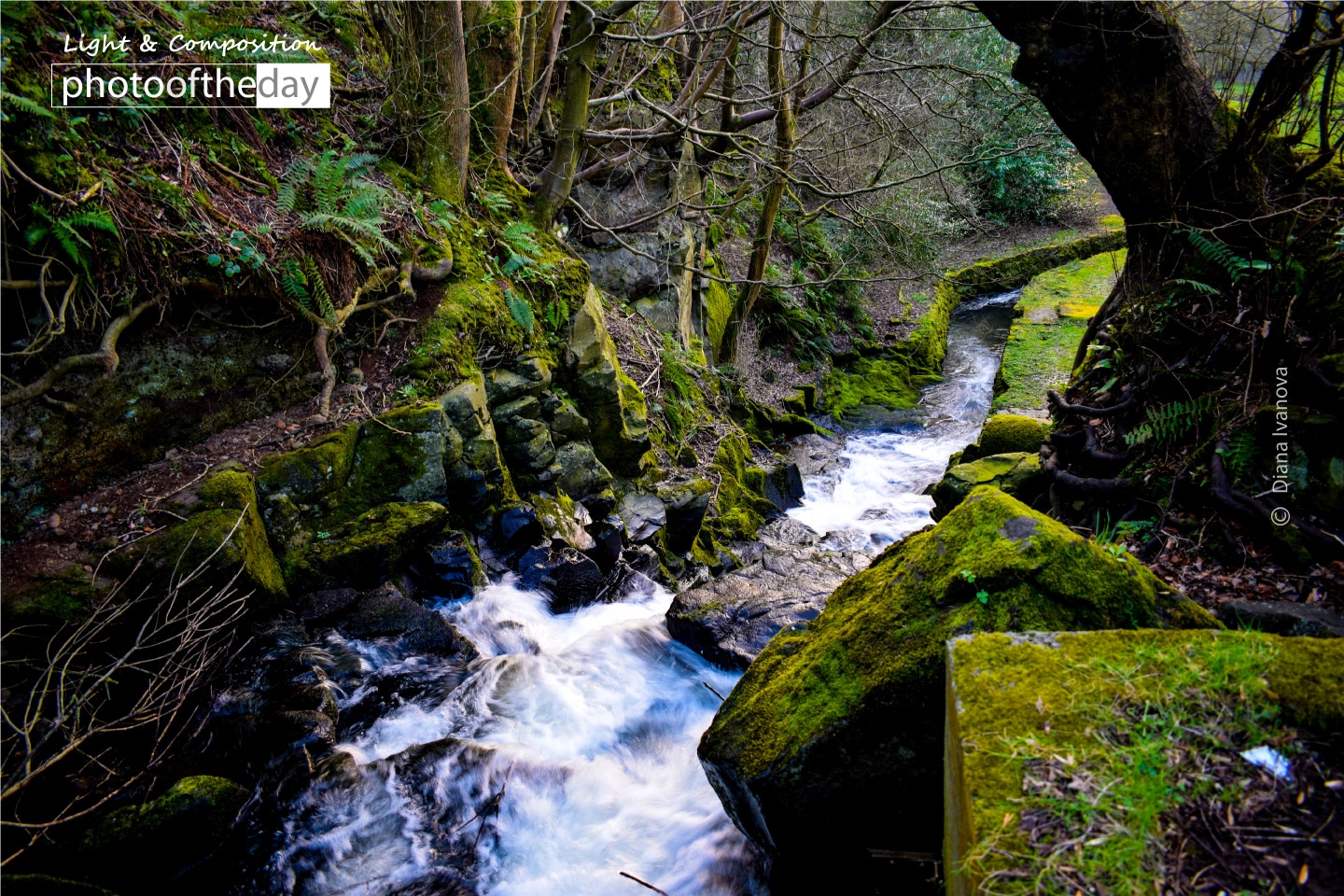
Waterfall in the Garden by Diana Ivanova
Captured on February 27, 2019, within the historic Daffodil Garden in Coleraine, Northern Ireland, this photograph highlights the serene beauty of a cascading water feature nestled among a world-renowned collection of cultivars. The photographer carefully composed the shot to emphasize the interplay between the flowing water and the meticulously curated heritage landscape. This image is award-worthy for its ability to transform a documented botanical site into a tranquil, evocative scene, demonstrating a keen eye for natural light and environmental harmony that elevates the garden’s status as a site of both historical and aesthetic significance.
Diana Ivanova
Born in Bulgaria, Diana Ivanova is a dedicated photographer currently based in Portrush, Northern Ireland. Her creative practice is defined by a deep-seated passion for discovery, viewing the camera as an essential tool for movement, learning, and exploration. Through her extensive travels, she captures the world with a focus on narrative and discovery, consistently striving to share her unique perspective with an international audience through her featured photographic work.
Resonance Score Breakdown
Transparency Note: The resonance score (10.7/20) is calculated based on social engagement metrics collected before the award announcement.
Expert Photography Reviews · 4
The Weight of Running Water
I keep a small, smooth river stone on my desk, worn down by years of being turned over in my palm. It is a heavy, silent thing, yet it speaks of a journey that never truly ends.
Read the reflection →The Architecture of Restraint
We often mistake the manicured garden for a slice of wild nature, forgetting that every hedge and watercourse is a manifestation of human intent.
Read the reflection →Reviews & Comments
Share your thoughts about this award-winning photograph. Your reviews contribute to the community engagement score.
Water is a ghost. It never repeats. Diana caught the flow, but I’m looking for the tension that makes a frame breathe. It’s pretty, sure, but where’s the friction? Cartier-Bresson would’ve waited for a stray petal or a frantic insect to break that stillness. I feel a strange, quiet ache looking at this—it’s peaceful, but it’s static. One tenth of a second later and the light might’ve danced. It’s a garden, but is it alive?
It’s a pleasant enough garden scene, but one wonders if the tripod ever left the path. The light feels accidental rather than invited. I’ve spent enough February mornings shivering in Northern Irish rain to know that true water studies require a certain damp misery. This feels like a lucky stroll, not a siege. It’s pretty, certainly, but I’m left wanting the grit of someone who actually stood there until the garden finally surrendered its secret.
The vertical axis here is anchored by the waterfall’s descent, creating a sharp 1:2 ratio against the surrounding foliage. I’m tracing the diagonals formed by the stone edges; they intersect perfectly, pulling the eye toward the lower-left quadrant. It’s a beautifully solved spatial equation. Honestly, the way the water’s motion disrupts the static geometry of the garden makes my heart race. It’s rare to see such precise, calculated tension balanced within a natural, organic frame.
Coleraine’s Daffodil Garden feels staged, doesn’t it? Ivanova captures the water’s movement, but I’m left wondering who curated this nature for our consumption. Why does the frame exclude the labor required to keep these cultivars so obediently pristine? It’s technically sharp, yet it feels hollow. I’ve seen this sanitized version of Ireland before, and honestly, it makes me feel restless. Whose history are we actually looking at here, and why does it feel so controlled?