Walking Down by Ryszard Wierzbicki
Captured during a trek along the Annapurna Circuit in the Himalayas, this image documents the rhythmic, arduous journey of mule caravans navigating the steep mountain paths. The photographer was drawn to the juxtaposition of the majestic, rugged Nepalese scenery and the tireless labor of the animals transporting goods to remote villages. By focusing on the descent, the composition highlights both the scale of the landscape and the intimate reality of mountain life. This photograph is award-worthy for its authentic storytelling, capturing a fleeting, culturally significant moment with technical precision and a profound sense of place.
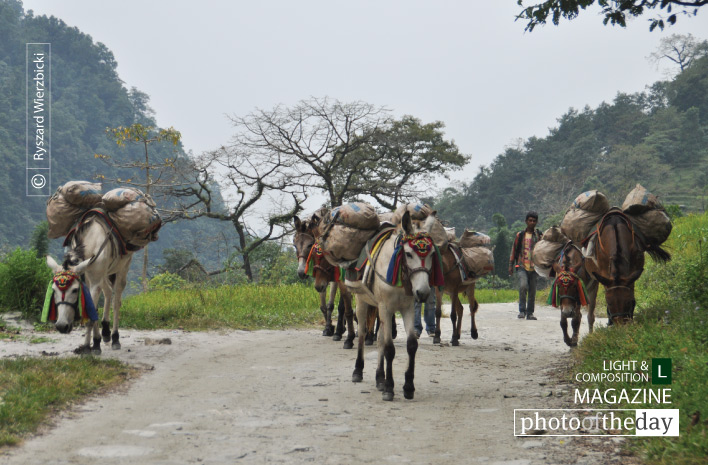
Exposure 1/500sec @ f/5.3 | ISO 400 | Focal Length 66mm
Ryszard Wierzbicki
Born in Poland in 1963, Ryszard Wierzbicki transitioned from a diverse career in education and marketing to a life dedicated to global exploration. After emigrating to the United Kingdom in 2006, he shifted his focus toward photography, travel, and scuba diving, eventually establishing online communities for fellow adventurers. His work is deeply informed by his experiences in South-East Asia and his commitment to charitable causes, reflecting a profound curiosity about the world and a desire to document the human and natural landscapes he encounters.
Resonance Score Breakdown
Transparency Note: The resonance score (13.5/20) is calculated based on social engagement metrics collected before the award announcement.
Expert Photography Reviews · 8
The Weight of the Path
I spent this morning trying to clear out my hallway closet. It was one of those tasks I had been putting off for months, mostly because I knew how much heavy lifting it would require.
Read the reflection →The Weight of the Ascent
We are all, in some measure, tethered to the things we carry. We walk through our own personal mountain ranges, navigating paths that have been worn smooth by the persistence of those who came before us.
Read the reflection →Reviews & Comments
Share your thoughts about this award-winning photograph. Your reviews contribute to the community engagement score.
Did you also take note of how they threw rocks to the animals to “direct” them…? Heaven and hell all in one place.
Before the eye identifies the mules, something in the chest tightens. It’s the weight of the descent, that rhythmic, heavy gravity pulling at the lungs. I feel a sudden, sharp ache in my own calves, a phantom fatigue from the steep, jagged path. When I return to this, I don’t see scenery; I see the silence of the climb. It’s a quiet, persistent exhaustion that follows me home, lingering long after the screen goes dark.
The diagonal descent creates a rigid vector, forcing the eye toward the lower frame. It’s a precarious geometry. The mule’s placement against the jagged scree provides a necessary fulcrum, anchoring the vast, indifferent negative space of the mountainside. The composition holds, though it’s dangerously close to collapsing under the weight of its own scale. I’ve grown weary of such landscapes, yet the structural discipline here demands a grudging respect. It’s a precise, cold architecture.
The dust rises in the thin, high-altitude air, catching that sharp, unforgiving light that only exists above the clouds. He stood there, waiting for the rhythm of the caravan to align with the mountain’s silence. It’s a heavy, rhythmic descent. I feel the ache in my own calves just looking at those mules. He didn’t rush the shutter; he listened to the stone and the breath of the animals until the path finally felt complete.
Of the thousands of travel shots I’ve reviewed, most are just postcards. What separates this from the pack is the rhythmic tension between the mules’ heavy, rhythmic descent and the crushing scale of the Manang peaks. It’s a brutal, honest look at labor. I’ll admit, my heart sank a little seeing the strain in those animals. It’s not just a trek; it’s a thirty-year document of a way of life that’s slowly vanishing. That’s why it endures.
The mountain path is steep. The mules descend. It’s a heavy, rhythmic pulse against the vast, grey stone. I feel the cold air in my lungs just looking at it. Wierzbicki doesn’t crowd the frame. He lets the rock breathe. The emptiness above the caravan isn’t just sky. It’s weight. It’s silence. Nothing here is accidental. The empty corner is not empty. It’s the space where the journey finally finds its quiet.
1/500sec at f/5.3, 66mm, ISO 400. It’s a safe, middle-of-the-road aperture choice that keeps the mule train sharp while letting the background soften just enough. The shutter speed is sufficient to freeze the movement, though I’d have preferred a tighter stop to pull more detail from the Himalayan rock face. It’s technically competent, if unadventurous. Honestly, the dust kicked up by those hooves makes me miss the trail. It’s a clean, functional capture of a brutal climb.
At 66mm, the Nikon’s glass struggles against the harsh Himalayan glare, yet the focal plane captures the mule’s gait with surprising fidelity. While the diffraction limit softens the distant scree, the micro-contrast on the animal’s harness is sharp enough to reveal the grit of the trail. It’s a rugged, honest rendering. I’m genuinely moved by how the lens resolves the dust motes dancing in the light; it’s a fleeting, microscopic beauty that most eyes simply miss.
The ochre dust of the Annapurna trail rises like a Turner fog, swallowing the mules in a haze of burnt sienna and parched earth that feels almost tactile against the skin. It’s a palette of profound exhaustion, where the muted, stony greys of the mountainside quarrel with the sun-bleached hides of the beasts. I’m breathless, truly, watching how the light clings to those tired flanks; it’s a melancholy, dusty symphony that lingers long after one looks away.