Wagasa by Jose Manuel Renteria Cobos
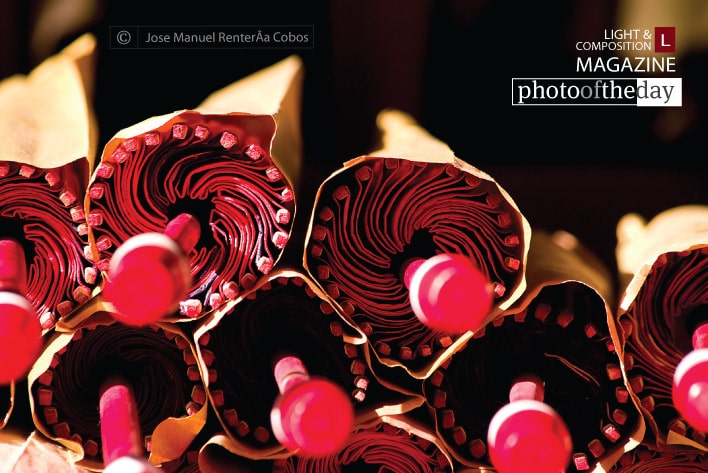
Captured on a crisp November day in 2010, this photograph highlights the intricate beauty of a traditional Japanese Wagasa. By focusing on the delicate bamboo structure and the refined Washi paper, the photographer captures the elegance of an object designed for both utility and art. The choice of a 170mm focal length allows for a tight, intimate framing that emphasizes the umbrella's complex geometry and vibrant textures. This image is award-worthy for its ability to elevate a cultural artifact into a study of form and color, inviting the viewer to appreciate the quiet craftsmanship inherent in Japanese tradition.
Jose Manuel Renteria Cobos
Born in Veracruz, Mexico, in 1973 and raised in Guadalajara, Jose Manuel Renteria Cobos is a professional airline pilot currently based in Osaka, Japan. His photographic journey, which began in 2000, is driven by a deep passion for aviation, street, and landscape photography, viewing the craft as a creative escape from his daily routine. A dedicated Pentax user, he constantly seeks to refine his technical skills while exploring the photogenic landscapes of his adopted home in Japan, documenting the world through a lens of curiosity and artistic discovery.
Resonance Score Breakdown
Transparency Note: The resonance score (13.1/20) is calculated based on social engagement metrics collected before the award announcement.
Expert Photography Reviews · 7
Shelter from the Quiet
I spent this morning trying to fix a broken hinge on my kitchen cabinet. It was one of those small, nagging tasks I had ignored for months.
Read the reflection →The Architecture of Shelter
In the quiet corners of a house, we often find objects that have outlived their original purpose, becoming instead small monuments to the hands that shaped them. There is a specific, rhythmic patience required to weave bamboo or treat paper until it holds the rain at bay.
Read the reflection →Reviews & Comments
Share your thoughts about this award-winning photograph. Your reviews contribute to the community engagement score.
Most submissions in this category lean on the exoticism of Japan, but this frame succeeds by ignoring the landscape entirely. By tightening the focal length to 170mm, the photographer forces us into the bamboo ribs of the Wagasa. It’s a study in tension. I’ve stared at these geometric intersections for years, and they still feel alive. It’s rare to see an object treated with such reverence; it’ll be just as sharp in thirty years.
The light here isn’t just illumination; it’s a soft, diffused breath caught within the bamboo ribs. I’ve spent enough mornings waiting for such stillness to recognize the patience required to frame this. It’s not about the umbrella, but the quiet geometry of tradition. When I look at those delicate, translucent veins of Washi paper, I feel a sudden, sharp ache for the silence of that November day. He didn’t rush. He simply listened to the light.
At f/7.1, the Pentax resolves the bamboo ribs with startling clinical precision. The focal plane is razor-thin, yet it captures the Washi paper’s fibrous weave before diffraction softens the edges. I’m genuinely moved by how the 170mm compression flattens the geometry into a rhythmic, structural pulse. It’s rare to see a lens push this hard into the material reality of an object. It doesn’t just show the Wagasa; it dissects the very physics of its craft.
The bamboo ribs pull the eye inward. Tension. Geometry. It’s a study of restraint. I find myself holding my breath, waiting for the paper to tear or the wind to shift. It doesn’t. The frame is tight, yet the space between the ribs breathes. Nothing here is accidental. The empty corner is not empty. It’s a quiet ache of tradition. I’ve never seen a Wagasa feel this heavy, this still. It’s enough.
A 170mm lens doesn’t hide a lack of commitment, yet here the geometry holds up. One suspects Cobos spent a long, shivering morning waiting for that specific light to hit the Washi paper just so. It’s a quiet, disciplined study. I’ve spent enough hours in the damp waiting for a single frame to recognize the patience required here. It’s not a lucky snap; it’s a photograph that’s been properly earned. Well played.
The cinnabar of the Washi paper vibrates with a visceral intensity that reminds one of Vermeer’s most daring pigments, yet it’s the way the light filters through the bamboo ribs—a pale, bruised ochre—that truly steals my breath. It’s a quiet, rhythmic collision of warmth that feels like a secret shared in the rain. I’ve rarely seen such a delicate tension between the structural geometry and the soft, bleeding heat of the paper’s saturated, sun-drenched skin.
The geometry of the Wagasa’s bamboo ribs dictates the frame’s internal logic. It’s a rigid, radial architecture that forces the eye toward the center. The tension between the translucent Washi paper and the dark, skeletal frame creates a necessary spatial weight. I’ve rarely seen such disciplined radial symmetry. It doesn’t rely on sentimentality; it relies on the precision of the 170mm compression. The frame holds because the structure demands it. It’s quite satisfying.