Too Dark Park by Andrea Migliari
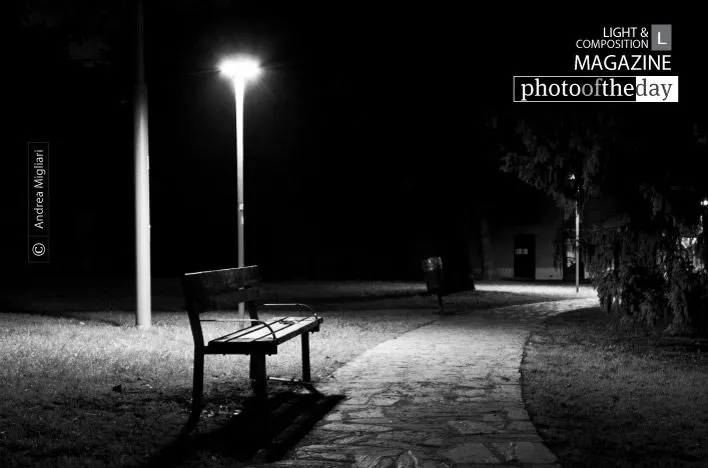
Captured at 2:00 AM, this photograph explores the eerie transformation of a city park under the cover of darkness. The photographer wandered through the quiet landscape, drawn to the stark, sinister contrast between deep shadows and pockets of artificial light. By utilizing a long 30-second exposure, the image emphasizes the mysterious path as it vanishes behind the trees, creating a sense of depth and unease. This work is award-worthy for its masterful command of nocturnal light and its ability to turn a familiar urban space into a haunting, cinematic scene that evokes a profound sense of solitude.
Andrea Migliari
Born in Italy in 1981, Andrea Migliari developed his artistic eye through a diverse life journey that took him from the urban landscape of Milan to the serene countryside near Lake Maggiore and a transformative period in London. A passionate photographer since his teenage years, he transitioned from traditional film and darkroom techniques to digital mastery, eventually refining a distinct workflow that spans landscapes, portraits, and live music. His work has been recognized in prestigious Italian art publications and photography competitions, reflecting his commitment to finding profound beauty in the everyday corners of the world.
Resonance Score Breakdown
Transparency Note: The resonance score (12.3/20) is calculated based on social engagement metrics collected before the award announcement.
Expert Photography Reviews · 8
The Quiet After Midnight
There is a particular quality to the world when the rest of the world has gone to sleep. The noise of the day—the chatter, the movement, the constant demands of being—dissolves into a heavy, velvet silence. In these hours, the things we walk past without notice begin to breathe.
Read the reflection →The Weight of Empty Paths
I keep a small, rusted skeleton key in a velvet-lined box, though I have long since forgotten which door it once opened. It is heavy for its size, cold to the touch, and carries the weight of a threshold I can no longer cross.
Read the reflection →Reviews & Comments
Share your thoughts about this award-winning photograph. Your reviews contribute to the community engagement score.
Two in the morning in Treviglio. Most would be tucked away, but Migliari’s out there, shivering for thirty seconds while the shutter drags. It’s a lonely business, isn’t it? I’ve spent enough nights in the damp to recognize that particular chill in the shadows. The composition doesn’t just happen; it’s wrestled from the dark. One suspects he returned until the light behaved. It’s a quiet, earned sort of solitude that I find rather refreshing. Well played.
The light spills across the path. It doesn’t reach the trees. I feel a sudden chill looking at that black void. It’s a heavy, velvet weight. The exposure holds the stillness of 2:00 AM perfectly. Nothing here is accidental. The empty corner is not empty. It’s a breath held in the dark. I’ve spent minutes staring into that shadow, waiting for the silence to break. It never does. It’s enough.
It’s a haunting charcoal symphony, where the absence of hue becomes a visceral, suffocating weight, echoing the muted, dusty stillness of a Morandi still life. I’m shivering at the way those artificial lamps bleed into the void, creating a sickly, sulfurous pallor against the encroaching obsidian. It’s not merely dark; it’s a terrifying, velvet abyss that swallows the path whole, leaving one to wander through a monochromatic dreamscape where the silence feels heavy, cold, and utterly, achingly lonely.
Treviglio’s park becomes a stage for a voyeuristic tension I find deeply unsettling. Why does the long exposure erase the human presence, leaving only an empty, artificial void? By stripping away the life that defines a public space, Migliari forces a sinister solitude onto a place meant for community. It’s a cold, calculated erasure. Who is this park for, if not the people? I can’t help but feel like an intruder watching a crime scene.
Thirty seconds of exposure turns Treviglio’s park into a ghost story. It’s not about the trees; it’s about the smear of light where the path dissolves into nothingness. I’m genuinely unsettled by how the artificial glow bleeds into the void. Why resolve the foliage when the blur captures the anxiety of the night better? This approach is closer to Hiroshi Sugimoto’s long-exposure theatres than to conventional landscape practice. It’s a brave refusal to let the camera see clearly.
At 2:00 AM, the world doesn’t just sleep; it exhales. Andrea stood here in the cooling dark, listening to the hum of artificial light against the encroaching void. That thirty-second exposure captures a stillness I’ve felt only when I’m truly alone. It’s haunting how the path dissolves into the trees, turning a common park into a liminal space. I find myself shivering, feeling the weight of that silence. It’s a quiet, heavy grace.
At two in the morning, the park isn’t empty; it’s waiting. We look at this path, stretching into the dark, and we feel the silence of someone who didn’t just walk through, but listened to the trees. It’s a portrait of a place holding its breath. I’ve walked paths like this, and honestly, it makes my skin prickle. Migliari didn’t just capture light; he captured the solitude of a ghost story told in shadows.
Before the eye identifies the path, the chest tightens. That thirty-second exposure doesn’t just capture light; it stretches the silence until it hums. I feel a sudden, sharp chill in my shoulders looking at those deep, swallowing shadows. It’s the kind of solitude that follows you into sleep. When I return to this park a year later, the trees feel closer, pressing in. It’s not a landscape anymore; it’s a place I’m afraid to walk through alone.