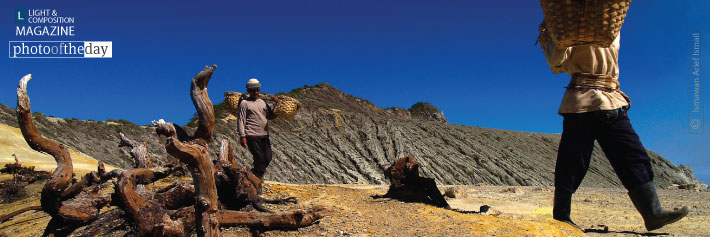
To the Crater by Ismawan Arief Ismail
Captured at the precipice of the Ijen crater in East Java, this documentary photograph highlights the grueling daily reality of traditional sulfur miners. The image documents the arduous journey of these laborers as they descend into the crater and navigate a steep, 200-meter climb while carrying 80-100kg loads of sulfur. By focusing on the raw strength and resilience of the miners against the dramatic backdrop of the volcanic landscape, the photographer captures a poignant intersection of human endurance and industrial hardship, earning recognition for its powerful storytelling and authentic portrayal of life in Indonesia’s mining regions.
Ismawan Arief Ismail
Born in 1972, Ismawan Arief Ismail is an IT executive based in Kuala Kencana, Papua, Indonesia. His photographic journey began during his high school years with a pocket camera, eventually evolving into a professional pursuit that complements his technical career. Currently balancing his corporate responsibilities with freelance assignments and stock photography, Ismail is dedicated to transitioning his long-standing passion for the lens into a full-time creative career.
Resonance Score Breakdown
Transparency Note: The resonance score (12.4/20) is calculated based on social engagement metrics collected before the award announcement.
Expert Photography Reviews · 4
The Weight of the Earth
We carry what we must. Sometimes it is a burden we choose, but more often it is the one assigned by the ground beneath our feet. There is a specific rhythm to labor that has nothing to do with time.
Read the reflection →The Weight of Breath
The air at high altitude has a sharp, metallic tang that clings to the back of the throat, tasting faintly of pennies and cold stone. It is a thin, hungry air that demands everything you have to offer.
Read the reflection →Reviews & Comments
Share your thoughts about this award-winning photograph. Your reviews contribute to the community engagement score.
Of the thousands of documentary frames I’ve reviewed, most vanish within a week. Ismail’s shot survives because of the tension between the sulfur’s toxic yellow haze and the miner’s strained posture. It’s not just a record of labor; it’s a visceral reminder of human cost. I’ll admit, the sheer weight of those baskets makes my own shoulders ache. That physical empathy is why this will still matter in thirty years. It’s brutal, honest, and essential.
One doesn’t simply stumble upon the Ijen crater with a camera and leave with this. The sulfur fumes alone would have sent a lesser photographer packing long before the light settled. Ismail clearly didn’t mind the sting in his lungs or the weight of the climb. I’ve spent enough time in similar hellscapes to know that grit when I see it. He earned every frame here. It’s a brutal, honest piece of work.
Sulfur fumes don’t just obscure the path; they swallow the miner’s intent. Ismail’s frame forces us to confront the abyss where light fails to penetrate the yellow haze. It’s a brutal, suffocating weight. I’ve stared at these shadows for hours, and I’m struck by how the darkness doesn’t hide the labor—it defines it. When the mountain demands everything, the shadow becomes the only honest witness left. It’s a heavy, necessary truth.
The sulfur’s jaundiced, acidic yellow—a hue reminiscent of Turner’s most feverish, toxic skies—clashes violently against the bruised, volcanic obsidian of the crater’s throat, creating a chromatic dissonance that makes my own chest tighten with a phantom, choking heat. It’s a brutal, visceral palette where the miners’ skin, rendered in the muted, dusty ochres of a Morandi still life, struggles against the landscape’s suffocating, mineral-heavy atmosphere, leaving one breathless before such relentless, chromatic cruelty.