Through the Night by Stefan Thallner
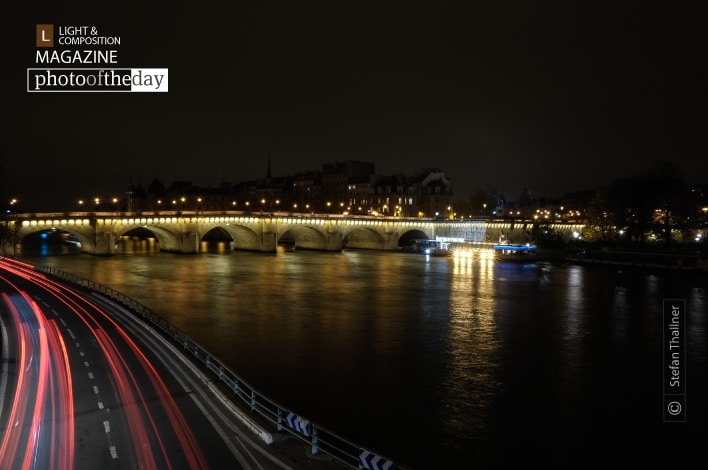
Captured during a quiet evening exploration of Paris, this photograph transforms the bustling tourist destination into a serene, nocturnal landscape. Stefan Thallner utilized a long exposure of 6.5 seconds to capture the city's stillness, carefully balancing the ambient light against the dark backdrop of the night. The composition is defined by its deliberate technical precision and a calm, atmospheric quality that invites the viewer to experience the city away from the daytime crowds. This image stands out for its masterful control of light and its ability to evoke a sense of peaceful solitude in one of the world's most vibrant capitals.
Stefan Thallner
Born in 1987 and based in Allhartsberg, Austria, Stefan Thallner is a photographer and web developer whose creative journey began with his grandfather’s vintage camera. After transitioning from technical computer science to professional web development, he refined his photographic craft through years of experimentation and a passion for exploring new challenges. His work, which has earned recognition in international competitions like the Scott Kelby Worldwide Photo Walk, reflects a deep sense of personal freedom and technical discipline, capturing moments that balance his analytical background with an artistic eye for light and composition.
Resonance Score Breakdown
Transparency Note: The resonance score (10.7/20) is calculated based on social engagement metrics collected before the award announcement.
Expert Photography Reviews · 6
The City After Hours
We often mistake the city for its peak performance—the rush of the commute, the commerce of the midday, the relentless noise of the crowd.
Read the reflection →The Silence Between Echoes
Why do we assume that a place is defined by the noise it makes? We walk through streets crowded with history and expectation, convinced that the city is a living, breathing beast that never sleeps.
Read the reflection →Reviews & Comments
Share your thoughts about this award-winning photograph. Your reviews contribute to the community engagement score.
The frame splits into a precise 1:2 ratio, anchoring the heavy architecture against the expansive, light-drenched pavement. Those converging lines create a perfect vanishing point that pulls the eye deep into the negative quadrant. It’s a rigorous spatial equation, yet the long exposure softens the geometry into something almost liquid. I’m genuinely moved by how the stillness resolves the chaos of Paris into such elegant, balanced vectors. It’s a rare, quiet victory of form over urban noise.
Most night shots of Paris are cluttered, desperate attempts to capture everything. Thallner’s work succeeds because he stripped the city down to its bones. The 6.5-second exposure didn’t just blur movement; it erased the noise of tourism entirely. I’ve stared at this for hours, and it’s the stillness that gets me—it feels like the city is finally holding its breath. In thirty years, we won’t remember the crowds, but we’ll remember this quiet, lonely light.
The frame’s geometry is its only salvation. Thallner’s long exposure flattens the Parisian architecture into a rigid, two-dimensional grid. It’s a cold, calculated exercise in spatial tension. The vertical lines anchor the composition, refusing to let the eye wander into the murky, underexposed voids. I’m genuinely unsettled by how the light bleeds into the pavement, disrupting the structural integrity. It doesn’t quite hold together, but the discipline of the frame keeps the chaos at bay.
Paris usually screams. Here, it breathes. The long exposure has stripped the city of its frantic pulse, leaving only the architecture of shadow. I feel a sudden, sharp ache for this stillness. It’s a rare grace. The frame doesn’t crowd the eye. It invites the gaze to rest in the dark, unhurried corners. Nothing here is accidental. The empty space is not empty. It’s a pause. A deep, quiet breath in the middle of the night.
You’ve managed to strip the noise out of Paris. I’ve walked those streets a thousand times, usually dodging crowds, but you’ve found the silence I’m always looking for. It’s lonely, isn’t it? That six-second exposure didn’t just capture light; it captured the city holding its breath. I felt a sudden, sharp ache of nostalgia looking at those empty stones. You waited for the world to stop moving so we could finally see it. That’s honest work.
The shutter stays open for six seconds, and Paris finally stops breathing. It’s a long, steady take where the light bleeds into the shadows, turning the city into a silent set. I’ve walked these streets, but I’ve never felt them this empty. The 18mm lens holds the frame wide, letting the stillness settle. It’s a perfect cut. If the shutter had closed a second earlier, the rhythm would’ve been lost. I’m genuinely envious of this quiet.