The Wonder Fruit by Bawar Mohammad
The Wonder Fruit captures the vibrant essence of the Hawraman pomegranates, celebrated globally for their superior quality and unique flavor. Set against the rugged, mountainous backdrop of the Kurdish region, the photograph highlights the fruit's rich texture and deep, natural hues. By utilizing a telephoto lens to isolate the subject, the photographer emphasizes the intricate details of the harvest, turning a local agricultural staple into a compelling visual narrative. This image is award-worthy for its ability to elevate a simple, culturally significant subject through precise technical execution and a keen eye for natural beauty.
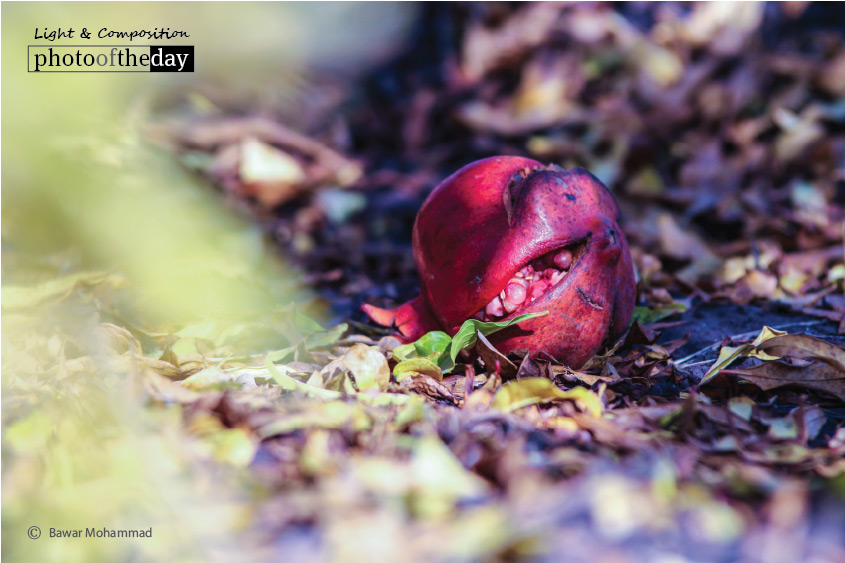
Exposure 1/500sec @ f/4 | ISO 100 | Focal Length 182mm
Bawar Mohammad
Born in 1985 in Duhok, Kurdistan, Bawar Mohammad is a computer science graduate who has dedicated his career to the arts and journalism. Working within the directorate-general of culture and arts, he has established himself as a versatile freelance photographer with a profound focus on nature, people, and regional heritage. His work serves as a bridge between his homeland and the international community, driven by a lifelong passion to document and share the artistic spirit of his nation with the world.
Resonance Score Breakdown
Transparency Note: The resonance score (12.5/20) is calculated based on social engagement metrics collected before the award announcement.
Expert Photography Reviews · 6
The Weight of the Harvest
There is a quiet dignity in the way the earth offers its bounty. We often rush past the cycle of growth, forgetting that every fruit is a slow conversation between the rain, the sun, and the patient soil.
Read the reflection →The Weight of the Harvest
Why do we feel a sudden, quiet reverence when we hold something that has spent months drinking the sun and the rain? There is a strange alchemy in the way a seed, buried in the dark, eventually pushes through the earth to offer itself up as sustenance.
Read the reflection →Reviews & Comments
Share your thoughts about this award-winning photograph. Your reviews contribute to the community engagement score.
In Hawraman, we don’t just harvest fruit; we gather stories. Bawar Mohammad’s pomegranate isn’t a still life, but a portrait of a landscape’s soul. We look at those deep, bruised crimsons and we feel the rugged weight of the mountains. It’s a quiet conversation between the earth and the hand that picked it. I’ve found myself lingering on the texture of the skin, feeling a sudden, sharp ache for a home I’ve never actually visited.
Most agricultural photography is purely functional, but this hits differently. I’ve seen thousands of fruit studies, yet the way Mohammad uses that 182mm compression to crush the Hawraman mountains into a soft, blurred backdrop makes the pomegranate feel monumental. It’s not just produce; it’s a relic of the landscape. I’ll admit, it makes me hungry for a place I’ve never visited. That’s the mark of an image that’ll still matter in thirty years. It’s earned its place.
Pomegranates in Hawraman aren’t plucked by the impatient. One suspects Mohammad spent a fair few hours dodging the mountain chill to catch this specific light. It’s a clean, sharp isolation of the harvest, though I’d have preferred a bit more grit in the frame to ground the fruit in that rugged landscape. Still, it’s a decent effort. I’ve spent enough time in similar terrain to know he didn’t just stumble upon this. It’s earned.
You’ve captured the weight of that pomegranate, and it makes me hungry for the soil it grew in. I can almost feel the rough skin under my own thumb. It’s a quiet, honest study of a harvest that clearly means everything to the people of Hawraman. Because you chose that tight focal length, you’ve stripped away the noise. You waited for the light to hit just right. There’s something deeply human in that patience. Nice work.
At 182mm and f/4, the focal plane is razor-thin, isolating the pomegranate’s leathery skin with clinical precision. The bokeh, a function of that wide aperture, renders the Hawraman mountains into a soft, chromatic wash that doesn’t distract from the fruit’s cellular texture. I’m genuinely moved by how the light catches those tiny, granular imperfections. It’s a rare moment where the lens resolves the biological complexity of the fruit beyond what my own eyes could ever hold.
The telephoto compression flattens the Hawraman terrain into a secondary plane, forcing the pomegranate into an aggressive foreground dominance. It’s a rigid, calculated isolation. The fruit’s weight anchors the frame, yet the background bokeh lacks the necessary structural density to support such a heavy subject. It’s almost clinical, though I’ll admit the texture of the rind against that blurred, chaotic mountain slope creates a tension that actually holds. The frame is tight, disciplined, and entirely unforgiving.