The Rising of the Moon by Nilla Palmer
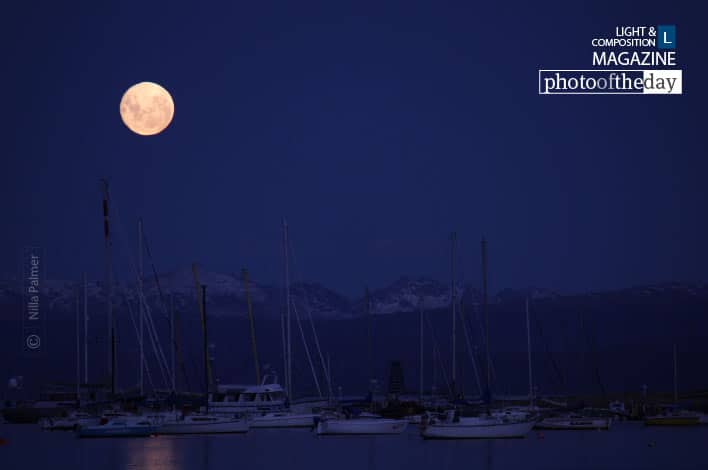
In the world’s southernmost city, Nilla Palmer captured an ethereal moment as an impossibly large moon cast a luminous glow over the boat-laden bay of Ushuaia. With winter approaching early, the moonlight danced across the water, perfectly reflecting the pristine, snowy slopes of the surrounding mountains. This image is award-worthy for its masterful handling of low-light conditions and its ability to evoke a profound sense of place. By balancing the stark brilliance of the moon against the quiet, frozen landscape, the photographer creates a tranquil yet striking narrative that transports the viewer to the edge of the world.
Nilla Palmer
Based in Brisbane, Australia, Nilla Palmer has spent over two decades cultivating a deep passion for global exploration and visual storytelling. Her journey began with film photography and darkroom techniques, eventually evolving into a sophisticated digital practice that seeks to capture fleeting, evocative moments. Driven by a desire to inspire audiences to discover far-off lands, Palmer focuses on creating images that leave a lasting impression, blending technical precision with a narrative intent that invites viewers to experience the world through her lens.
Resonance Score Breakdown
Transparency Note: The resonance score (13.1/20) is calculated based on social engagement metrics collected before the award announcement.
Expert Photography Reviews · 4
The Weight of the Tide
The moon does not ask for permission to rise. It simply arrives, a cold weight pulling at the salt and the silt. We spend our lives measuring the distance between the shore and the deep, convinced that we are the ones who decide when to leave and when to stay.
Read the reflection →The Quiet After Dark
I was walking home late last night, and for the first time in weeks, the streetlights were all flickering in unison. It felt like the world was holding its breath.
Read the reflection →Reviews & Comments
Share your thoughts about this award-winning photograph. Your reviews contribute to the community engagement score.
Ushuaia isn’t just a place; it’s a threshold. Palmer’s moon doesn’t illuminate the bay so much as it interrogates the silence of those frozen slopes. I’ve stared at these dark hulls, and they don’t invite us in; they repel our gaze, anchoring the frame in a necessary, heavy gloom. It’s a cold, lonely truth. When I look at those shadows, I feel a sudden, sharp ache for the things we’ve left behind in the dark.
The horizon line bisects the frame with surgical indifference. It’s a rigid anchor for the chaotic distribution of masts below. The moon’s placement creates a vertical axis that demands total visual obedience, yet the water’s reflection lacks the necessary geometric weight to ground it. I’ve grown weary of such atmospheric indulgence. It’s technically competent, but the composition doesn’t quite resolve. The tension between the peaks and the bay remains unresolved, leaving the frame feeling strangely hollow.
Most night shots of Ushuaia fall into the trap of over-processing the moonlight until it looks like a cheap postcard. What separates this from the field is the restraint in the water’s reflection; it’s not a mirror, but a textured, shivering silver. I’ve stared at this for years, and it still makes me shiver. It’s the silence of the snow-dusted mountains that anchors the frame, proving that stillness is the most powerful tool in photography.
Ushuaia’s cold air must have bitten deep that night. She waited until the moon claimed the bay, turning those frozen slopes into silver ghosts. It’s a quiet, heavy silence I’ve felt myself in the high desert. When I look at the way the light clings to the water, I feel a sudden, sharp ache for that stillness. She didn’t just capture a scene; she listened to the moon until it finally spoke to the earth.
Moon Struck!
Love this shot – you can ‘feel’ the calmness as you breathe in the beauty of the night.
Absolutely amazing!
Well done