The Past in the Present by Alessandra Gargano
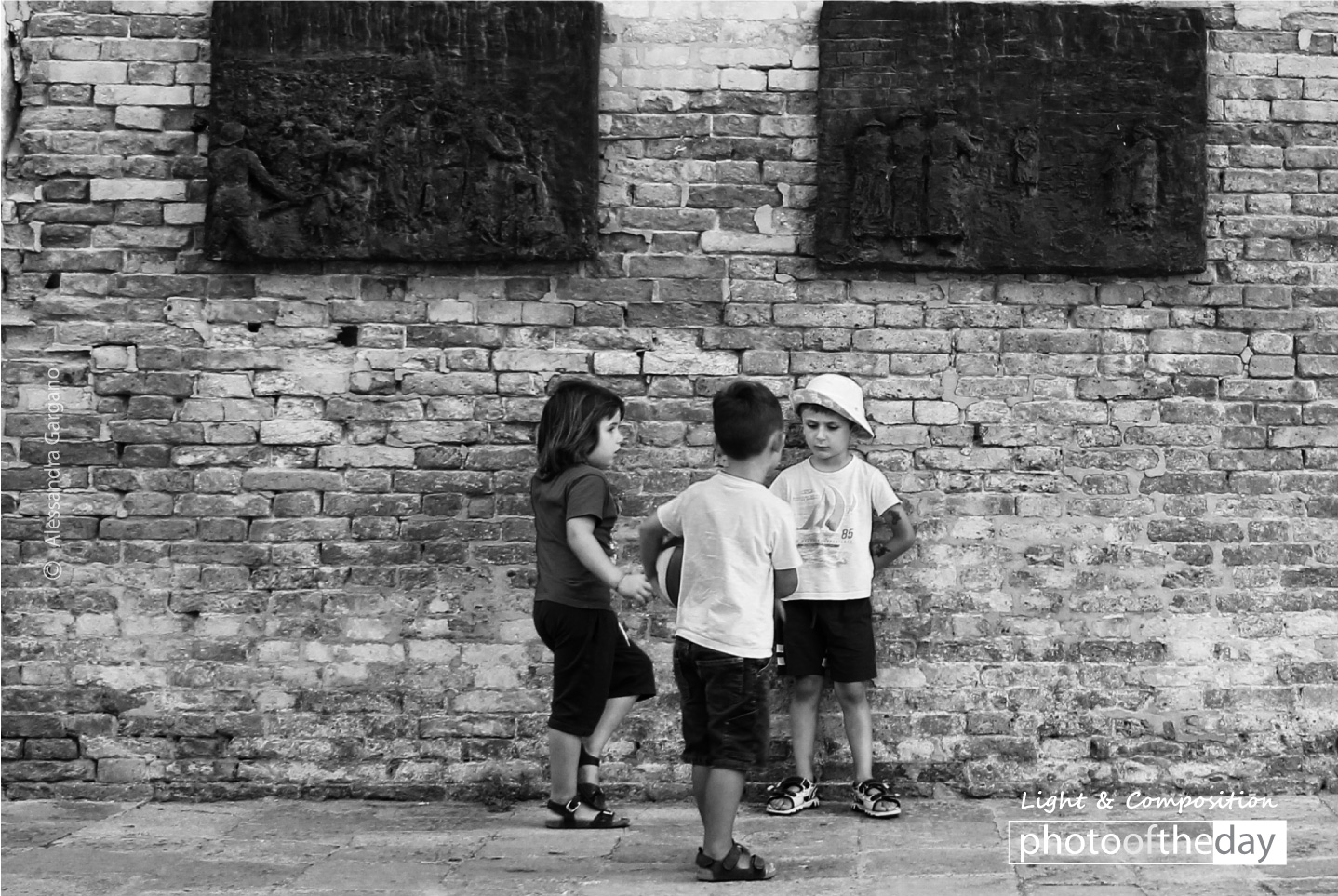
In this poignant street photograph, Alessandra Gargano captures a fleeting moment of childhood innocence set against the somber weight of history. As children organize their game, they stand before the bronze tiles of the Holocaust Monument in the Jewish Ghetto of Venice. The juxtaposition of vibrant, youthful life against the memorialized scenes of the Shoah creates a powerful dialogue between the past and the present. This image is award-worthy for its delicate balance of narrative depth and composition, transforming a quiet, everyday scene into a profound reflection on memory, resilience, and the continuity of human experience.
Alessandra Gargano
Based in Teramo, Italy, Alessandra Gargano is a dedicated photographer and law student who finds profound inspiration in the nuances of human behavior. Her work is defined by a keen ability to observe the subtle gestures and fleeting expressions of strangers, reflecting a deep emotional connection to her subjects. Through her lens, she seeks to document the beauty in everyday details, transforming simple moments into evocative narratives that resonate with empathy, joy, and thoughtful reflection.
Resonance Score Breakdown
Transparency Note: The resonance score (11.6/20) is calculated based on social engagement metrics collected before the award announcement.
Expert Photography Reviews · 8
The Weight of Pale Stone
There is a specific quality to the light in late autumn that feels heavy, as if the air itself has grown dense with the things we have forgotten to say. It is not the sharp, piercing clarity of a frost-bitten January, nor the diffuse, milky glow of a mid-summer fog.
Read the reflection →Echoes in the Stone
We often speak of time as a river, flowing in one direction, carrying us away from what has been. Yet, there are places where the current slows, where the weight of what came before presses gently against the soles of our feet.
Read the reflection →Reviews & Comments
Share your thoughts about this award-winning photograph. Your reviews contribute to the community engagement score.

Venice is a city built on water, yet here, the light behaves with a terrestrial clarity I rarely encounter. Looking at these children against the bronze tiles, I’m struck by the absence of the refractive distortion that usually muddies my world. There’s no backscatter to contend with, no desperate fight to reclaim the reds lost to depth. It’s hauntingly sharp. I find myself breathing easier, grateful for a scene where the light doesn’t steal anything away.
Most street photography is noise, but this hits differently. I’ve seen thousands of shots of Venice, yet Gargano’s framing of children playing atop the Holocaust memorial tiles stops me cold. It’s the tension between their oblivious movement and the cold, bronze permanence of the names beneath their feet. It hurts to look at, honestly. That friction is why this will still matter in thirty years. It doesn’t just document a moment; it forces us to confront time.
Before the eye identifies the bronze tiles, a cold stillness settles in the chest. It’s the dissonance that catches: the children’s kinetic, messy play colliding with the rigid, memorialized silence of the Ghetto. I find my breath hitching, caught between their fleeting joy and the weight beneath their feet. When I return to this, I don’t see history; I feel the terrifying, beautiful persistence of life. It’s a haunting reminder that we are always walking on ghosts.
The cold, metallic geometry of the bronze tiles anchors the frame, pulling the eye toward the weight of history beneath small, restless feet. It’s a heavy, somber stage. When I look at how the light hits those memorial markers, I feel a sudden, sharp ache for the innocence of the children playing above them. They don’t know the shadows they’re dancing on, yet their movement creates a beautiful, fragile dialogue between the past and our living present.
Why settle for a crisp, documentary rendering of Venice? Gargano’s choice to let the movement blur the children’s forms against those heavy, static bronze tiles is where the real work happens. It’s a ghosting effect that feels like memory itself. I’m genuinely moved by how she’s refused to resolve the figures, choosing instead to let them bleed into the history they’re playing upon. It’s closer to Sugimoto’s long-exposure theatres than to standard street photography. Brilliant.
Children playing atop the Stolpersteine in Venice’s Ghetto feels jarring. Does their innocence erase the trauma beneath their feet, or does it merely ignore it? I find myself holding my breath, unsettled by how easily we aestheticize this collision of play and genocide. Why do we demand that these children perform a narrative of resilience for our cameras? It’s a beautiful composition, sure, but it’s an uncomfortable act of looking that leaves me feeling deeply complicit.
Bronze tiles meet small feet. The children don’t look down. They’re playing. I’ve spent minutes watching the space between their shadows and the metal markers. It’s heavy. Yet, the frame breathes. It doesn’t crowd the history. It lets the silence sit. Nothing here is accidental. The empty corner is not empty. It’s a pause. I feel a sudden, sharp ache in my chest. Life continues. The past remains, held in the quiet.
The frame hinges on a sharp diagonal, slicing the composition into a 3:2 ratio of light-drenched stone against the dark, rhythmic grid of the bronze tiles. The children’s verticality disrupts the rigid, horizontal geometry of the memorial, creating a tension that’s mathematically precise. I’m genuinely moved by how their chaotic, organic placement resolves the static, repetitive pattern of the plaques. It’s a perfect spatial equation; the weight of history is balanced by the fleeting vector of youth.
Bellissimo scatto! Complimenti ?
Grazie ?
È bellissima, complimenti!
Grazie ?
È meravigliosa.. Super scatto!
Bravissima✌️?
Grazie ?
Intense !
Thanks ?
Complimenti!
Thanks ?
Bellissimo scatto ?
Grazie ?
Good job! :)
Thanks ?
?? Amazing!
Thanks ?
Good job
Grazie ?
Bravissima ❤️
Grazie ?
Beautiful ?
Grazie ?
Amazing!!
Thanks ?
Great picture! Amazing ??
Thanks ?