The New Tokyo Station by Madoka Hori
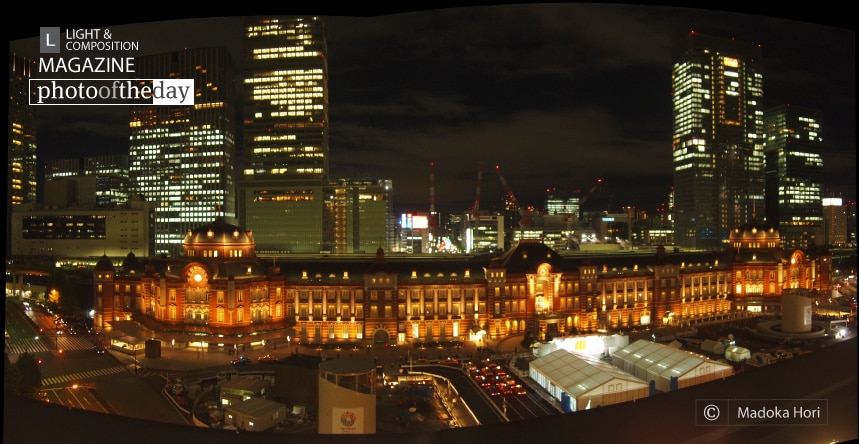
Captured just days before the grand reopening of Tokyo Station in 2012, this image reveals the historic brick facade after five years of extensive restoration. Positioned on the balcony of the Shin-Marunouchi Building, the photographer stabilized the camera on a handrail to secure a long exposure of the night scene. The resulting composition masterfully contrasts the warm, inviting glow of the station’s architecture against the cool, fast-paced energy of the surrounding metropolis. This photograph is award-worthy for its technical precision in low light and its ability to preserve a significant moment in the city's architectural history.
Madoka Hori
Based in Ashiya, Japan, Madoka Hori developed a fascination with photography at the age of four, eventually transitioning to digital media in her early twenties. Her work is defined by a keen interest in street photography and the exploration of human connection through the lens. Currently balancing a career in online marketing with her creative pursuits, Hori frequently utilizes her Olympus Pen E-P2 to document the vibrant urban landscapes and fleeting moments she encounters during her travels.
Resonance Score Breakdown
Transparency Note: The resonance score (12.3/20) is calculated based on social engagement metrics collected before the award announcement.
Expert Photography Reviews · 8
The Architecture of Waiting
We spend our lives building monuments to the things we hope will outlast us, brick by heavy brick, layering mortar with the quiet desperation of a gardener planting seeds in winter.
Read the reflection →The Weight of Coming Home
I walked past the old bakery on my street this morning and noticed they finally took down the plywood boards. It had been under construction for months, a dusty, closed-off space that made the whole block feel a little bit hollow.
Read the reflection →Reviews & Comments
Share your thoughts about this award-winning photograph. Your reviews contribute to the community engagement score.
The shutter stays open for half a second, catching the city’s pulse. It’s a wide shot, steady on the rail, breathing in the amber glow of the brick against the blue-black Tokyo night. I love how the motion blur of the traffic creates a rhythm, a frantic pace that makes the station’s stillness feel eternal. It’s the frame the editor keeps to establish the scene. The cut would’ve been a mistake. It’s perfect.
Balancing an Olympus on a cold handrail isn’t exactly the same as hauling a tripod up a mountain, but it’s a start. One suspects Hori spent a fair few shivering evenings waiting for the traffic to blur just so. It’s a decent bit of patience. I’ve spent enough nights on city balconies to know the wind bites harder than you’d expect. She caught the light perfectly. It’s a quiet, earned moment in a frantic city.
The city’s frantic pulse fades into a hum here. Hori waited on that cold railing, letting the station’s amber warmth breathe against the encroaching blue of the Tokyo night. It’s a quiet vigil. I’ve felt that same stillness, where the shutter release feels like an exhale rather than a decision. Looking at these glowing bricks, I feel a sudden, sharp ache for the history hidden beneath the modern glass. She listened, and the city finally spoke.
The vertical axis of the station facade anchors a rigid 1:2 ratio against the sprawling, chaotic light trails below. Hori’s geometry is precise; the horizontal lines of the brickwork intersect the motion vectors of the traffic at perfect right angles. It’s a calculated equilibrium between static history and kinetic urbanism. I’m genuinely thrilled by how the long exposure turns the city’s pulse into mere mathematical noise, leaving the architecture as the only stable variable.
Before the eye identifies the brickwork, a sudden stillness anchors the chest. It’s the weight of that half-second exposure, pulling the city’s frantic pulse into a steady, amber hum. I feel a strange, phantom ache in my own shoulders looking at it—the relief of finally arriving home. When I return to this frame a year later, the cool, blurred motion of the street still makes me hold my breath, waiting for the train to arrive.
The brick facade glows. It’s a warm anchor in the dark. I’ve stood on that balcony, feeling the city’s pulse beneath my feet. Hori captures the stillness before the rush returns. The sky isn’t just black; it’s a heavy, velvet curtain. Nothing here is accidental. The empty corner is not empty. It’s a breath held in the night. I find myself wanting to stay there, in that quiet, just a little longer.
At f/3.5, the 14mm lens struggles with the diffraction limit, yet it’s captured the brickwork’s texture with surprising clarity. The focal plane holds the facade’s geometry while the light trails bleed into soft, circular bokeh as a function of that wide aperture. I’m genuinely moved by how the sensor resolves the warm sodium vapor against the cool Tokyo night. It’s a precise, fragile balance of physics that makes the station’s history feel almost tangible.
Most night shots of Tokyo are just neon noise, but Hori’s frame holds a rare, quiet gravity. By anchoring the camera on that handrail, she captured the station’s restoration as a bridge between eras. It’s the contrast between the warm, static brick and the blurred, frantic traffic that makes me stop and breathe. I’ve seen thousands of cityscapes, but this one feels like a ghost of a city that’s already moved on. It’ll matter in thirty years.